
AUDIO PODCAST
Hellenistic Dualism and the Church: The Misunderstanding of Body and Spirit
One of the most pervasive distortions that has crept into Christian thought is the influence of Hellenistic dualism—the idea that the spiritual realm is inherently good while the physical is inherently bad. This mindset, rooted in Greek philosophy rather than biblical theology, has shaped how many believers interpret Scripture, particularly regarding the body (sōma, σῶμα) and the flesh (sarx, σάρξ).
While not a direct equivalent of sarx, the Hebrew term יֵצֶר הָרָע (yetser hara), which denotes the ‘evil inclination‘ in Jewish thought, provides a Hebraic conceptual parallel to the Pauline use of sarx as the sinful nature.
Literal Translation and Meaning
- יֵצֶר הָרָע (yetser hara)—”the inclination toward evil” or “the impulse to do wrong.”
- This term encapsulates the innate human drive that gravitates toward selfishness, sin, and destructive behaviour i.e. the moral struggle within.
In contrast, יֵצֶר הַטּוֹב (yetser hatov)—”the good inclination“—represents the moral impulse toward righteousness. Within Jewish theology, these two opposing forces are not merely adversarial but integral to human free will, creating the dynamic tension through which moral choice and spiritual growth emerge.
Because of the inlcination towards evil, Jesus, in Mark 10:18 & Luke 18:19, remarks:
“No one is [altogether] good except God alone.”
This is why we need the Holy Spirt to live in us and animate our conversation, which is King James parlance for speach and behaviour.
The Sarx/Sōma Confusion: What the Bible Actually Says
In the New Testament, sarx (often translated “flesh”) can refer to the sinful, fallen nature when used negatively (e.g., Galatians 5:17), but it can also simply mean physical flesh or humanity (e.g., John 1:14—“the Word became flesh [sarx] and dwelt among us”). Meanwhile, sōma (body) is consistently used to refer to the whole person, and Paul explicitly teaches that our bodies matter to God:
- “Your body (sōma) is a temple of the Holy Spirit” (1 Corinthians 6:19).
- “Present your bodies (sōma) as a living sacrifice” (Romans 12:1).
- “The body (sōma) is not meant for sexual immorality but for the Lord” (1 Corinthians 6:13).
Yet, due to Hellenistic dualism, many Christians mistakenly conflate sarx and sōma, assuming that all physical things—including the body—are inherently evil, when in fact, God created the material world good (Genesis 1:31).
Cognitive Dissonance: When We Hold Contradictory Beliefs
This false division between physical and spiritual realities creates cognitive dissonance—the psychological tension that arises when a person holds two contradictory beliefs or values at the same time. Many Christians experience this tension without realising it, affirming biblical truths while subconsciously living by Greek philosophical assumptions.
Examples of Cognitive Dissonance in Christian Thinking
- Dismissing the Body While Caring for It
- We say, “Only the spiritual matters; the body is temporary and unimportant,” yet we eat healthy, exercise, and seek medical care—clearly valuing our physical well-being.
- Viewing Work as ‘Secular’ and Ministry as ‘Sacred’
- Many believe only church-related activities are “spiritual” while treating daily work as insignificant, despite Paul saying, “Whatever you do, do it all for the glory of God” (1 Corinthians 10:31), which makes work our worship.
- Despising the Material While Enjoying It
- Some claim wealth or material possessions are inherently sinful, yet they own homes, use technology, and enjoy comforts, failing to see that material things, like the Promised Land’s abundance, can be part of God’s blessing when rightly stewarded.
- Longing for Heaven While Neglecting Earthly Responsibility
- We speak of heaven as our true home yet ignore the biblical call to steward the earth (Genesis 2:15) and live faithfully in the present world, as Jesus prayed: “Your kingdom come, your will be done, on earth as it is in heaven.”
This cognitive dissonance is problematic because it causes confusion in Christians and lack of commitment.
Reclaiming a Biblical View of the Physical and Spiritual
Christianity does not teach the rejection of the physical but its redemption. The resurrection is not an escape from the body but a glorification of it (1 Corinthians 15:42-44). True faith does not split the world into “sacred” and “secular,” “spiritual” and “physical,” but recognises that all of life belongs to God. The key is not rejecting the material but aligning it with the divine purpose.
By addressing our cognitive dissonance—recognising where our beliefs and actions contradict—we can return to a fully biblical worldview, one that sees both the spiritual and the physical as part of God’s good creation, destined for redemption, not rejection.
Romans 8:26-27 – The Holy Spirit Intercedes
“Likewise the Spirit also helpeth our infirmities: for we know not what we should pray for as we ought: but the Spirit itself maketh intercession for us with groanings which cannot be uttered. And he that searcheth the hearts knoweth what is the mind of the Spirit, because he maketh intercession for the saints according to the will of God.” (KJV)
The Greek word for “helpeth” is συναντιλαμβάνεται (synantilambanetai), a compound of three words:
- σύν (syn) – “together with”
- ἀντί (anti) – “against, opposite to”
- λαμβάνεται (lambanetai) – “to take hold of”
This is not a passive assistance. It means the Holy Spirit takes hold of our weakness, of us, gripping it as if to wrestle it from us, joining us in the struggle. He doesn’t just support us; He lifts with us, fights with us, moves through us.
Now, let’s examine “maketh intercession” – ὑπερεντυγχάνει (hyperentynchanei)
- ὑπέρ (hyper) – “on behalf of, beyond”
- ἐντυγχάνω (entynchano) – “to plead, to petition, to intervene”
This isn’t simply a request. It is a divine pleading, an intercession that goes beyond words—beyond human language, beyond articulation. It is raw spiritual energy in motion—emotion (energy-in-motion).
The Holy Spirit falls upon us in intimate communion, moving within us, transforming us from the inside out. This is not external prayer—it is God praying within God through us. The Spirit is not just beside us; He is within, stirring, brooding, birthing divine will in our spirits.
The Mystery of Prayer: A Divine Conduit
This brings us to the divine pattern of prayer:
- We pray to the Father. (Matthew 6:9)
- Jesus is our mediator. (1 Timothy 2:5)
- The Holy Spirit is the prayer (the one who prays) within us. (Romans 8:26-27)
- We present our bodies as vessels of/for prayer to take place. (Romans 12:1)
This is why He says,
“My house will be called a house of prayer for all the nations.” (Isaiah 56:7)
Prayer it tuns out, is the DNA of spiritual life.
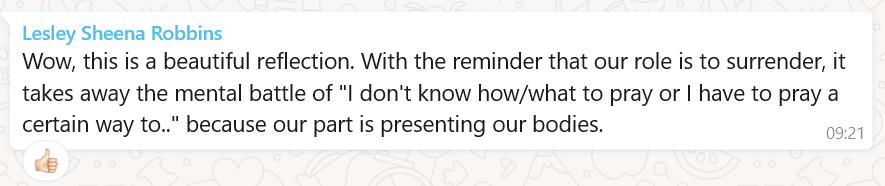
Our role in prayer is not to strive, but to surrender. By offering our bodies as living temples, we create the space for the Spirit to move, intercede, and accomplish His work. In essence, Christianity is God’s work from start to finish—He simply needs a dwelling place, and that dwelling place is us. Our job is to show up, to be present, and to yield—so that He can pray through us, speak through us, and move through us.
We do not initiate true prayer. We simply present ourselves as vessels. The Spirit prays within us; we are merely the conduit, the living altar.
Romans 12:1 – Present Your Body
“I beseech you therefore, brethren, by the mercies of God, that ye present your bodies a living sacrifice, holy, acceptable unto God, which is your reasonable service.”
The Greek for “present” is παριστάνω (paristanō) – meaning to stand beside, to offer up, to yield. This is a priestly act—we are not only praying, but we become the prayer, the sacrifice, the incense rising to God. This is the act or a priest who brings a present and dedicates it to God’s service.
Why the body? Because our body is the dwelling place of the Holy Spirit (1 Corinthians 6:19). Spirit moves through flesh. The Spirit does not operate in a vacuum. He needs a surrendered vessel. This is why Jesus took on flesh—because the divine will needs embodiment.
We often focus on the soul and spirit, but Paul is saying, consecrate your physical body, your very being, to be a vessel of divine communion. Worship isn’t just in the mind or heart—it is embodied. To consecrate literally means “to set apart, devote to, bring near to, or offer up to (usually in a sacred or divine context).
The Fire Within
When the Holy Spirit intercedes, it is not mere words—it is power, it is fire, it is energy, it is movement, it is energy in motion. It is divine energy surging through us, aligning heaven and earth, fusing the eternal with the mortal.
This is the mystery of divine intimacy—God within man, praying through man, moving beyond words, beyond logic, into the realm of pure Spirit. It is heaven touching earth through us.
Outro: A Call to Surrender and Ignite the Fire Within
You are not just a person who prays—you are a vessel of divine prayer itself. The Holy Spirit is not outside you, waiting to be called upon; He is within you, motivating, interceding, moving beyond words, beyond logic—beyond human limitation. When you yield, you don’t just speak to God—you become the very instrument through which heaven and earth connect.
Your body is the altar. Your soul is the incense. Your spirit is the flame. Your prayer is the spark.
Prayer is actually so much simpler than we have been led to believe. As the saying goes,
“It take a good theologian to complicate the matter.”
The question is not whether you can pray, but whether you will surrender to the prayer that is already moving within you. Present yourself—wholly, willingly, completely—and let the Spirit take over. When He prays through you, mountains move, heavens open, and your very being becomes a conduit of divine will.
Let go. Yield. Burn with His fire.
QUESTIONS FOR REFLECTION
- How does understanding the Holy Spirit’s intercession change the way you approach prayer?
- In what areas of your life are you still trying to control instead of yielding as a vessel?
- What does it mean to you that your body is a living sacrifice? How can you present yourself more fully to God?
- Have you ever experienced moments when prayer felt like an energy beyond words? How did that shape your faith?
- What practical steps can you take to cultivate deeper communion with the Holy Spirit in your daily life?
Devotional Prayer: A Surrender to the Fire Within
Holy Spirit, I yield to You.
I lay down my striving, my struggling, my scripted prayers.
and I surrender to the intercession that is you within me.
Move through me.
Pray within me.
Make my life a living prayer to you.
Teach me to be beyond words,
to step into divine communion,
divine intimacy with you,
where my heart beats in rhythm with Yours,
where my spirit billows in holy surrender.
I present my body, my mind, my will—
a living sacrifice, burning with Your presence.
Let my prayers shake the heavens,
let my life be an offering of fire.
and let me never again settle for anything less
than the fullness of Your Spirit moving through me.
🔥 In Jesus’ name, I surrender. Amen. 🔥
 The Hungry Hearts Collective
Leave a comment