
AUDIO PODCAST
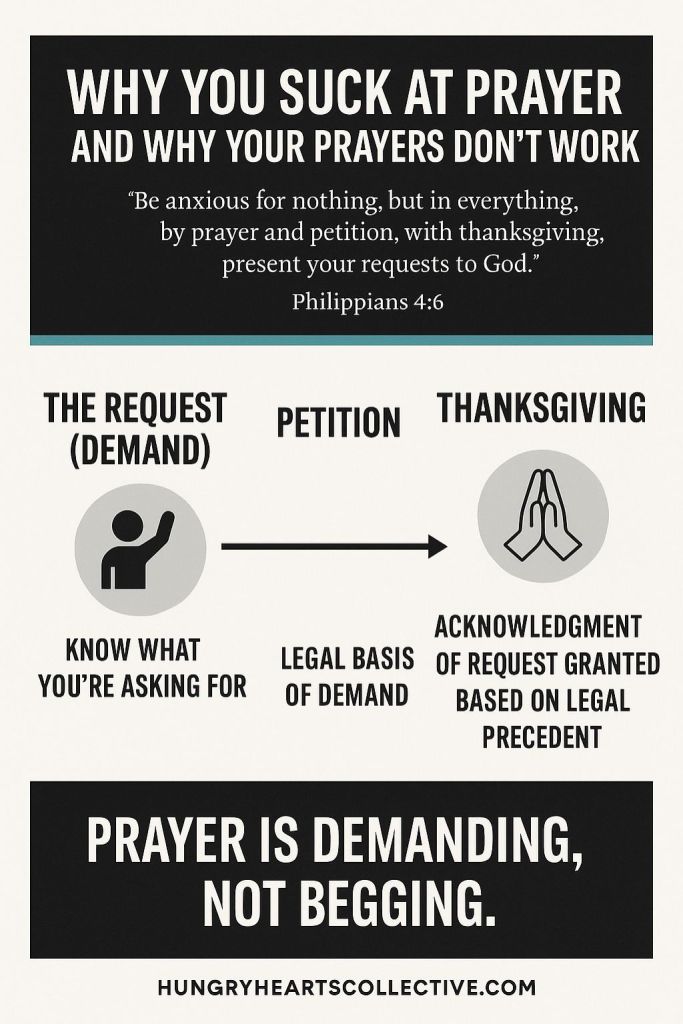
“Be anxious for nothing, but in everything, by prayer and petition, with thanksgiving, present your requests to God.” (Philippians 4:6)
Prayer, for most, is a mystical, passive whispering to the heavens—half apology, half desperation. But this is not the biblical model. You don’t suck at prayer because God doesn’t hear. You suck at prayer because you don’t understand what prayer is.
God doesn’t answer prayer because He is nice; He answers prayer because you have a legal case.
Most people approach God like orphans at a breadline—hoping He will pity them. But biblically, prayer is not about begging. It is about legal petitioning. It is a demand for divine enforcement. You are not at the mercy of an aloof monarch—you are an heir appearing before your Father-King, invoking rights guaranteed by covenant. Prayer is definitely not wishful thinking or hoping.
Let’s break it down.
THE REQUEST (DEMAND): KNOW WHAT YOU’RE ASKING FOR
The word request in Philippians 4:6 comes from the Greek αἴτημα (aitēma)—meaning a demand based on need or right. It is not passive. It is not optional. It implies a legal claim.
“This is the confidence we have in approaching God: that if we ask [aiteō] anything according to His will, He hears us.” (1 John 5:14)
The Hebrew concept of prayer—especially in the Psalms—echoes this courtroom boldness. David pleads, argues, declares, and invokes precedent. Consider Abraham’s prayer over Sodom (Genesis 18): it’s less a plea and more a negotiation. Moses reminds God of His own promises (Exodus 32:11–14). The righteous know how to “bring their case.”
MOSES IN THE WILDERNESS: COVENANTAL PETITION, NOT EMOTIONAL BEGGING
One of the clearest biblical examples of legal intercession—not begging, but boldly holding God to His word—comes from Moses in Numbers 11. The people are complaining again, this time about the lack of meat. God is angered, yet He makes a clear legal declaration of provision:
“Consecrate yourselves for tomorrow, and you shall eat meat. For you have wept in the hearing of the Lord, saying, ‘Who will give us meat to eat? For it was better for us in Egypt.’ Therefore the Lord [I] will give you meat, and you shall eat. You shall eat not one day, nor two days, nor five days, nor ten days, nor twenty days, but for a whole month—until it comes out of your nostrils and becomes loathsome to you—because you have despised the Lord who is among you, and have wept before Him, saying, ‘Why did we ever come up out of Egypt?’” (Numbers 11:18–20, NKJV)
God has spoken. Provision is promised—whether in anger or mercy, the decree is made. But Moses, weary and overwhelmed by the logistics, responds with a legal objection. Not a plea. Not a cry. A rational, covenant-based challenge:
“And Moses said, ‘The people whom I am among are six hundred thousand men on foot; yet You have said, “I will give them meat, that they may eat for a whole month.” Shall flocks and herds be slaughtered for them, to provide enough for them? Or shall all the fish of the sea be gathered together for them, to provide enough for them?’” (Numbers 11:21–22, NKJV)
This is not disrespect—it’s legal realism. Moses essentially says, “You said You’d do it—so how, exactly, will You fulfil this?” He is holding God accountable to His own word, the same way a seasoned legal petitioner would say, “According to the record, Your Honour, You have already declared Your intent.”
God’s response is equally legal and definitive:
“And the Lord said to Moses, ‘Has the Lord’s arm been shortened? Now you shall see whether what I say will happen to you or not.’” (Numbers 11:23, NKJV)
This is prayer in the dimension of prophetic litigation—not the cries of a slave, but the confident invocation of a legal heir. Moses demonstrates that real intercession isn’t about emotion, but about covenant memory: reminding God of what He has already said and demanding Him to act accordingly.
God is not offended by that. In fact, He invites it. “Put Me in remembrance; let us contend together; state your case, that you may be acquitted” (Isaiah 43:26, ESV).
In Kingdom terms, Moses was not reminding God out of doubt, but invoking precedent. This is not manipulation; it is covenantal litigation. You approach God not as a pauper, but as a prophet-statesman, armed with divine legislation.
PETITION: THE LEGAL BASIS OF YOUR DEMAND
In Philippians 4:6, the word translated “petition” is δέησις (deēsis)—a legal plea made from covenant standing i.e. what legally belongs to you because of your covenant with Him. This is not a random plea for mercy; it’s a strategic invocation of divine justice.
Let’s go deeper: the English word petition comes from Latin petitio—a formal legal application to a higher court.
God invites us to bring our petitions boldly:
“Let us therefore come boldly unto the throne of grace, that we may obtain mercy, and find grace to help in time of need.” (Hebrews 4:16)
Begging and crying works for babies not for Christians who should know better. And if you have had a Bible for a while…you should know better! When you come to pray, are you presenting a well-reasoned petition based on God’s law—or just crying in confusion?
THANKSGIVING: ACKNOWLEDGEMENT OF THE DECREE GRANTED
Thanksgiving is not an afterthought. It is proof of faith. It is the language of one who has already received.
When Jesus raised Lazarus, He prayed:
“Father, I thank you that you have heard me. I know that you always hear me…” (John 11:41–42)
Thanksgiving activates the prophetic law of divine transaction. It acknowledges that a verdict has already been passed in your favour.
You would know this already if you actually studied your Bible!
PRAYER IS NOT A PLEA, NOR IS IT BEGGING—IT’S LEGAL DEMAND
Let’s explore the word “prayer” itself.
Etymology:
- English prayer derives from Old French preiere, from Latin precari meaning “to ask earnestly.”
- But in liturgical French (prier), and even Afrikaans (bid), the connotation is still transactional—to make claim or take what is due.
- The Latin prendere (to take) is hidden behind these roots—linking prayer with assertive possession, not passive pleading.
- Root: prex / precis = prayer, request (demand), petition (legal demand)
This goes even deeper:
PRISE (A TAKING , A CAPTURE)
- From Old French prise (noun), from prendre (verb, “to take”)
- From Latin prehendere = “to seize, grasp, take hold of”
- Related English words: apprehend, comprehend, surprise, and prize.
In Philippians 4:6, the Greek προσευχή (proseuchē) combines pros (toward) and euchē (a vow or declaration)—a directed declaration toward God, typically with legal or binding implication.
This changes everything. And if you approach prayer as laying a demand, you will get what you want.
THE KING’S COURT: WHY PRAYER IS A COURTROOM ACT
In ancient times, kings were not only rulers but judges. Their court was a literal place of legal arbitration. The Hebrew word for “judgement” (mishpat) also implies setting things right—restoring justice!
In ancient Persia, one could not approach the king unless summoned (Esther 4:11). But Queen Esther took the risk—she came boldly, presented her case, and shifted the fate of a nation. That’s not begging. That’s courtroom confidence.
“Let us therefore come boldly unto the throne of grace, that we may obtain mercy, and find grace to help in time of need.” (Hebrews 4:16, KJV)
CASE STUDY: THE SHUNAMMITE WOMAN – DIVINE RESTITUTION
“Restore all that was hers, and all the fruits of the field since the day that she left…” (2 Kings 8:6)
After a seven-year exile, the Shunammite woman returns to plead her case before the king. She demands the restoration of her land, and Gehazi just happens to be recounting her miracle story to the king. The result? Not only is her land restored, but she receives back pay for all the years lost.Notice that if the illegal squatters would voluntarily surrender their position (on her land) none of this would be necessary.
The devil will not simply roll over and let you have what is RIGHTFULLY yours.
This is not emotional manipulation. It’s legal restitution.
It is the prosecuting of covenant promises before the throne.
“If the thief is caught, he must pay back sevenfold; he must give all the wealth of his house.” (Proverbs 6:31)
“The thief [devil] comes only to steal and kill and destroy; I have come that they may have life, and have it to the full.” (John 10:10)
Satan is a thief, that means whatever he has “acquired” (stolen) is not legally binding because it doesn’t belong to him. But God is a just King. Prayer is how you bring your evidence to court and enforce restitution.
JESUS’ PRAYER: A MASTERCLASS IN IMPERATIVES
Let’s examine the Lord’s Prayer in Greek grammar. Every verb is in the imperative mood—used to issue commands i.e. legal demands or petitions.
- “Hallowed be thy name” → ἁγιασθήτω (Let it be sanctified!)
- “Thy kingdom come” → ἐλθέτω (Come!)
- “Thy will be done” → γενηθήτω (Let it be!)
- “Give us today…” → δὸς (Give!)
- “Forgive us…” → ἄφες (Forgive!)
- “Deliver us…” → ῥῦσαι (Rescue!)
This is not spiritual whispering. This is judicial execution. Jesus models command-prayer. He shows us how to legislate Heaven’s will on Earth.
God’s will doesn’t happen by accident, it happens by legal mechanism!
WHY DON’T YOU KNOW THIS ABOUT PRAYER? BECAUSE YOU’RE WAITING TO BE SPOON-FED.
Let’s be brutally honest: the reason many believers don’t understand prayer as a legal, authoritative act is because they’ve outsourced their spiritual growth to others. You don’t know this because you’ve been trained to wait for a pastor, prophet, or podcast to interpret the Bible for you—like a baby bird with its mouth open, waiting to be spoon-fed half-chewed theology. But the Kingdom doesn’t run on second-hand revelation. You can’t wield a sword you’ve never studied.
Hebrews 5:12 rebukes this spiritual laziness:
“By this time you ought to be teachers, but you need someone to teach you the elementary truths of God’s word all over again. You need milk, not solid food!” (NIV)
This is not a matter of intelligence—it’s a matter of hunger. You have a Bible. You have the Spirit of God. What you lack is initiative. Jesus said the Spirit would lead you into all truth (John 16:13), not just your favourite influencer. Stop waiting to be entertained and start searching the Scriptures like your life depends on it—because it does!
Paul commended the Bereans for one reason:
“They received the word with all readiness, and searched the Scriptures [studied] daily to find out whether these things were so” (Acts 17:11, NKJV).
Let’s be clear: there is no shortcut. You can’t walk in legal authority with heaven if you won’t open the legal document. Your inheritance is written down in ink—but until you study it, you’ll keep praying as a beggar instead of operating as a legal heir.
You don’t need another altar call. You need a study desk. Remember Hosea 4:6,
“My people are destroyed because of a lack of knowledge.”
CONCLUSION: WHY YOUR PRAYERS DON’T WORK
Because you’re still begging for what’s already yours.
- Prayer isn’t mystical. It’s legal.
- It’s not soft. It’s strategic.
- It’s not hoping. It’s demanding in covenantal authority .
Covenantal authority is the authority (legal basis) as defined in by the terms and conditions in the Scriptures which you call the Bible.
You can’t demand your rights if you don’t know what they are!
If you’ve experienced theft, loss, or delay, you are not a victim waiting for scraps. You are a co-heir with Christ presenting your petition before the Highest Court. The judge is your Father. The blood of Jesus is your evidence. And the outcome is already foretold. You are not waiting for God to give you want is yours by law. He is waiting for you to enforce your legal rights in the court of heaven. And that is the definition of what prayer is.
Will you claim what is yours? Will you build a legal case based on Scripture (God’s promises)? Will you go to the throne of God and make a demand?
DEVOTIONAL PRAYER
Heavenly Father,
I thank You that You are not distant, but a just and present Judge. Today, I step boldly into Your throne room—not as a beggar, but as a son/daughter of the covenant. I bring my petition for everything stolen—years, opportunities, finances, relationships, health, wholeness—and I demand restitution by Your Word. I thank You in advance, because the verdict is already in my favour.
In Jesus’ Name. Amen.
MEMORY VERSE
“Be anxious for nothing, but in everything, by prayer [your demand] and petition [legal basis], with thanksgiving [confirming the favourable judgment], present your requests [case] to God.” (Philippians 4:6)
This verse isn’t just a nice idea, it is heavy with legal weight.
FIVE QUESTIONS FOR REFLECTION
- Have I been praying like a beggar or like a legal heir?
- What specific areas of loss am I demanding restitution for?
- Do I know the promises of Scripture well enough to build a legal case?
- What role does thanksgiving play in my daily prayers?
- What would change if I prayed as one who already has access to the verdict?
Like & Subscribe to make sure you don’t miss out on what you really need to know as a Christian!
HAS THIS POST HELPED YOU?

SUPPORT THIS COMMUNITY
If you have been helped by the posts on this blog, consider donating to keep the ball rolling.Your gift makes a difference and helps improve this community!
£10.00
 The Hungry Hearts Collective
Leave a comment