
VIDEO
AUDIO PODCAST
INTRODUCTION: THE VANITY OF MAN’S DREAM
Every civilisation has told itself the same story: that by human ingenuity, power, and progress, paradise can be built on earth. From the towers of Mesopotamia to the marble forums of Rome, from the cathedrals of medieval Europe to the skyscrapers of Wall Street, the promise is always the same — a garden without God, a kingdom without the King. Yet the record of history, the witness of Scripture, and the canvas of art all testify to the futility of that ambition.
“No one ever told the tale of civilisation as dramatically as Thomas Cole.” Born in England in 1801 and later settling in America, Cole was no mere painter of landscapes. His art was not decorative but prophetic. He peered into the valleys and mountains of time and saw that every empire carries within it the seeds of its own collapse. His five-part series The Course of Empire (1833–1836) offers a visual parable of humanity’s pride and downfall, rivaling even Augustine’s City of God in its scope.
THE SAVAGE STATE: ORIGINS IN WILDERNESS

The Savage State by Thomas Cole
The first painting, The Savage State, depicts a wild and untamed world. A hunter with bow in hand chases his prey across raw, unshaped land. This is man before empire, before refinement, before the illusion of control.
Here is Eden after the fall. Humanity still bears God’s image, still holds dominion, yet the land is cursed, and toil is the rule. Genesis 3 resounds: “By the sweat of your brow you shall eat bread, until you return to the ground” (Gen. 3:19).
Cole does not present the savage state as ideal; it is brutish, survival-driven. But neither is it condemned. It is honest. Here, man knows his smallness against creation. Augustine described this as the saeculum—the age in which man wanders east of Eden, longing for a home he cannot recreate.
THE PASTORAL STATE: ILLUSION OF BALANCE
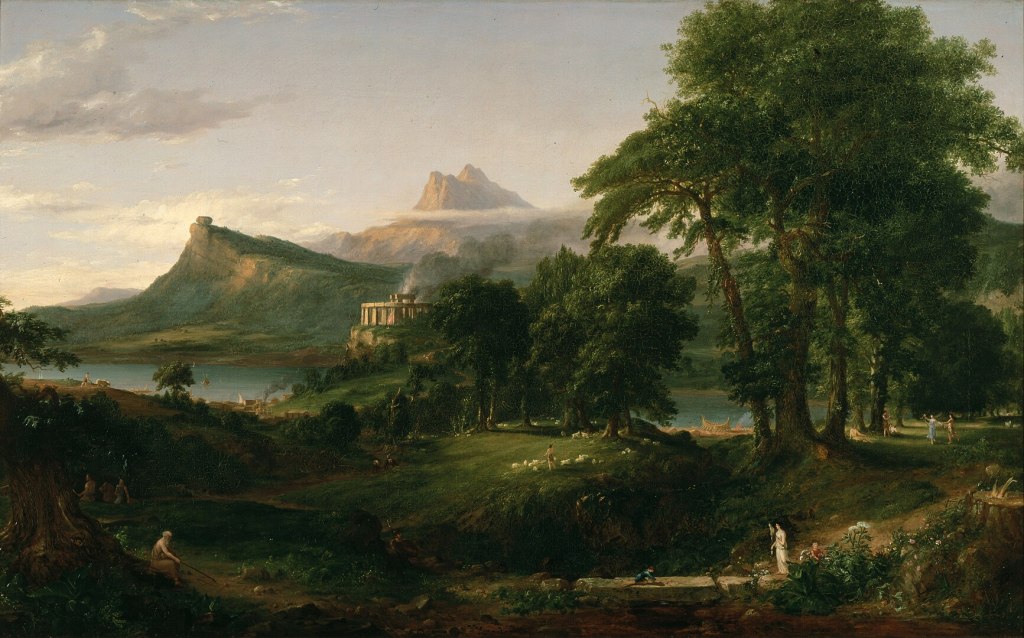
The Pastoral State by Thomas Cole
The second painting, The Pastoral State, shows humanity at rest and apparent harmony. Shepherds graze flocks, farmers till fields, and a temple rises. It is the age of order, beauty, and philosophy. Here civilisation begins to dream that paradise can be rebuilt.
It is in this stage that the Tower of Babel is repeated. Genesis 11 tells us:
“Come, let us build ourselves a city and a tower with its top in the heavens, and let us make a name for ourselves.”
The pastoral state seeks permanence, but it is already veering from God. It seeks salvation in its own name, not the Name above all names, The Lord (Yeshuah—Jesus Christ.) The apostle Paul warned of this illusion when addressing the Athenians:
“The God who made the world and everything in it, being Lord of heaven and earth, does not live in temples made by man” (Acts 17:24).
Pastoral order without God is but fragile scaffolding. Wisdom is cultivated, art flourishes, and law is codified—but the heart is still estranged from its Maker.
THE CONSUMMATION OF EMPIRE: THE APEX OF PRIDE
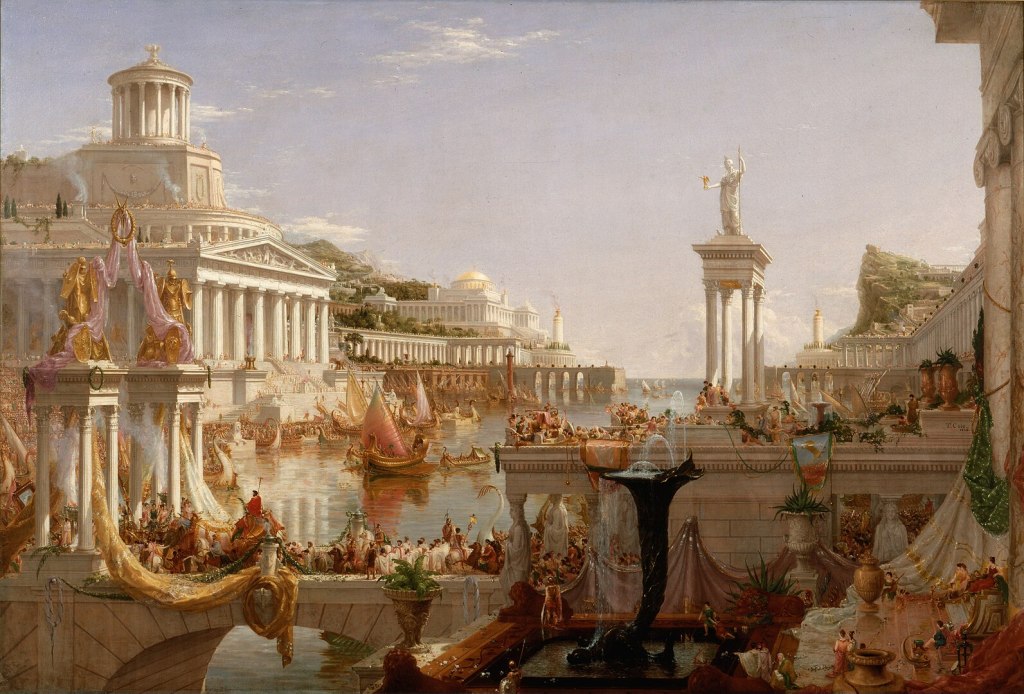
The Consummation of Empire by Thomas Cole
The third painting, The Consummation of Empire, is dazzling. Grand temples, marble columns, triumphal processions, banners unfurled. Humanity believes it has arrived. This is Rome at its height, Babylon in splendour, Egypt in its pyramids.
Yet Cole’s colours betray the scene—excess, overindulgence, pride. The prophet Daniel warned Nebuchadnezzar, “Your kingdom has been removed from you” (Daniel 4:31). The Consummation is civilisation’s boast: “Is not this great Babylon, which I have built by my mighty power?” (Daniel 4:30).
But as Proverbs 16:18 declares: “Pride goes before destruction, and a haughty spirit before a fall.”
DESTRUCTION: THE INEVITABLE COLLAPSE
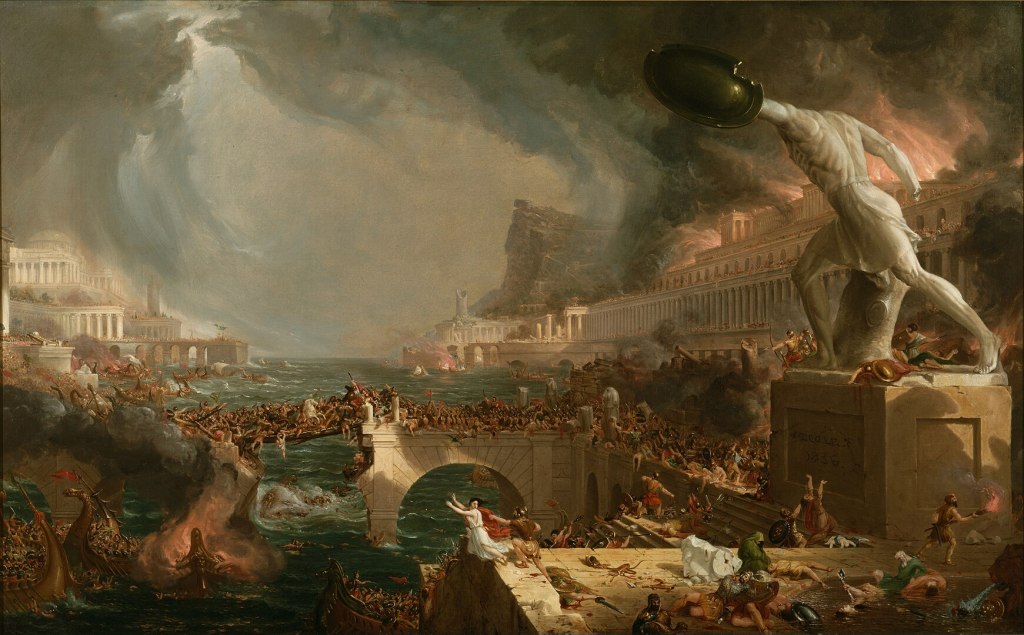
Destruction by Thomas Cole
The fourth painting, Destruction, is violent. Flames consume buildings, soldiers slay, and statues fall. What was celebrated is now torn down. Every empire finds its judgement day. Rome fell, Babylon was overthrown, and Jerusalem was razed. History testifies that no human construct endures.
Here we recall Revelation 18, where Babylon the Great falls: “Fallen, fallen is Babylon the great! For in a single hour all this wealth has been laid waste.”
Cole is unflinching. Civilisation’s dream of paradise always collapses under its own weight—greed, injustice, idolatry, violence. Augustine again: “Remove justice, and what are kingdoms but great robberies?”
DESOLATION: THE SILENCE AFTER MAN’S NOISE
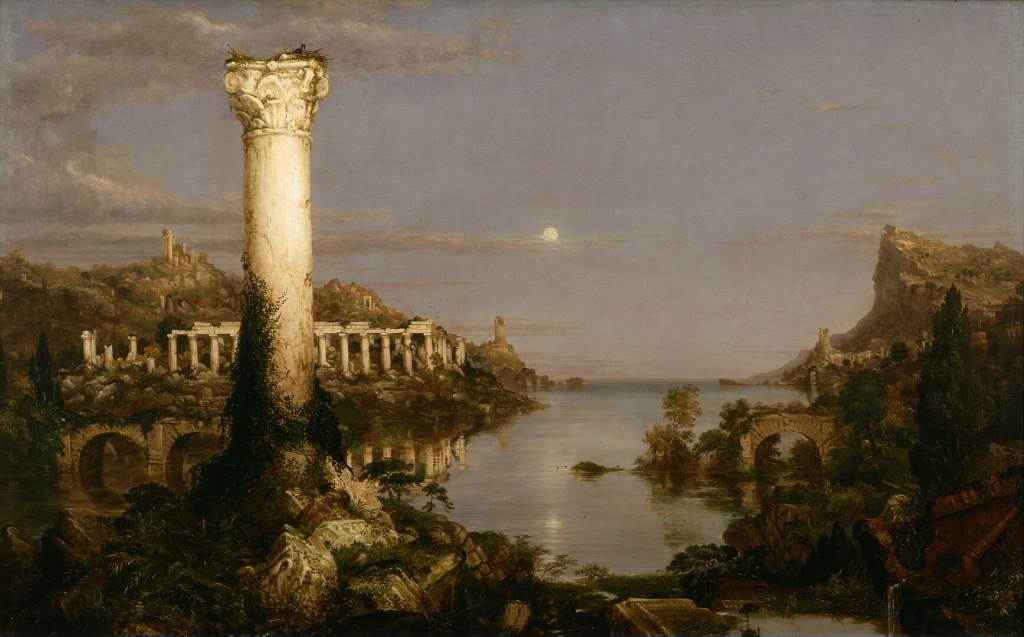
Desolation by Thomas Cole
The final painting, Desolation, is haunting. Ruins stand silent, ivy grows over broken columns, the sea laps against deserted stone. Man’s glory has returned to dust.
Here is Psalm 103:15–16:
“As for man, his days are like grass… the wind passes over it, and it is gone, and its place knows it no more.”
But Cole is not merely cynical. Desolation speaks of God’s patience. Empires pass, but the earth remains, awaiting redemption. Isaiah promises: “The earth shall be full of the knowledge of the Lord as the waters cover the sea” (Isaiah 11:9).
THE COURSE OF EMPIRE: FROM CANVAS TO HISTORY TO TODAY
| Cole’s Painting | Historical Example | Biblical Parallel | Modern Equivalent |
|---|---|---|---|
| The Savage State | Early tribal societies; the nomadic beginnings of Mesopotamia before cities. | Genesis 3–4: Adam to Cain; humanity east of Eden, struggling to survive. | Subsistence peoples on margins of modernity; survival cultures still in tune with creation but without lasting stability. |
| The Pastoral State | Ancient Greece in its early democratic / agricultural age; Israel in Solomon’s early reign. | Genesis 11: Tower of Babel — order, culture, ambition for permanence without God. | The Enlightenment period: rationalism, humanism, and “measured progress.” Modern suburban idealism of comfort, order, and beauty. |
| The Consummation of Empire | Rome at its zenith; Babylon under Nebuchadnezzar; Pax Romana. | Daniel 4: Nebuchadnezzar boasting, “Is not this great Babylon…?” | The West in the 20th century: skyscrapers, technological mastery, global dominance, consumer abundance. |
| Destruction | The sack of Rome (410 AD); the fall of Jerusalem (586 BC); Mongol conquests. | Revelation 18: “Fallen, fallen is Babylon the great… in a single hour.” | 21st century crises: terrorism, financial collapse, political unrest, ecological strain — empires fraying from within and without. |
| Desolation | Ruins of Nineveh, Athens, Carthage, Rome — once-mighty, now stones and silence. | Psalm 103:15–16 — man’s days fade like grass, and his place remembers him no more. | Abandoned cities, rust belts, fallen towers; haunting reminders that wealth, art, and empire are dust without God. |
SOCIETAL CYCLES IN REVIEW
ANNOTATED BIBLIOGRAPHY: CYCLES OF EMPIRE
(Amazon affiliate links)
| Book / Author | Key Idea About Civilisation | Biblical Resonance | Modern Application |
|---|---|---|---|
| The Fourth Turning – William Strauss & Neil Howe (1997) | History unfolds in recurring 80–100 year cycles (High, Awakening, Unravelling, Crisis). | “To everything there is a season, and a time to every purpose under heaven” (Eccl. 3:1). | Helps us see today’s turbulence as part of a larger pattern that leads either to collapse or renewal. |
| The Fate of Empires – Sir John Glubb (1976) | Empires last ~250 years, declining as wealth breeds complacency and loss of virtue. | Israel’s cycles in Judges: sin, oppression, repentance, deliverance. | Reminds nations (and individuals) that moral fibre, not wealth, sustains survival. |
| The History of the Peloponnesian War – Thucydides (5th c. BC) | Athens’ ambition and hubris led to ruin, despite brilliance in culture and power. | “Pride goes before destruction, and a haughty spirit before a fall” (Prov. 16:18). | Warns of overextension: when nations pursue dominance without humility, they invite downfall. |
| The End of Antiquity: The Last Days of Rome and the Rise of Islam (The Fall of the Roman Empire) – Nick Holmes | Explores the collapse of Rome, the transformation of Mediterranean society, and the rise of Islam as a new imperial-religious force. | “Nation shall rise against nation, and kingdom against kingdom” (Matt. 24:7); parallels with Israel’s fall and exile followed by God raising new powers. | Reminds us that no civilisation is permanent; shifts of power are opportunities to discern God’s purposes and re-anchor identity not in empire but in His kingdom. |
| The City of God – Augustine (426 AD) | Two cities: the City of Man (pride, self-rule) vs. the City of God (love, eternal hope). | Abraham’s vision: “He looked for a city… whose builder and maker is God” (Heb. 11:10). | Calls Christians to put ultimate trust not in empire but in God’s kingdom. |
| Civilization and Its Discontents – Sigmund Freud (1930) | Civilisation suppresses instinct, producing both order and unhappiness; man is restless. | “They have sown the wind, and they shall reap the whirlwind” (Hos. 8:7). | Shows the futility of seeking paradise in psychology or culture without healing of the soul. |
| A Study of History – Arnold Toynbee (1934–1961) | Civilisations rise when they respond to challenge; they fall when elites grow complacent. | Joseph in Egypt: prosperity maintained only by wise stewardship (Gen. 41). | Encourages leaders to cultivate resilience rather than entitlement. |
| Why Nations Fail – Daron Acemoglu & James A. Robinson (2012) | Institutions shape destiny: extractive systems lead to collapse; inclusive ones sustain growth. | Israel under just vs. corrupt kings: justice preserves, corruption destroys. | A call to reform governance and resist short-term greed. |
| The Collapse of Complex Societies – Joseph Tainter (1988) | Societies collapse when complexity outweighs available resources, leading to breakdown. | Tower of Babel: complexity, centralisation, and pride fractured by God. | Warns against unsustainable systems — economic, technological, or political — that promise too much. |
| The Decline of the West – Oswald Spengler (1918–1922) | Civilisations are like organisms: they are born, grow, flourish, and decay. The West is in its “winter.” | “The grass withers, the flower fades, but the word of our God will stand forever” (Isa. 40:8). | A sobering reminder that Western culture is not immortal; its twilight should drive us to eternal hope. |
| Principles for Dealing with the Changing World Order – Ray Dalio (2021) | Examines economic and debt cycles, showing why empires rise and decline, with focus on China vs. the U.S. | Joseph storing grain in Egypt during cycles of plenty and famine (Gen. 41). | Offers practical insight into financial stewardship and geopolitical shifts in today’s world. |
WHERE ARE WE TODAY?
The pressing question: which painting describes us now? Many would say we are between Consummation and Destruction. The West, like Rome, flaunts its technology, wealth, and autonomy, yet beneath the glitter is fragility.
We legislate morality without God, chase utopias of self-made identity, and bow before economic idols. We seek paradise in politics, in science, in consumption. But Cole reminds us: every empire’s story ends the same.
THE TRUE PARADISE: SUBMISSION AND REALIGNMENT
What then is the answer? Not withdrawal into primitivism, nor blind pursuit of progress. The answer is what Jesus proclaimed: “Seek first the kingdom of God and his righteousness, and all these things will be added to you” (Matthew 6:33).
Faith is not passive resignation but active alignment. It is the refusal to trust in the kingdoms of men and the decision to trust in the eternal reign of God. Augustine contrasts two cities: the City of Man, built on pride, and the City of God, built on love. One perishes, the other endures.
Thomas Cole’s paintings are not mere history lessons—they are calls to repentance. They remind us that paradise cannot be recreated by human hands. It is received as a gift, restored only through Christ, who declared:
“Behold, I [not man] make all things new” (Revelation 21:5).
PRAYER
Lord, deliver us from the pride of Babylon and the illusion of self-made kingdoms. Teach us to see the vanity of our attempts to build paradise apart from You. Align our hearts to Your eternal City, that our lives may bear witness not to the crumbling empires of men, but to the enduring kingdom of Christ. Amen.
MEDITATION VERSE
“Unless the LORD builds the house, those who build it labor in vain. Unless the LORD watches over the city, the watchman stays awake in vain.”
QUESTIONS FOR REFLECTION
- Which stage of The Course of Empire do you think most accurately reflects our world today?
- In what ways have you personally sought “paradise” apart from God?
- How does Scripture reframe your understanding of civilisation’s rise and fall?
- What does it mean for you, practically, to “seek first the kingdom of God”?
- How might you live today with eternity, not empire, in view?
 The Hungry Hearts Collective
Leave a comment