
VIDEO
AUDIO PODCAST
You will never truly dwell in the promises of God unless the promises of God first dwell in you. That is why meditation is essential. Meditation is the internalisation of God’s Word—allowing it to take root, shape your spirit, and power your walk from the inside out.
KEY STATEMENT
THE COMMAND TO MEDITATE: JOSHUA 1 AND THE PRACTICE OF INTERNALISING GOD’S WORD
When Joshua took the mantle of leadership after Moses’ death, God gave him a startling command:
“This Book of the Law [more correctly: “instruction” like a software program] shall not depart from your mouth, but you shall meditate on it day and night, so that you may be careful to do according to all that is written in it. For then you will make your way prosperous, and then you will have good success.“ (Joshua 1:8, ESV)
Notice what God emphasised: meditation, not merely reading. The Hebrew word used here is hagah (חָגָה), which means “to murmur, to utter, to ponder, to rehearse.” It is not passive reflection, but an active internalisation of God’s Word until it sinks from the lips into the heart, shaping thought, speech, and action.
Meditation is therefore not an option for the believer—it is a divine command, directly tied to prosperity, success, and spiritual resilience. It is how we “chew” God’s Word until it becomes part of us, fuelling our spirits for the battles of life.
Biblical meditation has nothing to do with what our culture understands meditation to be be. It is how we terraform our inner world to (re)align with heaven and so reflect it on earth.
The promises of God must be embodied to be experienced.
WHY MEDITATION IS NECESSARY
Many believers today face struggles not because God has not answered their prayers, but because there is spiritual resistance in the unseen realm.
The prophet Daniel prayed, and God answered immediately:
“Do not be afraid, Daniel. Since the first day that you set your mind to gain understanding and to humble yourself before your God, your words were heard, and I have come in response to them. But the prince of the Persian kingdom resisted me twenty-one days.” (Daniel 10:12–13, NIV)
The delay was not on God’s side. The answer was sent from the first day. The hindrance was the enemy.
This is why meditation is critical: it strengthens the spirit to stand firm, hold the line, and enforce the victory of Christ despite opposition. Meditation arms us to resist the resistance.
MEDITATION AS THE PRECONDITION FOR THE PROMISED LAND
In Joshua 1, God repeatedly emphasises to Joshua that success in taking possession of the Promised Land is inseparable from meditation:
“This Book of the Law shall not depart from your mouth, but you shall meditate on it day and night…then you will make your way prosperous, and then you will have good success.” (Joshua 1:8)
The promise of inheritance, prosperity, and victory is contingent on the internalisation of God’s Word. The land was not given because of military skill alone; it was given to a people whose hearts, minds, and spirits had absorbed the law. Meditation prepares the heart to discern God’s timing, act in obedience, and resist spiritual opposition.
Joshua’s command reveals a profound spiritual principle: before entering your Promised Land, you must first dwell in the Word. Your spiritual conquest begins internally, not externally. Meditation is the crucible where faith, obedience, and authority are forged. Without it, victories are delayed, promises remain distant, and resistance overwhelms.
In short, dwelling in the Promised Land within is the prerequisite for dwelling in it externally.
THE PROMISED LAND: INTERNALISATION BEFORE EXTERNAL REALITY
Paul reminds us in 1 Corinthians 10:11 that “these things happened to them as examples and were written down as warnings for us, on whom the culmination of the ages has come.” The experiences of Israel were not merely historical; they are spiritual templates for our lives. This means that the Promised Land carries a deeper, symbolic meaning for believers today.
The Promised Land represents the fullness of God’s promises, the territory He has prepared for us to walk in. As 2 Corinthians 1:20 declares: “For all the promises of God find their Yes in him.” In Christ, the promises are guaranteed; to walk in the Promised Land is to walk in the realisation and enjoyment of these promises in daily life.
Joshua 17:3 describes how the inheritance was given according to God’s promise: “This is the inheritance of the families of the descendants of Joseph…just as the LORD commanded.” God’s promises define the territory. Similarly, our internal Promised Land is shaped by the promises of God, which must first take root and be integrated within us before we can fully manifest them externally.
This internalisation is crucial: before we dwell in the land outwardly, we must dwell in it in our hearts and minds. Meditation, study, and declaration of God’s promises internalise them, aligning our spirit with God’s will and making us ready to receive and possess the external reality.
The principle is echoed in 3 John 1:2: “Beloved, I pray that in all respects you may prosper and be in good health, just as your soul prospers.” Notice that outward prosperity flows from the condition of the inner life. Walking in the Promised Land externally depends on dwelling in it within.
In essence, the Promised Land is:
- Spiritual alignment with God’s promises
- Integration of His Word and truth into our inner life
- A precursor to external fulfilment and victory
Thus, before claiming the mountains, rivers, and inheritance of God, we first claim them internally through faith, meditation, and obedience. Our internal Promised Land becomes the foundation from which external manifestation naturally flows.
Meditation moves Scripture from the lips to the subconscious, from mental information to spiritual formation.
MY TONGUE AS THE PEN, MY HEART AS THE TABLET
“My heart is stirred by a noble theme as I recite my verses for the king; my tongue is the pen of a ready writer.” (Psalm 45:1, ESV)
This is not mere poetry—it is the process of meditation made manifest. When we speak God’s Word aloud, we are not just vocalising truth; we are transferring it from the mind into the deepest layers of the soul.
Meditation moves Scripture from the lips to the subconscious. It transforms mental knowledge into spiritual formation, shaping thought patterns, desires, and identity. What begins as reading becomes speaking, what is spoken becomes internalised, and what is internalised becomes life itself. The promises of God are no longer external truths to admire—they become the architecture of the heart, guiding choices, steadying faith, and aligning imagination with the divine.
Just as a pen inscribes letters onto paper, so the tongue, guided by the Spirit, writes God’s Word upon the the tablets of the heart. This is the subtle, powerful work of internalisation: the Word moves from memory to marrow, from syllable to spirit, from concept to lived reality.
Faith is not only held—it is written, engraved, and lived from the inside out.
THE HEBREW ROOTS OF MEDITATION: HAGAH AND EDENIC CONNECTIONS
Interestingly, hagah shares roots with several Semitic and related linguistic forms that resonate with Edenic and cosmic imagery. The Hebrew verb used in Joshua 1:8 is חָגָה (hagah), which literally means:
- To murmur, utter, or speak softly
- To meditate, ponder, or rehearse mentally
- To growl or roar, often like a lion—indicating intensity and focus
The Hebrew hagah also has fascinating linguistic and symbolic links:
- Hagal: In Ugaritic and Akkadian, conveys murmuring, chanting, or rhythmic sound, echoing the voice of creation.
- Harkal / Harkon: Found in Hebrew place names, carries the sense of (rhythmic) flowing, vibrating, or echoing, reflecting the inner resonance of God’s Word.
- Edenic Connection: Like Adam naming creation, meditation aligns speech, thought, and reality with divine order. Internalising God’s Word is creative, formative, and participatory.
- German : Hakeln
- Afrikaans: Hakel, Hekel
- English: Hagel
Meditation thus prepares the believer to enter the Promised Land, both internally and externally.
MEDITATING: INTERNALISING GOD’S PROMISES
Finally, the fight of faith finds its rest in meditation and internalisation of God’s promises. To fight faithfully is not merely to resist doubt or cling to hope—it is to dwell deeply on the Word, letting it saturate thought, heart, and imagination.
2 Peter 1:4 calls these promises “great and precious,” and they are so because they are alive—capable of shaping our inner being. Hebrews 4:12 reminds us that the Word discerns the intentions of the heart; when meditated upon, it transforms our very framework of thought, aligning soul and spirit with God’s truth.
Meditation is the act of rehearsing God’s promises inwardly, speaking them over life, and envisioning them as already active in our reality. It is not passive reading; it is a conscious, deliberate internalisation that moves faith from the mind to the core of being, until the promises become part of our identity.
Psalm 149:6–9 reminds us that this internalised Word is not idle—it equips us for victory, giving strength to remain steadfast and courage to act in righteousness. When the promises are written on the heart, faith is no longer fragile; it becomes an unshakeable force, sustaining us in trial and advancing God’s kingdom through us.
In meditation, the fight of faith becomes joyful, confident, and victorious, for we are not struggling alone—we are anchored in the living Word and enfolded by the certainty of His eternal promises.
SCRIPTURE AS A SWORD
When the Word of God is only on the page, it remains external. When it is memorised, recited, and meditated on until it burns in our hearts i.e. internalised, it becomes a sword in the Spirit’s hand. The enemy can only be defeated by a Word-filled believer.
Meditation is the non-negotiable strategy for victory.
The Word becomes a weapon only when internalised and declared:
“Take the helmet of salvation and the sword of the Spirit, which is the word of God.” (Ephesians 6:17)
“For the word of God is living and active, sharper than any two-edged sword, piercing to the division of soul and of spirit, of joints and of marrow, and discerning the thoughts and intentions of the heart.” (HEBREWS 4:12, ESV)
“Let the high praises of God be in their throats and two-edged swords in their hands, to execute vengeance on the nations and punishments on the peoples, to bind their kings with chains and their nobles with fetters of iron, to execute on them the judgment written! This is honor for all his godly ones. Praise the Lord!” (Psalm 149:6-9)
When memorised, meditated upon, and declared, Scripture equips us to enforce victory, resist the enemy, and walk in God’s promises.
AN EXAMPLE FRAMEWORK FOR PRACTICE
To make meditation practical, we can begin with a focused set of Scriptures. The 12 Victory Verses form a powerful cluster of truth about Christ’s triumph over the enemy.
I suggest you read all of them but only choose three (3) to use in your meditation.
12 VERSES FOR MEDITATION AND VICTORY
First, here is the (a) list, you can also make one that address a particular challenge you are facing:
- Revelation 12:11
“They overcame him by the blood of the Lamb and by the word of their testimony; they did not love their lives so much as to shrink from death.” - Colossians 2:15
“And having disarmed the powers and authorities, he made a public spectacle of them, triumphing over them by the cross.” - Hebrews 2:14
“Since the children have flesh and blood, he too shared in their humanity so that by his death he might break the power of him who holds the power of death—that is, the devil—” - Romans 8:37
“No, in all these things we are more than conquerors through him who loved us.” - 1 John 5:4–5
“For everyone born of God overcomes the world. This is the victory that has overcome the world, even our faith. Who is it that overcomes the world? Only the one who believes that Jesus is the Son of God.” - 1 John 4:4
“You, dear children, are from God and have overcome them, because the one who is in you is greater than the one who is in the world.” - Romans 16:20
“The God of peace will soon crush Satan under your feet. The grace of our Lord Jesus be with you.” - Luke 10:19
“I have given you authority to trample on snakes and scorpions and to overcome all the power of the enemy; nothing will harm you.” - John 16:33
“I have told you these things, so that in me you may have peace. In this world you will have trouble. But take heart! I have overcome the world.” - Ephesians 6:11
“Put on the full armour of God, so that you can take your stand against the devil’s schemes.” - James 4:7
“Submit yourselves, then, to God. Resist the devil, and he will flee from you.” - 2 Corinthians 10:4–5
“The weapons we fight with are not the weapons of the world. On the contrary, they have divine power to demolish strongholds. We demolish arguments and every pretension that sets itself up against the knowledge of God, and we take captive every thought to make it obedient to Christ.”
These verses teach, affirm, and arm the spirit, forming a foundation for meditation and declaration.
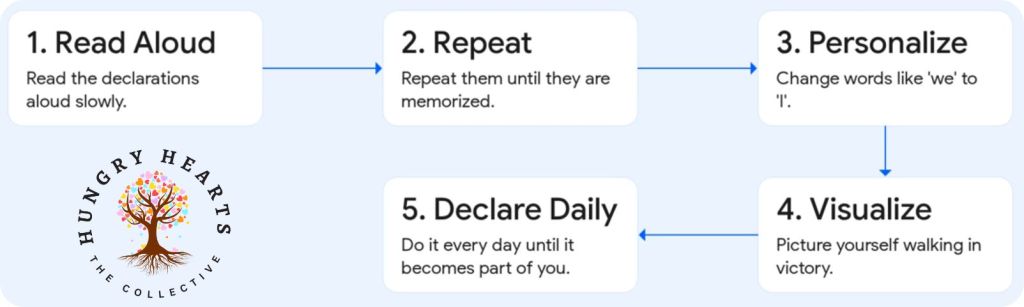
HOW TO MEDITATE
- Bring your attention to the present. Put pressing issues on the back burner for 5mins.
- Read aloud slowly, emphasising each phrase.
- Repeat until memorised.
- PersonaliSe—replace “we” with “I.”
- Visualise your victory and authority.
- Declare daily until the words are part of your spirit.
1-MINUTE VICTORY DECLARATION (OR CRAFT YOUR OWN)
We overcome the enemy by the blood of the Lamb and the word of our testimony (Rev 12:11).
Christ has disarmed the powers of darkness, triumphing over them on the cross (Col 2:15), breaking the power of death itself (Heb 2:14).
We are more than conquerors through Him who loved us (Rom 8:37).
Greater is He who is in us than he who is in the world (1 John 4:4).
God will crush Satan under our feet (Rom 16:20), and Christ has given us authority over all the power of the enemy (Luke 10:19).
We take heart, for He has overcome the world (John 16:33).
We put on the full armour of God, resist the devil, and he flees (Eph 6:11; James 4:7).
Our weapons demolish strongholds, tear down arguments, and bring every thought captive to Christ (2 Cor 10:4–5).
In Jesus’ name, we stand victorious—the enemy is defeated, disarmed, and made a public spectacle.
THE DIFFERENCE MEDITATION MAKES
When we meditate, our spirits are fortified. Like Daniel, we may face opposition, but our persistence ensures that the answer breaks through. Like Joshua, meditation makes our way prosperous and guarantees success. Like Jesus in the wilderness, meditation equips us to say, “It is written,” and silence the adversary.
The issue is not that God has not spoken, not that God has not answered, but that the Word must be internalised and wielded. Meditation is the bridge between God’s answer and our lived victory.
Consider Matthew 4:4:
“But [Jesus] answered and said, ‘It is written, Man shall not live by bread alone, but by every word that proceeds from the mouth of God.’ “
And when we connect it with 2 Peter 1:4:
“Through these he has given us his very great and precious promises, so that through them you may participate in the divine nature, having escaped the corruption in the world caused by evil desires.” (NIV)
As our natural bodies receive physical life from physical food, our spiritual bodies receive spiritual life from spiritual food.
The key phrase is “his very great and precious promises” (In Greek: ta megala kai timiata epaggelmata autou).
It emphasises that God’s promises are not ordinary—they are powerful, valuable, and life-transforming, intended to bring us into His nature and victory over worldly corruption.
FINAL NOTE
You will never truly dwell in the promises of God unless the promises of God first dwell in you. That is why meditation is essential. Meditation is the internalisation of God’s Word—allowing it to take root in the heart, shape your spirit, and power your walk from the inside out.
MEMORY VERSE
“Let the word of Christ dwell in you richly in all wisdom; teaching and admonishing one another in psalms and hymns and spiritual songs, singing with grace in your hearts to the Lord.” (Colossians 3:16, KJV)
DEVOTIONAL PRAYER
Lord, teach me to meditate on Your Word day and night. Let it dwell in my heart and mind, guiding my soul and preparing me for the Promised Land. Strengthen me to resist the enemy’s schemes, to act in faith, and to enforce the victory of the cross in my life. May I dwell in Your promises internally so that Your inheritance flows in every part of my life. Amen.
QUESTIONS FOR REFLECTION
- Why is meditation on the promises of God essential for me to experience my spiritual inheritance?
- Which verse from the 12 Victory Verses speaks most to my current battle?
- Have I been trying to achieve God’s promises through striving rather than the rest that faith gives?
- How can I make meditation a daily rhythm in my life? Where can I take 5-10mins to meditate?
- What changes do I notice (feel, experience) when I dwell in the Promised Land internally?
 The Hungry Hearts Collective
Leave a comment