
VIDEO
PODCAST
GROUNDHOG DAY
Have you ever felt stuck—as though you’re living the same day on repeat? You wake up with the same thoughts, respond to the same triggers, and wonder why the same frustrating patterns keep appearing in your life. It’s not laziness, nor a lack of willpower. It’s programming.
The truth is sobering yet liberating: your present life is largely a reflection of your personality—your memorised, subconscious patterns of thinking, acting, and feeling. Change the personality, and you change the personal reality.
This isn’t fluffy self-help. It’s a paradigm emerging at the crossroads of neuroscience, epigenetics, psychology, and theology. Ancient Scripture whispered this long before science caught up: “As a man thinks in his heart, so is he” (Proverbs 23:7). This is why Paul addresses the “renewing of the mind” in Romans 122 as the key to a transformed life. Now laboratories are confirming what mystics, prophets, and poets have always insisted—thought and imagination are the seeds of destiny.
In this article, we’ll journey through five scientific truths that dismantle the myth of a fixed identity and show how to think yourself into a new reality. But more importantly, we’ll anchor them with biblical wisdom, Hebraic insight, and practical application. You’ll see that transformation isn’t waiting for a crisis—it’s possible in a state of inspiration and joy.
1. YOUR REALITY IS RUN BY A 35-YEAR-OLD SUBCONSCIOUS PROGRAM
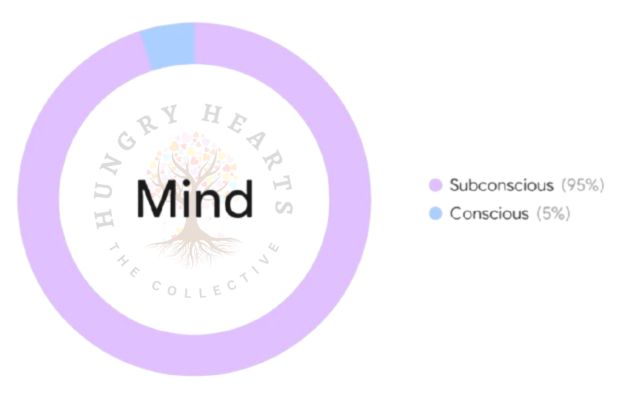
By the time we reach our mid-thirties, 95% of who we are has been handed over to the subconscious: memorised habits, ingrained beliefs, automatic reactions. Neuroscientists estimate we think 60,000–70,000 thoughts per day—and 90% of them are carbon copies of yesterday’s.
It’s a closed loop.
Same thoughts → same choices → same behaviours → same experiences → same emotions → same identity.
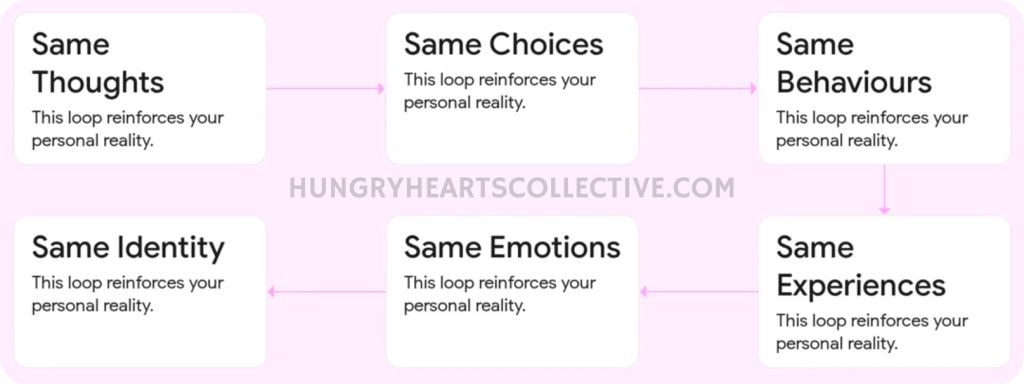
This is why willpower so often fails. You cannot fight a 95% autopilot programme with the 5% of conscious effort. The body itself becomes conditioned—wired chemically to expect unworthiness, anxiety, or frustration.
Here Scripture speaks with startling clarity. The Hebrew concept of yetser (יֵצֶר)—translated “imagination,” “formation,” or “conception“—literally refers to the inner moulding of the self. In fact the word derives from the verb “yatsar“, which means “to shape or mould into a form, specifically like a potter fashions clay.”
Your subconscious yetser becomes the potter’s wheel of your destiny. If it remains unchallenged, it shapes you by default. But if you renew it, you rewrite your story. And if you rewrite your story, you rewrite your life.
We reiterate, the Apostle Paul echoes this in Romans 12:2:
“Be transformed by the renewing of your mind.” Transformation isn’t behaviour modification—it’s inner re-formation.
If our lives are not changing, it’s because we have chosen the ease of living on autopilot, that is, thinking the same thoughts and expecting a different outcome.
2. YOUR BODY DOESN’T KNOW THE DIFFERENCE BETWEEN A REAL EVENT AND A POWERFUL THOUGHT
Here lies a staggering truth: the body is the unconscious mind. It cannot distinguish between a lived event and a vividly imagined one. Recall a betrayal, and your body releases the same stress hormones as if the moment were happening again. Fear the future, and your biology prepares for war against shadows.
This means that even when there are no immediate dangers pressing in on us, we can still find ourselves trapped in a state of survival—hearts racing, minds scanning for threats that do not exist. Our nervous system, finely tuned to protect us, can become overactive, mistaking the ordinary pressures of life for life-or-death emergencies. And so, without lions chasing us or storms overhead, we live as though the ground might give way at any moment.
This constant readiness for disaster creates what could be called a background hum of anxiety—a low-level panic humming beneath the surface of modern life. It explains why so many in our society feel restless, irritable, and chronically unsafe, despite living in relative comfort. The body is braced for battle, while the soul is weary from carrying invisible weights.
Chronic stress, as science confirms, also suppresses immune function, dysregulates genes, and accelerates disease. Stress is not just a mental burden—it’s physiological sabotage.
But if negative thoughts can harm, what of intentional, elevated ones? Gratitude floods the body with oxytocin, serotonin, and dopamine, strengthening immunity and building resilience. Psalm 103 anticipated this:
“Bless the LORD, O my soul… who heals all your diseases, who redeems your life from the pit, who crowns you with steadfast love and mercy.”
The Hebrew word for amen (אָמֵן, ’emun) is rooted in firmness, faithfulness, and support. To say “amen” is to embody agreement so deeply that your very biology aligns with it. If the body believes the thought, then your “amen” is not a whisper but a neurological command.
3. TO CREATE A NEW FUTURE, YOU MUST FEEL IT BEFORE YOU SEE IT
The Newtonian model of reality taught us that we are victims of cause and effect. Something happens out there before we feel something in here.
- Promotion → success.
- Relationship → love.
- Healing → wholeness.
But the quantum model reverses the equation. We must embody the future before it manifests.
Scientifically seen, your thoughts are the electrical charge you send out into possibility; your feelings are the magnetic charge that draws it back.
Thought is the language of the mind while emotion is the language of the body. When proactive thought and elevated emotion converge, they create a new electromagnetic signature—a new broadcast to the field of potential (the unified field). These charges are measurable with the right instruments.
This echoes the faith principle:
“Whatever you ask for in prayer, believe that you have received it, and it will be yours” (Mark 11:24).
Notice the tense: believe you already have it. Feel it first. Then see it.
In Hebrew, the word for faith—emunah (אֱמוּנָה)—derived from Hebrew “aman” (Eng. “amen”), does not mean mental assent but active steadfastness, lived alignment.
To walk in faith is to live as though the future promise were already present reality.
4. YOUR BRAIN CAN BE A RECORD OF THE PAST OR A MAP TO THE FUTURE
Each morning you wake up rehearsing yesterday’s problems, you rewire your brain as a record of the past. Neural circuits fire in the same grooves, carving deeper ruts of habit. Thus the neural nets, we call brain structure, are the physical footprints of where our consciousness has walked mentally.
Mental rehearsal—the conscious practice of imagining a new reality—builds fresh neural pathways. Neuroscience calls it neuroplasticity. Scripture called it meditation.
“This book of the law shall not depart from your mouth, but you shall meditate on it day and night… then you will make your way prosperous” (Joshua 1:8).
The Hebrew word for meditate, hagah (הָגָה), means to mutter, rehearse, imagine. The brain doesn’t merely record reality—it can pre-record a new one.
What we reaffirm daily, we make firm in our reality.
When you mentally rehearse courage, generosity, or vision, you wire the brain as a map to the future, not a museum of the past.
As Blaise Pascal observed in his Pensées, “The heart has its reasons which reason does not know.” The neurological rehearsal of possibility is not mere fantasy—it’s aligning the invisible architecture of thought with the reality of becoming.
5. REAL CHANGE HAPPENS IN THE “UNKNOWN”
Here lies the crucible—the fiery threshold where transformation is tested. The instant you refuse to react as you did yesterday, you step into the unknown. Neuroscientists describe this threshold as the “river of change”—a turbulent crossing where the familiar banks of the past are left behind, and the opposite shore of the new self has not yet come into view.
This imagery echoes Heraclitus’ ancient vision: “No man ever steps in the same river twice,” for both the river and the man are in motion. The philosopher linked this river to the Logos—the ordering principle of reality itself—suggesting that change is not chaos but the very flow of existence.
Yet when you step into this current, your old self does not go quietly. It rises in biochemical protest, a chorus of neural alarms insisting: “This doesn’t feel familiar!” The body clings to the familiar even when the familiar has become destructive. Discomfort swells, fear grips, doubt whispers. The mind grasps for solid ground, unaware that we are yielding to the familiar current.
Crossing the river of change is never easy. But it is in that resistance, in that storm of inner protest, that the possibility of true renewal is forged.
The void is not a danger—it is the birthplace of destiny.
In Hebrew mysticism, this space is called tohu vavohu (תֹהוּ וָבֹהוּ)—the “formless void” of Genesis 1:2. Out of this chaos, order itself was born. Likewise, stepping into the unknown is the death of the old self, but it is also the only place where the new can be conceived.
Isaiah 26:3 promises: “You keep him in perfect peace whose mind [phronema] is stayed on You.” The Greek phronēma—the Greek equivalent of the Hebrew yetser—in Romans 8:6 (mindset) points to a sustained inner focus.
“The best way to predict your future is to create it, not from the known, but from the unknown.”
Dr. Joe Dispenza
WHO ARE YOU BECOMING?
Science and Scripture converge on a single truth: we are not doomed by our past, nor imprisoned by our genes. We are creatures of plasticity and possibility, designed to co-create with God.
Your personality—your yetser/phronema of thought, feeling, and imagination—creates your personal reality. Change the inner script, and you rewrite the outer story.
So we see that thought is the invisible hand that shapes our reality like clay in the hands of the potter.
So the only question remaining is, Will you continue recycling the past, or will you dare to live from the future?
DEVOTIONAL PRAYER
Father of all creation,
You formed me in the secret place and breathed Your Spirit into my frame. Yet too often I have lived bound by the echoes of my past, replaying fears and failures. Today, I step into the river of change. I release the old patterns and invite You to renew my mind. help me shape my yetser, the inner potter’s wheel of my imagination, to align with Your purposes. Teach me to feel the joy of Your promises before they appear, to embody faith as if it were already done. Let my life be a testimony that with You, all things are possible. Amen.
QUESTIONS FOR REFLECTION
- Which subconscious patterns or “programmes” from your past are you still running on autopilot?
- How has your body responded to thoughts you continually rehearse—whether fear, resentment, or gratitude?
- What future reality can you begin to emotionally embody today, before it appears externally?
- Is your mind currently a record of the past or a map of the future? What practices could help you rewire it?
- Where are you being invited to step into the “unknown,” trusting God’s promise of perfect peace?
 The Hungry Hearts Collective
Leave a comment