
VIDEO
PODCAST
Redefining Prayer as Spiritual Work (Latreia)
THE WORLD AT WAR
We live between two invisible empires. One is the kingdom of order and wholeness, where every motion of creation flows harmoniously beneath the will of God; the other is the kingdom of disorder and brokenness, where rebellion breeds fragmentation and despair. Every human soul stands somewhere upon this contested ground.
Prayer, then, is not a polite conversation—it is an act of war. It is not a candle of sentiment but a sword of alignment. The early fathers knew this. Chrysostom called prayer “the strong wall of the Church, the arsenal of the faithful.” Augustine described it as “the exercise (implementation) of desire,” that is, the divine desire of heaven for earth. To pray is to enlist. To pray rightly is to take one’s place upon the front lines of an eternal campaign.
Yet our age has tamed prayer into convenience. It has been domesticated by comfort, reduced to murmured wish lists and theological small-talk. The Church’s crisis today is not that we do not pray, but that we no longer strive and rest as Scripture commands. We have lost the rhythm of the battlefield—agon and anapausis, struggle and repose.
THE TWO VERBS THAT DEFINE THE CHRISTIAN LIFE
At the closing of his letter to the Romans, Paul gives two extraordinary words that form the arc of the Christian life:
“Now I urge you, brethren, by our Lord Jesus Christ and by the love of the Spirit, to strive together [συναγωνίσασθαί] with me in your prayers to God for me… that I may come to you with joy by the will of God and may rest together [συναναπαύσωμαι] with you.” —Romans 15:30–32
These are not throwaway terms. They encapsulate the rhythm of all discipleship: to strive together in divine purpose and to rest together in divine peace.
WORD STUDY 1—ΣΥΝΑΓΩΝΊΖΕΣΘΑΙ (Synagōnizesthai)
This is the origin of the word “agonise.”
| Aspect | Detail |
|---|---|
| Root | syn (with, together) + agōn (contest, struggle, assembly) |
| Meaning | To strive together; to join a contest; to labour side by side in the arena of faith |
| Classical Usage | Homer used agōn for the games of heroes; Plato for the moral struggle of the soul. In both, the arena was both athletic and ethical. |
| Biblical Usage | Paul uses agon imagery for spiritual warfare (Phil 1:27, 1 Tim 6:12). To pray is to wrestle (Gen 32:24–30). |
| Patristic Commentary | Origen calls the Church “the stadium of souls.” Chrysostom writes: “None wins the crown who fights alone; the saints are fellow combatants.” |
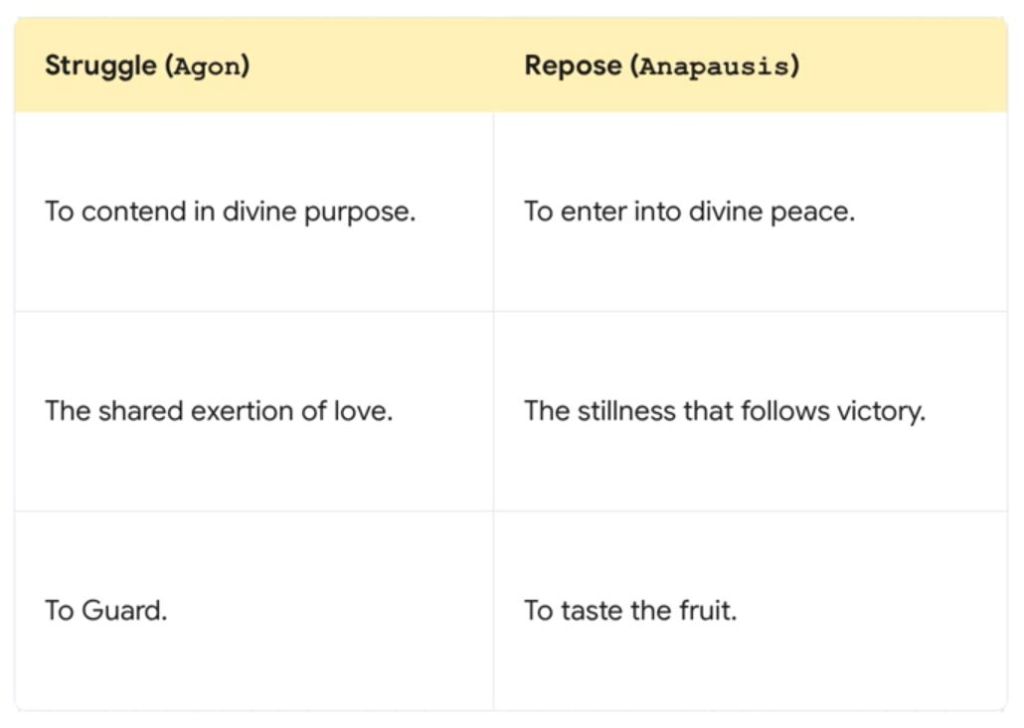
To synagōnizesthai is therefore to enter the same contest with another—to lock arms in the invisible arena, where prayer becomes the shared exertion of love.
WORD STUDY 2 — ΣΥΝΑΝΑΠΑΎΣΩΜΑΙ (Sunanapausōmai)
This is the origin of the word “pause.”
| Aspect | Detail |
|---|---|
| Root | syn (with, together) + anapauō (to rest, refresh, make to cease) |
| Meaning | To rest together; to share a mutual repose after labour; to find refreshment in unity. |
| Classical Usage | In Plato’s Phaedrus, anapausis is the rest of the soul returning to truth. |
| Patristic Usage | Augustine called heaven “the Sabbath of Sabbaths,” the eternal anapausis of the saints. The term appears in Clement and the Didache as the peace of shared faith. |
| Theological Nuance | This is no passive rest but a Sabbath of completion—the stillness that follows victory. It mirrors God’s rest after creation. |
Together these verbs outline the whole pilgrimage of human life: to contend (agon) and to enter rest (anapausis). They form a divine rhythm—what modern idiom might call “work hard, play hard,” though transfigured into holiness.
THE RHYTHM OF WORK AND REST
Genesis 2:15 declares:
“The LORD God took the man and put him in the garden of Eden to cultivate it and guard it.”
The Hebrew verbs here—ābad (to serve, cultivate) and šāmar (to guard)—describe both labour and protection. Humanity was designed to work within rest, to guard Eden not from exhaustion but from intrusion. Both words, ʿābad and šāmar carriy the sense of both practical action (labour, cultivation) and sacred vocation (worship, ministry). It unites what modern life separates—work and worship, duty and intercession.
Paradise was, and still is, rhythmic, not static.
When sin fractured that rhythm, work became toil and rest became sloth. Redemption restores the rhythm. The Garden is no longer outside us but within—paradise relocated, as mystics would say, to the interior geography of the soul. There, prayer re-cultivates the sacred order and guards the heart from encroaching chaos.
To strive is to guard; to rest is to taste the fruit of what has been guarded.
THE ARC OF ROMANS 15:30–33—FROM WARFARE TO REST
Romans 15 ends not with a benediction of ease, but with the heartbeat of pilgrimage. Paul invites the Roman believers to synagōnizesthai—to wrestle with him in prayer—that he may at last sunanapausōmai—rest with them in peace.
This arc—warfare → joy → rest → peace—is the pattern of every believer’s journey. Life begins in struggle, matures in endurance, and culminates in the Eirēnē tou Theou (“the Peace of God”). Prayer is the thread that binds the stages together.
REDEFINING PRAYER AS WORK (Latreia)
Romans 12:1 calls us to “present your bodies as a living sacrifice, holy and acceptable to God, which is your reasonable service”—the Greek word here is latreia, meaning priestly service or sacred labour.
True prayer is latreutic—it is labour performed in the temple of time. It is not recreation; it is re-creation. It costs. It demands the sacrifice of attention, convenience, and comfort. Life is better when we stop consuming and begin creating.
The saints who changed history did not pray at ease; they prayed until heaven moved. Prayer is not meant to be convenient—it is meant to be consecrated.
Tertullian observed: “Prayer is a sacrifice of the heart, offered upon the altar of faith.” And as in all sacrifices, something must die—often our self-will, our schedule, or our pride.
KNOW YOUR WHY—WHAT IS THE PRIZE?
The prize is rest.
“Therefore, while the promise of entering His rest still stands, let us be careful that none of you be deemed to have fallen short of it.” —Hebrews 4:1
This rest (katapausis) is not the absence of battle but the fruit of victory. It is the peace of alignment with divine order.
The world system, by contrast, operates on divide et impera—divide and conquer. The enemy’s tactic is isolation. Everyone suffers their agony alone. But the kingdom of God calls us to suffer and to strive together.
Amalek attacked the stragglers—the weary ones who lagged behind the group (Deut 25:17–18). Separation was vulnerability. Unity was protection.
To “know your why” is to see prayer not as escape but as engagement—to fight for the restoration of rhythm in a disordered world.
Why do we avoid the one thing that secures our experience of victory? Would we rather agonise in life than agonise in prayer?
KNOW YOUR HOW—STRIVING TOGETHER IN WARFARE
“For our [not my] struggle is not against flesh and blood, but against the rulers, against the authorities, against the powers of this world’s darkness, and against the spiritual forces of evil in the heavenly realms.” —Ephesians 6:12
The Greek pale denotes hand-to-hand combat. The enemy is unseen, yet the wounds are real.
“Let the high praises of God be in their mouth, And a two-edged sword in their hand, To execute vengeance on the nations and punishment on the peoples, To bind their kings with chains and their nobles with fetters of iron, To execute [enforce] on them the written judgment ; this is an honor for all His godly ones. Praise the LORD!” —Psalm 149:6-9
We fight not with swords but with Scripture, worship, and agreement. Psalm 149:6–9 reveals that “the high praises of God in their mouths” are a double-edged sword in their hands. 2 Peter 1:4 calls us “partakers of the divine nature” and “enforce the written judgement” which is recorded for our convenience in the Bible (2 Corinthians 1:20) so that we do not have to ignorant of Satan’s strategies—empowered not by might but by participation in His essence.
Nehemiah 4:14 captures the cry of holy leadership:
“Do not be afraid of them. Remember the Lord, who is great and awesome, and fight for your families, your sons and your daughters, your wives and your homes.”
This is the heart of synagōnizesthai: communal battle under divine remembrance.
Jehoshaphat in 2 Chronicles 20 fought with a choir. The singers went before the army, and praise became a weapon. When they lifted their voices, the enemy turned upon itself.
So too today: worship is not the prelude to battle—it is the battle.
SI VIS PACEM, PARA BELLUM
“It is no use saying, ‘We are doing our best.’ You have got to succeed in doing what is necessary.” —Winston S. Churchill
The Roman proverb si vis pacem, para bellum (“if you want peace, prepare for war”) is more than military wisdom—it is spiritual reality. The peace of God is not passive; it is hard-won. It is the stillness that descends after the storm, not the absence of it. Heaven’s peace is not negotiated but enforced by those who have taken up their place in Christ’s victory.
In the Kingdom of God, peace is not the opposite of conflict but its consummation—the fruit born only when order subdues chaos, when divine harmony silences rebellion. Just as Rome’s legions secured the Pax Romana through disciplined strength, so the Church is called to enforce the Pax Christi—the Peace of Christ—through the weapons of righteousness, prayer, and unity.
When Paul urged believers to “put on the whole armour of God,” he was not calling them to aggression but to alignment. Prayer is the posture of warriors who have already won—soldiers who stand, not to conquer, but to hold the ground their King has already claimed. “Be strong in the Lord,” he wrote, “and in the power of His might” (Ephesians 6:10).
“This is the word of the LORD to Zerubbabel: ‘Not by might nor by power, but by my Spirit,’ says the LORD Almighty.” —Zecharia 4:6
The strength is His; the standing is ours.
To prepare for peace is to become fluent in both stillness and struggle—to understand that the serenity of God is forged in the furnace of intercession. The Church must therefore recover her militant tenderness, her active peace. For we are not monks hiding in cloisters, but sentinels guarding the frontiers of grace. Every prayer is a line held, every act of love a shield raised.
The paradox remains: those who most desire peace must be most prepared for battle. Yet it is not a battle of fists, but of faith; not with the sword of iron, but with the sword of the Spirit. For our warfare is not against flesh and blood, but against the invisible structures of disorder and despair. And so we pray, not to escape the world’s chaos, but to transform it—until the kingdoms of this world become the Kingdom of our Lord and of His Christ, and He shall reign forever (Revelation 11:15).
As our Lord Himself proclaimed, the true purpose of prayer is not persuasion but to align earth with heaven’s will—that His will may be done, and His kingdom (basileia—His divine order, governance, and harmony) may come, manifesting on earth even as it reigns in heaven (Matthew 6:10).
FIGHTING FROM VICTORY, NOT FOR VICTORY
Most battles of the flesh are fought in desperation—hoping to win. But the battles of the Spirit are fought in remembrance—enforcing what has already been won.
At the Cross, the contest was settled once and for all. Christ did not merely survive the arena; He overthrew it. The Greek cry “Tetelestai!” (“It is finished”) was a legal term, stamped across contracts when a debt was paid in full. To pray from that position is to act not as a beggar seeking rescue, but as ambassadors enforcing policy.
Spiritual warfare, then, is law enforcement, not litigation. We do not argue for victory—we execute it. The believer is heaven’s representative body on earth, authorised to enact the rulings of Calvary.
“Having disarmed the powers and authorities, He made a public spectacle of them, triumphing over them by the cross..” —Colossians 2:15
“Thanks be to God, who always leads us in triumph in Christ.” —2 Corinthians 2:14
“The God of peace will soon crush Satan under your feet.” —Romans 16:20
Notice the inversion: peace crushes chaos. Rest enforces victory. The warfare that remains is administrative—the occupation of conquered territory, the driving out of squatters who refuse to acknowledge the King’s rule.
This is why prayer must be bold, declarative, and grounded in identity. When you speak, you speak in His name—that is, in His authority, His victory, His memory. Heaven does not answer uncertainty; it responds to remembrance.
→ Every “Amen” is not a wish but a warrant.
→ Every declaration of faith is not an attempt—it is an enforcement.
→ Every act of worship is not a plea—it is a proclamation that the throne is occupied &victory already secured.
To fight from victory is to pray with Sabbath in your soul—rested authority.
It is to stand, not strive; to affirm, not argue; to enforce, not endure.
This is the paradox of sunanapausōmai: rest is the proof of triumph.
“Be still, and know that I am God.” —Psalm 46:10
Stillness is not passivity; it is dominion exercised without panic.
When believers grasp this, striving becomes sacred confidence. The prayer room becomes the courtroom of heaven, and every word of faith a legal decree echoing Christ’s eternal verdict:
“It is finished.”
THE WISDOM OF THE FATHERS AND MODERN WARRIORS
- John Chrysostom: “Prayer is the queen of virtues; through it we stand armed against demons.”
- Augustine: “He who sings prays twice.” (because song unites heart and voice in battle formation)
- Derek Prince reminds us that “prayer is not preparation for the battle; it is the battle.”
- Amanda Buys speaks of “redemptive communities”—believers joining in identification repentance, closing spiritual breaches together.
- Rebecca Brown warns that “isolation is Satan’s most effective weapon; unity terrifies him.”
These voices echo a single truth: Christianity is action. It is not lip service or moral sentiment. It is the active alignment of heaven’s will with earth’s resistance.
UNITY = EXPONENTIAL POWER
“One can chase a thousand, and two can put ten thousand to flight.” —Deuteronomy 32:30
Spiritual mathematics defy logic: unity multiplies strength exponentially.
Paul’s metaphor of the body of Christ is not poetic; it is tactical. Every limb supplies another.
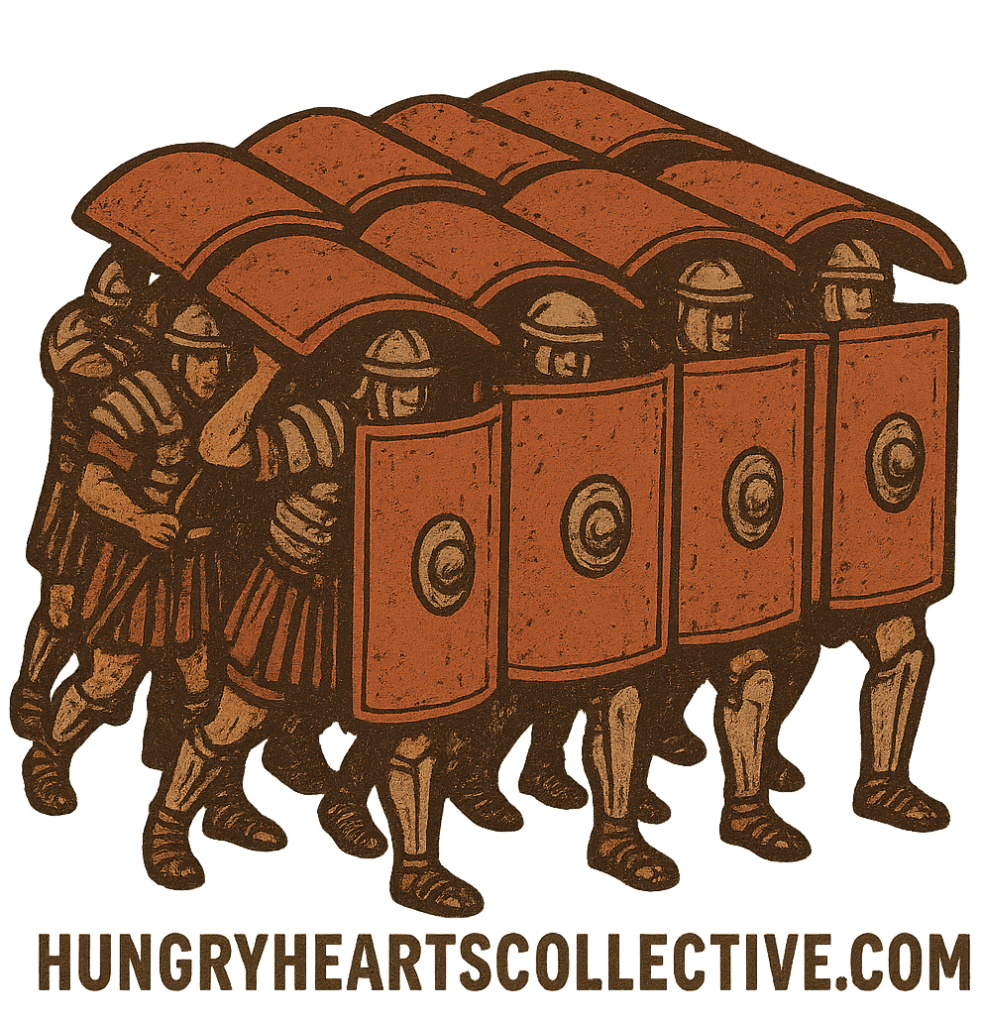
The Roman testudo (tortoise formation) offers a vivid image. Soldiers interlocked their shields overhead and on all sides, forming a living fortress. Individually, they were vulnerable; together, they were impregnable. So it is with intercession.
When believers link their faith, the gaps through which the enemy fires his arrows are closed.
The “shield of faith” (Eph 6:16) is designed to overlap.
Jesus taught us to pray, “Our Father.” Not “My Father.” Prayer begins in plurality. It assumes community. Heaven responds to corporate resonance.
PRACTICAL SECTION—CREATING YOUR PRAYER POSSE
The English word posse derives from the Latin posse, “to be able, to have power.” In medieval law, the posse comitatus was the “power of the county”—ordinary citizens summoned for mutual defence.
A prayer posse is a company of believers bound by covenant, purpose, and rhythm—people who fight together for families, nations, and souls.
How to form one:
- Discern Purpose. Every posse must know why it gathers—intercession for revival, for nations, for healing. Purpose births endurance.
- Establish Rhythm. Alternate striving and rest. Labour in prayer, then share meals, laughter, worship. Sunanapausōmai completes synagōnizesthai.
- Guard Unity. Offence breaks formation faster than arrows. Keep short accounts; forgive quickly.
- Share Burdens. Galatians 6:2 commands, “Bear one another’s burdens.” Prayer teams should distribute the weight.
- Record Victories. Testimonies sustain morale. They remind you that the war is already won in Christ (1 Samuel 30:6).
When difficulties arise, remember their holy purpose: to drive us together toward God’s presence, where alone is safety. The enemy trembles at united weakness leaning on omnipotent grace.
THERE IS ONLY SO MUCH YOU CAN DO ALONE
Individual piety has its place, but solitary heroism is unsustainable. Elijah’s cave proved that even prophets burn out in isolation.
Christ Himself modelled team prayer—He took Peter, James, and John into Gethsemane. He who could command legions still desired companionship in agony.
The early Church gathered in one accord and the room shook (Acts 4:31). That shaking still awaits those who will strive and rest together.
The goal is not exhaustion but equilibrium: work hard, pray hard, rest deep. The rhythm of heaven is both warfare and sabbath.
DEVOTIONAL PRAYER
Lord of the harvest and Captain of hosts,
Teach us to strive without fear and to rest without guilt.
Knit our hearts into one purpose, one prayer, one victory.
Where we have prayed alone, draw us into communion.
Where we have fought alone, surround us with comrades.
Let our striving end in peace,
And our peace fuel new labour for Your kingdom.
Amen.
QUESTIONS FOR REFLECTION
- What does prayer as work mean to you personally?
- Where have you been striving alone instead of with others?
- How might you cultivate both synagōnizesthai and sunanapausōmai in your weekly rhythm?
- Who belongs in your “prayer posse”?
- In what ways does rest become warfare, and warfare become rest?
TEN QUOTES ON SPIRITUAL WARFARE
- “Prayer is the slender nerve that moves the muscle of omnipotence.” —Charles Spurgeon
- “He who kneels before God can stand before any man.” —Unknown
- “The Church is an army; it marches best on its knees.” —Chrysostom
- “Satan trembles when he sees the weakest saint upon his knees.” —William Cowper
- “There is no victory without travail.” —Amanda Buys
- “Spiritual authority is exercised through obedience, not aggression.” —Derek Prince
- “When believers pray in unity, heaven’s geometry multiplies their strength.” —Peter Hasert
- “The purpose of darkness is to make us seek the light together.” —Augustine, Confessions (paraphr.)
- “Every prayer that costs you nothing buys you nothing.” —Rebecca Brown
- “Rest is not retirement from war; it is the banner raised over conquered ground.” —Matthew Henry
TEN SCRIPTURE VERSES ON UNITY AND PRAYER
- Romans 15:30–33—Strive together… rest together.
- Hebrews 4:1—The promise of entering His rest.
- Ephesians 6:12—Our struggle is not against flesh and blood.
- Nehemiah 4:14—Fight for your families.
- 2 Chronicles 20:21—The choir before the army.
- Deuteronomy 32:30—One chases a thousand, two ten thousand.
- Genesis 2:15—To cultivate and guard.
- Acts 4:31—They prayed, and the place was shaken.
- Psalm 133:1—How good and pleasant it is when brethren dwell in unity.
- Matthew 18:19—If two agree on earth… it shall be done.
FINAL EXHORTATION
We were never meant to fight alone. The Christian life is a pilgrimage from agon to anapausis, from warfare to rest, from isolation to communion. The victory belongs to Christ, but the battle belongs to the Church.
To pray is to join that sacred procession—to shoulder the shield beside your brother, to lift your voice beside your sister, to sweat, weep, and finally sing together in the peace of God.
So, pray hard—and rest well.
Because the rhythm of heaven is not exhaustion, but union.
 The Hungry Hearts Collective
Leave a comment