
KEY VERSE(S)
“Take delight in the LORD, and he will give you your heart’s desires.” — Psalm 37:4
“Delight yourself in the Almighty and lift up your face to God.” — Job 22:26
“But I with the voice of thanksgiving will sacrifice to you; what I have vowed I will pay. — Job 22:26
INFO GRAPHIC
VIDEO
AUDIO PODCAST
Let me say this as clearly as I can. Many of us are not actually frustrated with God:
We are frustrated with and disillusioned by a version of Christianity that was handed to us—one that sounds spiritual, but is not biblical.
We were told, again and again, that Christianity is “a relationship.” And that sounded wonderful. Intimate. Personal. Warm. But no one stopped to explain what kind of relationship we are actually talking about.
If as a Christian you feel as if something is missing or it seems as if God is not keeping His promises as you expected, then this post is for you.
The word “relationship” became a soft, undefined concept—something we could quietly shape according to our own expectations. And when a word remains undefined, we instinctively fill in the meaning ourselves. We project onto God what we think that relationship should look like. We decide the tone. The boundaries. The obligations. The benefits. And then we are surprised that it does not seem to work.
Why does our Christianity not deliver what we assumed it would? Simply put, the version of Christianity we practice and is taught commonly in Churches is a pseudo Christianity that makes only promises but does not advise us of our obligations. That leads to the Christians being infantilised and perpetually dependent on ecclesiastical organizations to survive spiritually—and that just barely.
So what are we actually talking about when we say “relationship”?
- Is it a friendship, where mutual affection is enough?
- A mentorship, where advice is offered but not binding?
- A therapeutic support system, where God exists to stabilise our emotions?
- A spiritual co-pilot, helping us reach destinations we have chosen ourselves?
- A cosmic car wash?
- A spiritual shopping center?
The truth is far weightier than that.
Far more demanding.
Far more structured.
And far more glorious.
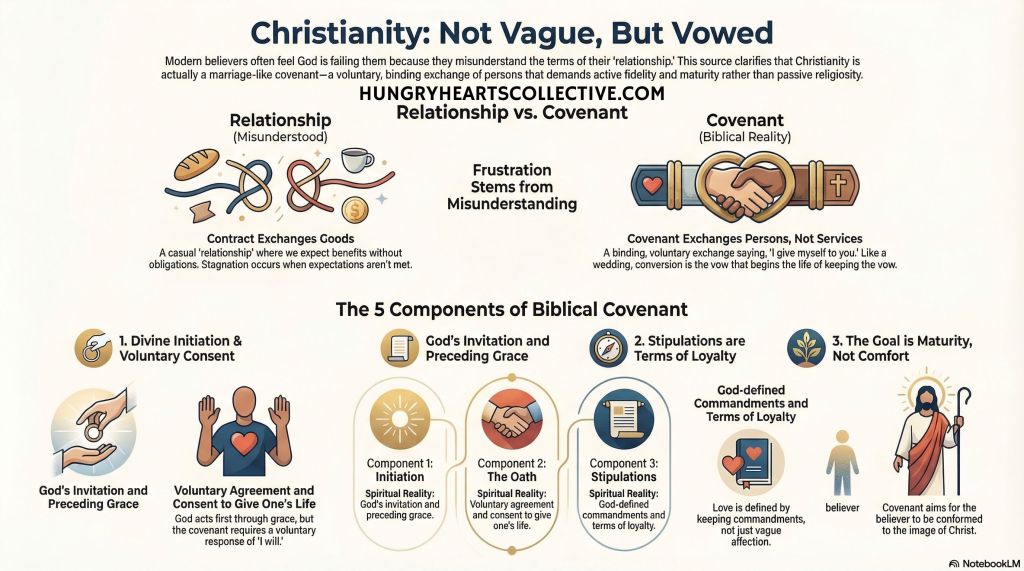
Christianity is not merely a relationship in the casual, modern sense of the word.
It is a covenant—a word we know very little about in our post modern, post Christian and post truth hedonistic world. And ignorance is dangerous, even deadly (cf. Hos. 4:6).
Until we recover that word—until we allow it to define the terms of our relationship with the Lord—we will quietly continue to feel as though God is not keeping His promises, when in reality we have never fully understood what we committed ourselves to when we promised to give Him our lives.
So let’s slow down.
Let’s clear away the vagueness.
And let’s build this properly from the ground up.
WHAT IS A COVENANT?
A covenant is not the same thing as a modern contract to access services from a company like a utility.
A contract is transactional. It exchanges goods, services, performance. It says, “You fulfil your part, I’ll fulfil mine.” It is built on negotiated terms and limited liability.
A covenant is something altogether deeper.
A contract exchanges commodities.
A covenant exchanges persons.
A contract says, “Do this for me” and “You owe me this.”
A covenant says, “I give myself to you” and “I owe you this.”
Contracts are temporary whereas covenants are permanent. That is why covenant language in Scripture is so weighty. It is never casual. It invokes God Himself as witness, judge, and guarantor. Covenant is not merely witnessed by God—it is enforced by Him.
When we accepted the Lord’s offer of covenant relationship, no one coerced us. There was no compulsion. No spiritual arm-twisting. We came because we saw something — mercy, forgiveness, peace, eternal life. We saw beauty in Him. We saw hope for ourselves. And we responded.
It was voluntary.
We said yes because of the grace extended to us.
But here is the part we rarely pause to consider: covenant grace is never one-sided indulgence. It is mutual self-giving.
We were drawn by the benefits — forgiveness of sin, reconciliation with God, the promise of life — and rightly so. Scripture openly declares them. Yet covenant does not end with receiving. It moves immediately into reciprocation.
Not repayment — we could never repay Him.
But response.
Love answered by love.
Faithfulness answered by faithfulness.
Self-giving answered by self-giving.
A covenant is not sustained by one party continually pouring out while the other simply consumes. That is dependency, not union. Covenant flourishes when the benefits received awaken loyalty, obedience, and devotion in return.
We entered willingly.
And because we entered this covenant willingly, our response must also be willing. Keeping covenant is the definition of love in the Bible.
That is not legalism. It is honour and glory.
This is precisely why marriage in Scripture, unlike our modern consumerist version, is covenantal, not contractual.
“Therefore I urge you in full view of the obvious covenant benefits, to offer your bodies [like a bride to to her bridegroom] as living sacrifices, holy and pleasing to God, which is your spiritual service of worship.” — Romans 12:1
Marriage, biblically understood, is not sustained by feelings. It is sustained by sworn self-giving before God which is the definition of our required spiritual service/worship of God.
“Yet she is your companion and your wife by covenant.” — Malachi 2:14
And this is why the Church is described in bridal language.
“For I have betrothed you to one husband, that I may present you as a chaste virgin to Christ.” — 2 Corinthians 11:2
“Let us rejoice and be glad… for the marriage of the Lamb has come, and His bride has made herself ready.” — Revelation 19:7
Christianity, then, is not a loose spiritual affiliation. It is a marriage covenant between Christ and His people.
And covenant always carries two realities: benefits and obligations, not only benefits.
That word “obligations” makes modern ears nervous. It sounds like legalism. It sounds oppressive. It sounds like we must check our “credit score” before we can partake of the benefits.
But it is not legalism.
It is reality.
Every meaningful bond in life contains responsibility. Realising this is the path to maturity. The deeper the union, the greater the mutual claim. Covenant is not restrictive because it is harsh; it is binding because it is sacred and reliable.
Matthew Henry captures this balance beautifully when reflecting on covenant obedience:
“God’s promises are not intended to encourage our sloth but to quicken and engage our diligence.” — Matthew Henry, Commentary on Deuteronomy 30
We become slothfull when our immaturity is fostered in liturgical church meetings that do not clarify our obligations.
The promises of God are not cushions for passivity. They are fuel for faithfulness.
And that single insight explains why so many believers stall in their growth. We have embraced the promises as comfort, but not as summons. We are waiting to receive the benefits, but hesitated at the obligations. That’s fine as an infant because you don’t know better, but when you have been around the block and had the time to read the fine print you actually agreed to, it becomes inescapable.
Covenant does not function on selective participation. It flourishes where self-giving is mutual.
And that is where Christianity becomes not burdensome—but powerful.
THE FIVE COMPONENTS OF BIBLICAL COVENANT
Across Scripture—from Abraham to Sinai to the New Covenant—covenants follow a pattern. We see this structure clearly in places like Exodus 19–24 and Deuteronomy.
Here are the five core components—and how they apply to Christianity.
1. INITIATION: DIVINE INVITATION
Every covenant begins with God’s initiative.
“You did not choose Me, but I chose you.” — John 15:16
At Sinai:
“You yourselves have seen what I did to the Egyptians… Now therefore, if you will indeed obey My voice…” — Exodus 19:4–5
God acts first. Grace precedes obligation.
Your salvation was not your achievement. It was invitation.
But invitation demands response.
2. THE OATH: VOLUNTARY CONSENT
Covenant is never forced—it is voluntary agreement.
Israel responded:
“All that the LORD has spoken we will [choose to] do.” — Exodus 19:8
At conversion, we said i.e swore an oath:
“Lord, I give You my life.”
Ecclesiastes warns us:
“When you make a vow to God, do not delay to pay it… Better that you should not vow than that you should vow and not pay.” — Ecclesiastes 5:4–5
and again:
“Keep the king’s command, I say, because of your oath before God.” — Ecclesiastes 8:2-3
A wedding ceremony is not the marriage…It is the vow that begins the life of keeping the vow.
Conversion is not the finished act…It is the oath that begins obedience.
3. STIPULATIONS: TERMS OF THE RELATIONSHIP
Here is where modern Christianity becomes uncomfortable.
God defines the relationship—not us.
At Sinai, the covenant came with commandments. In the New Covenant, Jesus says:
“If you love Me, keep My commandments.” — John 14:15
“Why do you call Me ‘Lord, Lord,’ and not do what I tell you?” — Luke 6:46
Love is not vague affection. It is covenant loyalty.
Matthew Henry comments on Luke 6:46:
“The profession of religion without obedience to the precepts of Christ is but a mockery of Him.”
Strong words—but honest ones.
Many believers feel that in their experience God has changed. In reality, the terms were always there. We simply did not study them. God makes allowances for infants, but not for adults and by this time, we should be adults. Christians frustration is in part ignorance, but also in part an unwillingness to grow up.
4. BLESSINGS AND CONSEQUENCES
Every covenant includes outcomes—what we signed up for.
Deuteronomy 28 outlines blessings and consequences under Mosaic covenant.
In the New Covenant:
“Abide in Me… If you abide in Me and My words abide in you, ask whatever you wish, and it will be done for you.” — John 15:4,7
Notice the structure:
Abiding → Words abiding → Asking → Receiving.
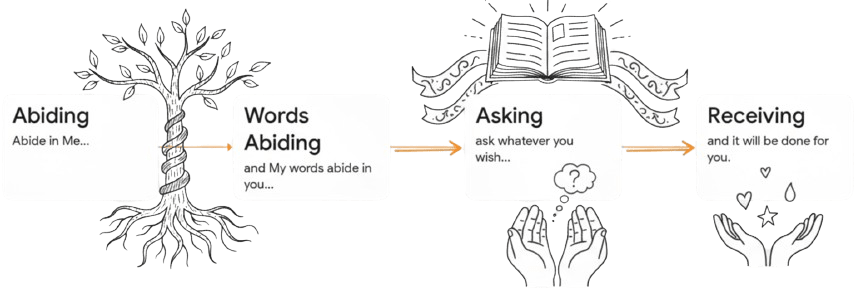
We often skip the first two and wonder why the fourth is absent.
James is direct:
“You ask and do not receive, because you ask wrongly.” — James 4:3
God is not breaking covenant. He is maintaining justice (a topic for another day).
If the universe is morally structured—and Scripture insists it is—then covenant cannot be one-sided indulgence.
5. MATURATION: TRANSFORMATION INTO THE COVENANT PARTNER
Covenant aims at likeness.

God’s goal is not your comfort. It is your maturity.
“For those whom He foreknew He also predestined to be conformed to the image of His Son.” — Romans 8:29
Hebrews explains discipline:
“For the Lord disciplines the one He loves… that we may share His holiness.” — Hebrews 12:6,10
Matthew Henry writes:
“Afflictions are the medicines which our gracious and wise Physician prescribes because we need them.”
At the beginning of our walk, everything feels easy. Like infancy. And this is fair. But God cannot treat a ten-year believer like a spiritual toddler. That would be unfair.
Responsibility increases with revelation.
To whom much is given…
“…of him much will be required.” — Luke 12:48
WHY THE EXPERIENCE CHANGES
In the beginning, the Christian life often feels like being carried.
There is a kind of supernatural cushioning. Prayers seem quickly answered. Mistakes seem quickly covered.
God appears to step in before the consequences fully land. It is tender. Almost parental. Like a father steadying a toddler who is still learning to walk.
But as understanding grows, expectation grows with it.
Revelation increases responsibility. Light increases accountability.
You now know what obedience looks like—or at least you should. You have read the words. You have heard the teaching. You have felt the conviction.
And that changes things.
Here is the painful—but profoundly liberating truth:
Most Christian frustration is not really the cry :“Why isn’t God keeping His promises?”
It is the quieter, more uncomfortable question: “Why am I not experiencing the benefits?”
Beneath that, deeper still, lies the real issue: Am I keeping covenant? Am I living what I vowed? Am I giving Him what I said I would give?
Not flawlessly—covenant faithfulness is not sinless perfection, but sincerety.
Not casually drifting through belief—but deliberately aligning my life with the One I pledged myself to.
Because covenant (benefits) is not activated through sentiment, but through faithfulness to fulfilling my vow.
And when we dare to ask that deeper question, frustration begins to turn into clarity—and clarity into growth.
THE ONE THING NECESSARY
Jesus said:
“Martha, Martha, you are anxious and troubled about many things, but one thing is necessary.” — Luke 10:41–42
That sentence cuts through so much religious noise.
Covenant begins there.
- Not in activity.
- Not in performance.
- Not in anxious striving to prove ourselves useful.
- Not in a spiritual credit score.
It begins at His feet.
- Listening.
- Waiting
- Learning.
Mary was not being passive—she was positioning (aligning) herself. She understood something Martha had not yet grasped: before you serve the covenant, you must understand the covenant. You must become a mature lover.
And here is the truth:
- You cannot keep what you do not understand.
- You cannot walk out what you have not first received.
- You cannot activate what you refuse to practice once you know better.
That is why James is so direct:
“Be doers of the word, and not hearers only, deceiving yourselves.” — James 1:22
Notice the word deceiving. The danger is not ignorance alone, but self-deception—the quiet assumption that hearing equals obedience, that agreement equals alignment. Of fashioning a convenient Lord and Master in our comfortable image.
It does not.
Covenant is not sustained by inspiration. It is sustained by application.
And this is why Scripture matters so profoundly.
The Bible is not spiritual ambience. It is not devotional decoration for a coffee table. It is covenant documentation. It is not a collection of comforting quotations to dip into when we feel low. It is a map to be followed.
The Bible is covenant documentation.
- It records what God has promised.
- It reveals what we agreed to.
- It shows how He acts.
- It clarifies how we respond.
If we neglect it, we are not merely neglecting reading—we are neglecting the very terms of the relationship we claim to value. We are choosing to stay voluntarily ignorant and are surprised when it leaves us feeling frustrated, lost, disappointed and vulnerable.
Covenant cannot flourish in vagueness. It flourishes in understanding, and in lived obedience.
THE FUNNEL AND THE BROAD PLACE
There is a narrowing that comes with real spiritual growth.
It feels like constriction.
- Options reduce.
- Excuses fade.
- Compromises become harder to justify.
What once felt wide and undefined begins to focus and the focus is Christ.
Hebrews speaks of this process as maturity—the movement from milk to solid food, from infancy to discernment. Growth is not expansion in every direction; it is refinement. It is being shaped.
Jesus describes it even more starkly:
“For the gate is narrow and the way is hard that leads to life, and those who find it are few.” — Matthew 7:14
The narrow way is not restrictive for the sake of restriction. It is directional. It removes what does not belong. It presses you toward what is essential.
And yet—this is the paradox—on the other side of surrender, something unexpected happens.
David testifies:
“He brought me out into a broad place; He rescued me, because He delighted in me.” — Psalm 18:19
Notice the order. Rescue. Alignment. Delight. Then breadth.
The narrowing was never meant to suffocate you. It was meant to align you.
- To straighten what was bent.
- To focus what was scattered.
- To purify what was divided.
When you stop trying to widen your own life—through control, ambition, distraction, or compromise—and instead allow God to shape you, something shifts. Once aligned, life widens in a way that does not fracture you.
God broadens what you no longer strive to broaden for yourself. And the breadth He gives does not compete with your soul.
Christianity can be defined as voluntary restriction to access divine enlargement.
WHAT DOES IT MEAN TO GIVE YOUR LIFE TO HIM?
It means:
- Your will becomes secondary i.e you put your covenant partners’ needs ahead of your own.
- Your understanding submits to revelation.
- Your desires are retrained.
- Your obedience becomes deliberate.
- Your identity becomes covenantal, not cultural.
It does not mean passive religiosity. It means active covenant fidelity. And fidelity is not compulsory, it is voluntary.
You chose Him as He chose you. Christianity is about continuing to choose Him on a daily basis.
And the result is remarkable—as you take care of your covenant partners’ interests, He begins to take care of yours.
“But seek first the kingdom of God and his righteousness, and all these things will be added to you.” — Matthew 6:33
CONCLUSION: CHRISTIANITY IS NOT VAGUE — IT IS VOWED
The modern reduction of Christianity to “relationship” without covenant has produced confused (and hurting) believers.
Covenant clarifies everything:
• Why obedience matters
• Why discipline comes
• Why maturity is required
• Why promises sometimes feel delayed
• Why Scripture must be studied
• Why God cannot simply indulge immaturity
He is not breaking His side. He has bound Himself to you.
The question is not whether He is faithful. It is whether we are growing more faithful to the covenant we swore to uphold. And that growth is not punishment. It is the door to the abundant blessing we were promised. He is doing for you, not against you.
Real Christianity is preparation for union and the resulting intended blessing that accompanies it.
Trust me, God wants you to experience the promised blessing more than you even want them—Remember this, He paid the ultimate price for you to access them and now is helping you cooperate with Heaven in the framework laid our by covenant.
Sooooo….
The next time you are temped to complain about the Lord not keeping His promises to you, stop and ask yourself,
AM I KEEPING MY PROMISE TO GIVE MY LIFE TO THE LORD?
Do what you said you would do and trust that as you do, God will do what only He can for you.
You are not waiting for Him to be faithful, He is waiting for you.
Smile Jesus loves you :)
FIVE QUESTIONS FOR REFLECTION
- When I first said, “Lord, I give You my life,” what did I believe that meant? Has that definition deepened?
- Do I know the clear stipulations of the New Covenant—or am I assuming them?
- Where might I be interpreting Scripture through my experience rather than reshaping my experience through Scripture?
- In what area is God currently calling me from spiritual childhood into maturity?
- If Christianity is a covenant, what deliberate acts of fidelity should mark my daily life?
A DEVOTIONAL PRAYER
Lord Jesus Christ,
You did not offer me vague spirituality—You offered covenant.
You bound Yourself to me in faithfulness.Forgive me where I have enjoyed Your benefits
without seeking to understand my obligations.Teach me what it truly means to give You my life.
Align my will.
Reshape my understanding.
Mature my obedience.Lead me through the narrow place
into the broad place of Your delight.Make me faithful as You are faithful.
Amen.
 The Hungry Hearts Collective
Leave a comment