
Your Forward Operating Base in the Battle for the Kingdom
AUDIO PODCAST
INTRODUCTION: THE WARFARE MOST CHRISTIANS WERE NEVER TRAINED FOR
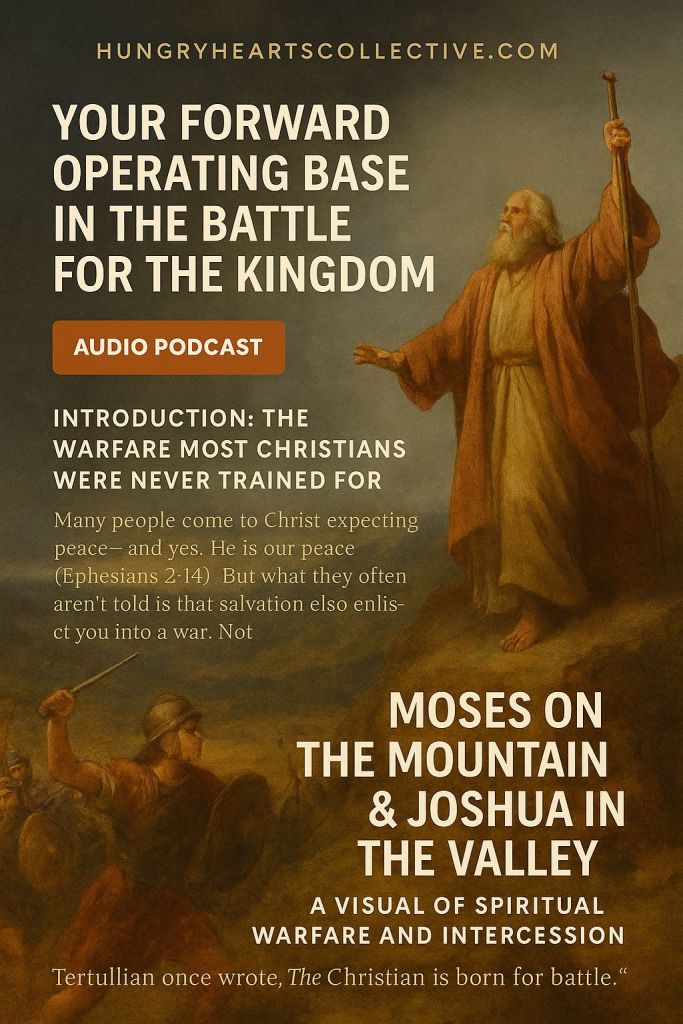
Many people come to Christ expecting peace—and yes, He is our peace (Ephesians 2:14). But what they often aren’t told is that salvation also enlists you into a war, and it is by engaging in this war that you secure your “peace” in every area of your life. Not a metaphorical war. A spiritual war. And most are dropped into it unarmed, untrained, and unaware.
In military terms, this would be illegal.
According to the Geneva Convention, sending a soldier into combat without a weapon is a violation of international law. Likewise, U.S. Army doctrine—outlined in Field Manual 7‑0 (Training)—emphasises that no soldier should be deployed without first being fully trained, equipped, and prepared for the demands of battle.
And yet—how many believers are saved on Sunday and sent into skirmishes by Monday, completely ill-equipped to deal with the backlash?
Not being trained how to use a weapon, or handle yourself in battle, is as dangerous as not having a weapon at all.
Why? Because skirmishes will break out, and lack of knowledge kills (Hosea 4:6). Every believer is sent to take back territory that the kingdom of darkness has illegally occupied. The land has already been declared Christ’s by the blood of the cross—but it’s up to His soldiers to enforce the written judgment (Psalm 149:6–9):
“Let the high praises of God be in their mouth, and a two-edged sword in their hand… to enforce the written judgment: this honour [duty] have all His saints.”
This is our duty and our warfare: to drive out spiritual squatters and expand the dominion of the King—His basileia, His Kingdom.
But war isn’t waged without supply lines. You don’t drop soldiers into enemy territory without establishing a place of retreat—a forward operating base (FOB).
Herodotus, the father of history, used the Greek word aphormē (ἀφορμή) to describe this place—a provisioned stronghold from which a military campaign could be launched and sustained. The Apostle Paul borrows this very word in Romans 7:8, reminding us that even sin seizes opportunities (aphormē) to launch an attack.
But for the Christian, our aphormē is the secret place—our spiritual base of operations. It is there that we are:
- Resupplied with spiritual firepower
- Reoriented by divine strategy
- Recommissioned with heavenly authority
The battlefield belongs to those who dwell in the secret place of the Most High (Psalm 91:1). This is not hiding—this is high ground.
Let us now revisit the scene of Moses on the mountain and Joshua in the valley, not as a Sunday school story, but as a divine training manual for spiritual warfare. It is here we see the pattern for Kingdom conquest:
Prayer on the hill, obedience in the field, and a banner raised over all.
A VISUAL OF SPIRITUAL WARFARE AND INTERCESSION
MOSES ON THE MOUNTAIN & JOSHUA IN THE VALLEY
Tertullian once wrote, “The Christian is born for battle.” (De Corona, Chapter 11)
This imagery is powerfully captured in Exodus 17, where Moses ascends the mountain to pray while Joshua wages war in the valley below. It is not merely a tale of physical conquest, but a divine revelation:
Our victories on the ground are deeply tied to our victories in the spirit.
Battles are not only waged on the battlefield, but often far away at a military headquarters in a room dubbed a ‘War Room.’ Our prayer closet is our War Room.
“Prayer is not preparation for the battle; it is the battle.” — E.m. Bounds
We are not fighting for victory—we are fighting from victory. As Paul exhorts in Ephesians 6:13–14, having done all, we are to stand. This is not passive stillness but spiritually armed readiness. Our place of intercession—our prayer life—becomes the high ground where the true victory is won.
The meeting place with GOd is our spiritual HQ, our war-room where battles are won before going out into the field of life.
APHORMĒ: YOUR SPIRITUAL BASE OF OPERATIONS
The Greek word aphormē (ἀφορμή), used in military contexts, refers to a base of operations—a stronghold or strategic position from which attacks are launched. Simply running out to do life without being supplied in prayer, is often how many Christian do life and then wonder why it isn’t working as expected.
Thucydides writes:
“Corcyra became a great base of operations [aphormē] for both the Athenians and the Peloponnesians.” (History of the Peloponnesian War 1.44)
In Romans 7:8, Paul employs this very term to describe sin taking opportunity (aphormē) to strike. But in our walk with God, we reverse the use: prayer becomes our aphormē, our divine foothold, from which we push back darkness and enforce Christ’s victory.
Herodotus too observed:
“The Athenians gained an aphormē against their enemies—a strategic foothold to press their attack.” (Histories 6.102)
When we go up the mountain in prayer, we are establishing a stronghold of divine alignment. The high place becomes our outpost of authority.
The etymology reveals:
- ἀπό (apo) — “from“
- ὁρμή (hormē) — “an impulse, onset, attack“
Thus, aphormē implies more than a place; it is a charged beginning, a moment full of potential and momentum. It is both place and posture and where victory originate from.
YOUR SECRET PLACE AS STRATEGIC STRONGHOLD
Your secret place of prayer is not incidental. It is your aphormē—your fortified base of operations.
- On the mountain, Moses intercedes: God is enlisted.
- In the valley, Joshua obeys: Faith becomes action.
Together, intercession and obedience form a divine alliance.
As Epictetus once said:
“If you would incline toward vice, give room to vice—aphormē is all it needs.” (Discourses 2.18.1)
The same is true in reverse. If you would incline toward holiness (separating yourself to God in private), prayer, courage, and love, then give room—give aphormē—to these things. Establish a rhythm of victory from a place of prayer, but never in your own strength. As Scripture instructs,
“Not by might, nor by power, but by my Spirit, says the LORD of hosts.” — Zechariah 4:6
KEYWORD DEEP DIVE
PRAYER
“Prayer is not just asking God for things. It is joining forces with Him to accomplish His will on earth.” —Derek Prince
Moses does not hold a sword—he holds up his hands calling on the Lord. This is where heaven meets earth. This is where battles are won.
“I desire then that in every place the men should pray, lifting holy hands without anger or quarreling.” —1 Timothy 2:8
POWER
“Heaven does not lack power; Earth often lacks aligned, persistent prayer.”
“He who stands boldly before men on behalf of God must first stand before God on behalf of men.”
—E.M. Bounds
Joshua’s victory is born in Moses’ quiet persistence. Prayer is not weak; it is power under discipline.
AUTHORITY
“Our work is to bring the will of God from heaven to earth through the exercise of spiritual authority in prayer.”
—Derek Prince
The staff in Moses’ hand, lifted in surrender and strength, became a symbol of divine authority. Intercession is not a whisper—it is a roar.
WEAKNESS
“Let the weak say I am strong.” (Joel 3:10)
“He who stands boldly before men on behalf of God must first stand before God on behalf of men.”
—E.M. Bounds
Even Moses grew tired. But with Aaron and Hur to hold his hands, his weakness became strength. Community is not a luxury; it is a necessity.
BANNER
Moses names the altar YHWH-Nissi—”The LORD is my banner.”
“He brought me to the banqueting house, and his banner over me was love.” —Song of Solomon 2:4
A banner is not just cloth—it is a declaration. A signal of identity, territory, and victory.
“But thanks be to God, who always leads us in triumph in Christ, and through us spreads the fragrance of the knowledge of Him in every place.”
—2 Corinthians 2:14 (NASB)
PARDES ANALYSIS: EXODUS 17:8–16
PESHAT (LITERAL)
Israel is attacked by Amalek. Moses goes up the hill, lifts the staff of God in prayer. When his hands are raised, Israel wins; when he lowers them, they falter. Aaron and Hur support him. Victory comes. An altar is built.
REMEZ (HINT)
Amalek = the flesh (Galatians 5:17) or in Hebrew thought, the Yetser hara—”the evil inclination“. Moses = Christ, interceding. Joshua = the believer, obeying. Aaron and Hur = the Body of Christ, standing in support.
DERASH (MORAL)
Victory is not by strength alone, but by intercession and community. Even Moses needed help. We are called to support the arms of others in their spiritual battles.
SOD (MYSTICAL INTERPRETATION)
When Moses lifts his hands on the mountain, his arms—held up by Aaron and Hur—form the shape of the Hebrew letter Hey (ה). In Hebrew mysticism, Hey symbolises breath, Spirit, and divine revelation. It is the very letter added to Abram’s name to become Abra-h-am, marking covenant and the indwelling of God’s presence (Genesis 17:5).
This lifted posture is not merely symbolic—it opens the heavens. It’s a prophetic act, declaring that victory comes not by sword, but by the breath of God released through intercession.
WHO IS AMALEK?
The name Amalek (עֲמָלֵק) has obscure origins, possibly from Hebrew or a foreign tongue, but its gematria (numerical value) is 240—the same as the word safek (סָפֵק), meaning “doubt,” or “uncertainty,” i.e. confusion.
- Both Amalek (עֲמָלֵק) and Safek (סָפֵק) share the same numerical value: 240.
- In Jewish mysticism, this is interpreted to mean Amalek is the spiritual embodiment of doubt—he attacks faith, especially when it’s tired, unsure, or unguarded (see Deut. 25:17–18).
- Doubt (סָפֵק) becomes the gateway through which Amalek attacks.
Amalek, then, is not merely a nation or a man—it is the spirit of doubt and resistance to divine purpose. It strikes when you’re weary, sows disbelief, and questions what God has spoken. As it is written:
“Remember what Amalek did to you on the way, when you came out of Egypt… when you were faint and weary, and he attacked you from behind.”
(Deuteronomy 25:17–18)
Linguistically, Amalek may combine:
- עָמַל (ʿāmal) – to toil, labour, suffer
- מֶלֶךְ (melek) – king
Hence, “king of suffering” or “ruler of oppressive toil.” This directly echoes Pharaoh, who imposed unbearable labour upon Israel—both are types of Satan, the oppressor of God’s people.
REDEMPTION FROM THE STRONGER ONE
“The oppressor is too strong for me, but the LORD has redeemed my life.”
(Jeremiah 31:11)“Let the redeemed of the LORD say so—whom He has redeemed from the hand of the enemy.”
(Psalm 107:2)
We were not simply redeemed from Egypt—we were delivered from a spiritual Pharaoh, the “strong man” whom Christ overthrows:
“Resist the devil, and he will flee from you.”
(James 4:7)
“Be alert… Your adversary the devil prowls around like a roaring lion, seeking whom he may devour. Resist him, steadfast in the faith.”
(1 Peter 5:8–9)
We are called to go to the meeting place between heaven and earth—our secret place of prayer—and proclaim what God has done for us.
THE MOUNTAIN AND THE VALLEY: PRAYER AND WARFARE
In Exodus 17, we are given a prophetic pattern:
- Moses represents the believer born from water and who ascends the mountain to lift holy hands in intercession.
- Joshua (Yehoshua)—the Hebrew name for Jesus—fights Amalek in the valley.
- As long as our hands are raised, the dominion of Heaven prevails. When they fall, Amalek advances.
This teaches us: as we remain in prayer, Jesus fights for us.
We are Moses—called to ascend in prayer.
Christ is Joshua—warring on our behalf.
Amalek is Satan—the tempter, the accuser, oppressor, and enslaver.
This is the war within and without:
- Flesh vs. Spirit
- Doubt vs. Faith
- Satan vs. Jesus-Yehoshua
“The LORD will have war with Amalek from generation to generation.”
(Exodus 17:16)
APPLICATION TABLE: YOUR APHORMĒ IN PRACTICE
| Element | Mountain (Prayer Life) | Valley (Daily Obedience) |
|---|---|---|
| Position | Secret place of prayer—your aphormē | Work, leadership, parenting, outreach, purpose, freedom |
| Posture | Hands lifted, surrendered, persistent intercession | Courage to engage, consistency in action |
| Support | Holy Spirit and prayer partners | Strength through community and feedback |
| Outcome | Spiritual authority, vision, breakthroughs | Practical victory, wisdom, fruitfulness |
QUOTES TO ANCHOR YOUR SOUL
“The secret to powerful prayer… is waiting on God.”
“The man [person] who can get God’s ear can get all that He has.” — John G. Lake
“Prayer is not passive—it is strategic deployment of power.”
“A man [person] is in a great place when he has no one to turn to but God” — Smith Wigglesworth
FINAL ENCOURAGEMENT
- Establish your aphormē—a set-apart time and place where you regularly meet God.
- Lift your hands, even when they feel heavy.
- Ask for help—allow Aarons and Hurs to support you.
- Stand for others—be the one who holds arms up.
- Declare God’s banner over your battle.
- And always, always remember:
Let the weak say: I am strong. (Joel 3:10)
You may be weary, but you are not without a banner. Victory is not out there somewhere—it begins where you stand, where you kneel, where you lift your hands in faith.
This is your mountain. This is your aphormē. This is holy ground. Your secret retreat. You place of power.
KEY STATEMENT
The Christian’s victory on the battlefield is determined by their posture in the secret place.
MEMORY VERSE
“He that dwelleth in the secret place of the most High shall abide under the shadow of the Almighty.” —Psalm 91:1
QUESTIONS FOR REFLECTION:
- Have I been trained to use my spiritual weapons effectively—or am I still battling unarmed?
- What does my current prayer life reveal about my position in the battle?
- Who supports me when I grow weary—and whom do I support?
- Have I truly claimed my aphormē—my secret place—as a base of spiritual operations?
- What territory in my life or calling still needs to be reclaimed and enforced with God’s written judgment?
PRAYER
Father,
I thank You for enlisting me not only as a child in Your household but also as a soldier in Your Kingdom. I repent for every moment I’ve rushed into battle without pausing to seek You in the secret place. Train my hands for war and my fingers for battle. Teach me to dwell, not just visit, in Your presence. Raise me up to fight not by might nor by power, but by Your Spirit. I take up my post again—in prayer, in obedience, in community. Let Your praise be in my mouth and Your sword in my hand. You are YHWH-Nissi (Yahweh-Nissi)—my Banner and my victory.
Amen.
LIKE & SUBSCRIBE
 The Hungry Hearts Collective
Leave a comment