
VERSE
“If I do not wash you, you have no share [portion] with me.” —Luke 13:8
VIDEO
AUDIO
WHEN YOU STOP: THE SAVING PLACE OF SITTING WITH JESUS CHRIST
This week I have been sitting with the scene of Jesus washing the disciples’ feet. Not skimming it. Not theologising it away. Simply letting it arrest me.
What keeps returning to me is this quiet inversion at the heart of the gospel (cf. Isa. 64:4):
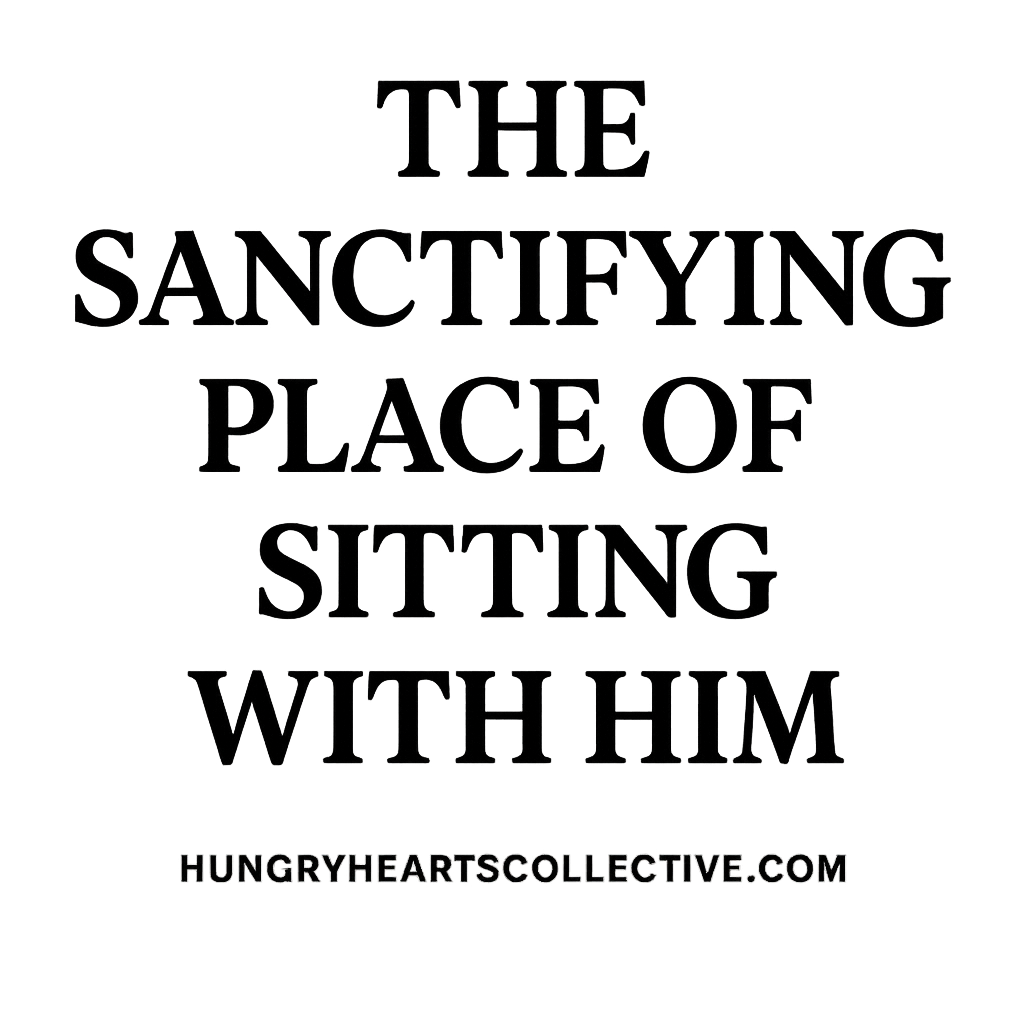
When you stop, He works.
When you rest, He sanctifies.
The Sabbath was never about religious restraint; it was about space—space in which God could act (cf. Exod. 20:8, Isa. 64:4, Psa. 46:10). Jesus Himself restored that meaning when He healed on the Sabbath, revealing that rest is not passivity but alignment (Luke 13:16). Stillness is not withdrawal. It is cooperation (cf. Psa. 46:10). This moment at the basin presses three questions into my own soul:
→ Why?
→ How?
→ Where?
And perhaps these are the very questions we silence by staying busy.
THE DEVIL’S BUSINESS IS BUSYNESS
LUKE 10:38–42
Business “protects” us from confronting what we are not solving on our own—it gives us the illusion of control.
WHY: “IF I DO NOT WASH YOU, YOU HAVE NO PART WITH ME”
We often approach Scripture as a task—something to complete, consume, or conquer—a checklist. Or we read it as distant history, informative but safely removed from our own lives. Both approaches protect us from being addressed, being helped, and being “saved.”
Jesus does not allow Peter that distance:
“If I do not wash you, you have no part/share/portion/allotment with Me.”
This is covenant language. To have a part, a portion, a share with Him is to participate in His life—His inheritance, His provision, His promises. The ‘why’ is confronting in its simplicity:
→ If we don’t go to Jesus, He cannot minister to us.
→ If Jesus does not minister to us, we cannot partake with Him.
→ If we refuse to be served by Him, we cannot share in what is His.
HOW: YOU CANNOT BE WASHED WHILE YOU ARE BUSY WASHING YOURSELF
Jesus cannot wash our feet while we are rushing about trying to “wash” ourselves from all our troubles and challenges on the road of life.
The disciples were not unclean men—they were dusty men. They had already been bathed. What clung to them was the residue of the road of life, the accumulation of ordinary living, the burdens, the daily grind and resulting anxious-mindedness.
→ “Washing” here speaks of Jesus meeting our inner need.
→ “Having a share with Him” speaks of our portion, our lived inheritance—the promised inheritance of the Father available in Christ (cf. 2 Cor. 1:20).
Yet we resist this spiritual posture/practice. We prefer effort to exposure, activity to intimacy, and movement to surrender. And so we remain unwashed—not because He is unwilling, but because we are unavailable.
WHERE: THE SECRET PLACE IS NOT A METAPHOR
Jesus can only do for us what He longs to do when we come to Him. After all, we are the ones who are lost—not Him.
The where is what Scripture calls “the secret [seter] place of the Most High” (Ps. 91:1), echoed again by Jesus Himself when He speaks of the door that is shut and the Father who sees in secret (Matt. 6:6).
In Hebrew this place is סֵתֶר (seter): my-seter-y (mystery), e-seter-ic (esoteric).
In Greek it is κρυπτός (kryptos): en-krypt—the secure private place of connection.
The secret place is not mystical escapism. It is hiddenness. Not secrecy, but privacy. Not absence, but encounter. It is shelter, provision and protection in the midst of the chaos, dysfunction and suffering on the earth—boētheia (refuge, aid, protection) and skepē (covering, shelter) in LXX.
ETYMOLOGY AND HISTORY DEEP DIVE
Consider the following (for those interested; otherwise, just skip to the next section.)
1. ΒΟΉΘΕΙΑ (BOĒTHEIA): AID, REINFORCEMENT, MILITARY ASSISTANCE
A. Thucydides—History of the Peloponnesian War (explicit military usage)
Greek (verbatim):
καὶ ἐπὶ τούτοις ἔπεμψαν πρέσβεις εἰς Σπάρτην περὶ βοηθείας.
(Thucydides, 1.25)
English:
“And in addition to this they sent envoys to Sparta concerning military assistance.”
Here boētheia refers specifically to armed reinforcement, not emotional or spiritual help. It is a strategic, martial term.
B. Xenophon—Hellenica (reinforcements in battle)
Greek (verbatim):
ἐπειδὴ δὲ οὐκ ἐγίγνετο βοήθεια, ἀνεχώρησαν.
(Xenophon, Hellenica 4.2.19)
English:
“But since no reinforcements came, they withdrew.”
Again, boētheia = troop support, the arrival of forces that determines victory or retreat.
C. Septuagint (LXX)—Psalm 45(46):2
(military + cosmic protection language)
Greek (verbatim):
ὁ Θεὸς ἡμῶν καταφυγὴ καὶ δύναμις, βοήθεια ἐν θλίψεσιν ταῖς εὑρούσαις ἡμᾶς σφόδρα.
English:
“God is our refuge and strength, a very present help in troubles.”
This psalm is saturated with war imagery (nations raging, kingdoms shaken). Boētheia retains its reinforcement sense—God as active defender, not passive comforter.
2. ΣΚΈΠΗ (SKEPĒ): COVERING, SHELTER, DEFENSIVE PROTECTION
A. Homer—Iliad (martial, physical protection)
Greek (verbatim):
ἀσπίδος ὑπὸ σκέπῃ.
(Iliad 5.453)
English:
“Under the covering of his shield.”
Skepē here is literal military cover—the shielding that keeps a warrior alive in combat.
B. Herodotus—Histories (political–military protection)
Greek (verbatim):
ὑπὸ τῇ Περσέων σκέπῃ γενέσθαι.
(Herodotus, 1.141)
English:
“To come under the protection of the Persians.”
This is imperial-military shelter—vassalage under a dominant power’s defence.
C. Septuagint (LXX)—Psalm 90(91):1
(theologically charged, but still military in origin)
Greek (verbatim):
ὁ κατοικῶν ἐν βοηθείᾳ τοῦ Ὑψίστου, ἐν σκέπῃ τοῦ Θεοῦ τοῦ οὐρανοῦ αὐλισθήσεται.
English:
“He who dwells in the help of the Most High shall lodge under the covering of the God of heaven.”
This verse pairs βοήθεια and σκέπη deliberately:
- βοήθεια = active intervention / reinforcement
- σκέπη = defensive cover / shelter
The imagery is siege warfare language transposed into theology.
SYNTHESIS
In ancient usage, these words are not sentimental:
- βοήθεια → reinforcements arriving to change the outcome of a battle
- σκέπη → cover that prevents lethal impact (shield, roof, fortress, imperial protection)
Psalm 91 is not “comfort poetry”; it is battlefield theology.
In short, it is the place where you find the help you long for.
Older Christians called it the prayer closet—that deliberate withdrawal from noise and demand, where one shuts the door for a moment to be alone with Jesus. Not to perform. Not to persuade. Simply to be washed.
Simply to receive what Jesus longs to give.
THE SHOCKING TRUTH ABOUT THE PROMISES OF GOD
Here is a clear, rarely spoken truth—one that, if grasped, changes what it actually means to be Christian:
You do not qualify for the promises of God. You never have. You never will. But the good news is, you don’t have to.
Romans 3:23, 6:23
No discipline, insight, or obedience can change that.
Only one has ever qualified—“For all the promises of God find their Yes in Him” (2 Cor. 1:20). The inheritance of the Father belongs to the Son, not to us.
Only when we belong to Christ does what belongs to Christ belong to us.
Even so, this inheritance is only entered by coming to where He is; for the scandal of grace is this—that Jesus summons us to partake in what He alone has earned. And the way into Christ is abiding intimacy:
“If I wash you…you can partake.”
You are not waiting for Jesus to come and rescue you in your situation. He is waiting for you to come to Him—so that He can do for you what you could never do for yourself.
This is not a once-off agreement. It is the daily surrender you voluntarily consented to when you said, “Jesus, I give You my life.”
The secret place of prayer is how that surrender is lived—quietly, repeatedly, relationally, daily.
Christianity is not a label; it is a spiritual practice of staying connected to Christ—it’s in the name: CHRIST-ianity.
Being a Christian is not an identity tag. It is the way of abiding.
A spiritual practice of stopping, sitting, and staying. Of letting yourself be served by God. And astonishingly, this is all He ever wanted.
Luke 13:8, John 15
It is all He ever needed to save you. He did what you couldn’t; now you must do what He can’t and come to Him—the next move is yours!
A DEVOTIONAL PRAYER
Father,
I step out of striving and into stillness.
I lay down my self-effort, my noise, my restless motion.Jesus, I come to You—not to prove myself, but to be washed.
Where the dust of the road clings to me, cleanse me.
Where weariness has settled in my soul, quiet me.Draw me into the secret place,
where I am hidden yet fully known.
Teach me to wait—not as delay, but as devotion.I choose abiding over busyness,
nearness over independence,
and rest over resistance.Amen.
DID THIS HELP YOU?
Then subscribe for more practical content like this.


Leave a comment