
AUDIO PODCAST
THE CHURCH THAT REFUSES TO GROW UP
We were never meant to remain children. Yet in many ways, the modern Church has become just that—stunted, soft, dependent, emotionally driven, and increasingly allergic to conflict, challenge, and responsibility. We have confused compassion with passivity, and nurturing with neglect. This is not the way of Christ.
Paul writes with piercing clarity in 1 Corinthians 13:11:
“When I was a child, I spoke like a child, I thought like a child, and I reasoned like a child. When I became a man, I gave up childish ways.”
The Church today, particularly in the West, has largely lost its masculine edge—not in terms of gender roles, but in terms of spiritual courage, strength, and maturity. We have become, as Søren Kierkegaard might observe, a generation of believers who have sentimentalised the Gospel and evaded the weight of divine responsibility.
We gather weekly not to be equipped for war, but to be coddled in a safe space.
FEMININE ENERGY VS MASCULINE RESPONSIBILITY
It’s no accident that the Church is described as a bride. She is meant to be radiant, responsive, and intimate with her Groom—Christ. But she is not meant to take His place. She is not the head; Christ is. When the feminine energy of the Church—nurturing, compassionate, empathetic—overpowers the masculine authority of God’s word and Spirit, imbalance sets in.
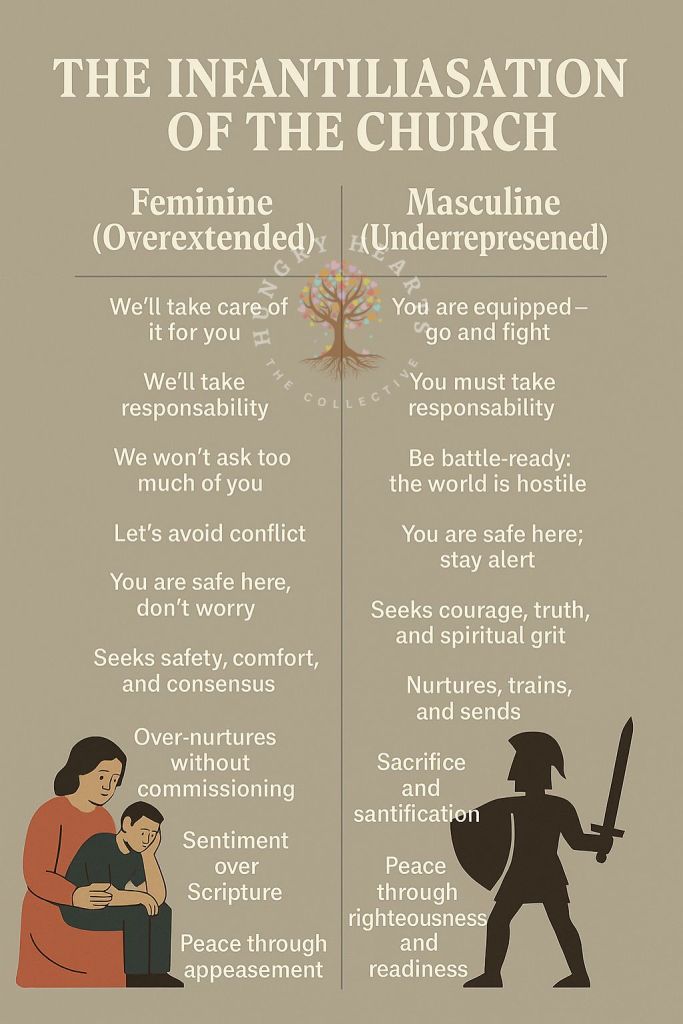
CONTRASTING DYNAMICS: THE FEMINISED CHURCH VS THE WARRIOR BRIDE
| Feminine (Overextended) | Masculine (Underrepresented) |
|---|---|
| “Seeks dependence” | “Seeks independence” |
| “We’ll take care of it for you.” | “You are equipped—go and fight.” |
| “We’ll take responsibility.” | “You must take responsibility.” |
| “We’ll pray for you.” | “You must pray for yourself.” |
| “We won’t ask too much of you.” | “You have a duty—step up.” |
| “Let’s avoid conflict.” | “Engage, be battle-ready; the world is hostile.” |
| “You are safe here, don’t worry.” | “You are safe in the secret place; don’t worry.” |
| Seeks safety, comfort, and consensus | Seeks courage, truth, and spiritual grit |
| Over-nurtures without commissioning | Nurtures, trains, and sends |
| Sentiment over Scripture | Sacrifice and sanctification |
| Peace through appeasement | Peace through righteousness and readiness |
It’s not that these feminine traits are wrong—they are essential. The Church is meant to comfort the brokenhearted, bind wounds, and welcome the weary. But these traits must be balanced by the masculine calling to equip, challenge, discipline, and prepare the saints for warfare (Ephesians 6:10–18).
As it stands, we have a Church that is warm but weak, loving but listless, and inclusive but immature.
The question we all must ask ourselves is whether we are part of the solution or part of the problem.
INFANTALISATION: A SOCIOLOGICAL PROBLEM, A SPIRITUAL PANDEMIC
Sociologist Neil Postman warned of the cultural shift toward the “disappearance of adulthood” in his seminal work The Disappearance of Childhood (1982), tracing how media, technology, and consumer culture blurred the lines between childhood and maturity. But this trend hasn’t just stayed in the culture—it’s bled into the Church.
Instead of spiritual adults, we are raising perpetual spiritual adolescents. Christians who demand to be “fed” rather than learn to feed themselves (Hebrews 5:12–14). Congregants who desire comforting sermons, not convicting ones. Disciples who want therapy, not training.
The historical Church was built on martyrs and warriors—people who knew the cost of following Christ. But today, we have exchanged the full armour of God for emotional support animals. We’ve swapped spiritual warfare for safe spaces, and robust theology for moralistic therapeutic deism.
THE BIBLICAL BLUEPRINT FOR GROWTH
The Scriptures are relentless in their call to grow up.
- Hebrews 5:12–14: “Though by this time you ought to be teachers, you need someone to teach you… You need milk, not solid food!”
- Ephesians 4:11–15: The role of apostles, prophets, evangelists, shepherds, and teachers is to “equip the saints for the work of ministry… until we all attain… to mature manhood.”
- Nehemiah 4:14: “Do not be afraid… Remember the Lord… and fight for your brothers, your sons, your daughters, your wives, and your homes.”
True love grows up. True faith strengthens. The goal of the Christian life is Christlikeness—and Christ is not just a shepherd but a King, not just a healer but a warrior. Rashi comments that the command (Neh. 4:14) is not merely defensive but a charge to communal honour, to uphold the name of God through action. Warfare, when divinely sanctioned, is not destruction—it is preservation of divine order.
WHERE DID WE GO WRONG?
Somewhere along the way, the Church became a nursery instead of a bootcamp.
Yes, we needed care. Yes, we needed trauma-informed pastors and a softer touch after centuries of legalism. But in overcorrecting, we raised a generation that doesn’t know how to stand.
The crisis of leadership is a crisis of discipleship. Many preachers now carry the burden of popularity, not responsibility. And the congregants have grown accustomed to being comforted, not commissioned.
But both leaders and laity are responsible.
- Leaders must stop enabling dependency and begin fostering independence and equipping for warfare.
- Congregants must stop outsourcing responsibility to others (clergy, ecclesiastical superstars) and begin embodying maturity.
The Church, like the Body it represents, thrives in balance—neither the masculine nor the feminine is sufficient on its own. The feminine brings nurture, compassion, and a safe space for healing; the masculine offers strength, direction, and the courage to face battle. Without the feminine, the Church grows hard, detached, and unapproachable. Without the masculine, it becomes soft, indecisive, and unwilling to confront evil. We need both to reflect the image of God fully—nurturing like a mother but also leading like a father; offering comfort but also calling believers into maturity, sacrifice, and responsibility.
PATHWAYS TO MATURITY
If we are serious about reversing the trend of infantilisation, we need a renewed vision for Christian maturity:
FOR PREACHERS:
- Preach the whole counsel of God (Acts 20:27), not just the soothing parts.
- Train, don’t just teach. Give your people spiritual reps—practical, missional responsibility.
- Call out greatness. Challenge the men and women in your church to grow, lead, and war in the Spirit.
- Model spiritual authority. Show what it looks like to walk in truth, power, and grace.
FOR THE BELIEVER (CONGREGATION):
- Own your discipleship. Take responsibility for your faith—study, pray, fast, and obey.
- Say yes to hardship. Maturity is forged in the fire, not the nursery.
- Stop outsourcing your spiritual life. Your pastor is not your saviour.
- Join the battle. Use your gifts to build the kingdom. Stop spectating.
SI VIS PACEM, PARA BELLUM
“If you want peace, prepare for war.” (Roman maxim, attributed to Vegetius)
The modern Church has often misunderstood peace. We have confused peace with passivity, gentleness with safety, and grace with indulgence. But biblical peace is not the absence of conflict—it is the result of righteous order being enforced and maintained in a fallen, chaotic world. And that order must often be contended for.
Nehemiah 4:14 gives us the masculine call to arms:
“Do not be afraid of them. Remember the Lord, who is great and awesome, and fight for your brothers, your sons, your daughters, your wives, and your homes.”
This is a world that crucified the Prince of Peace. If we are to follow Him, we must expect spiritual resistance, internal warfare, and external misunderstanding. Christ Himself declared:
“Do not suppose that I have come to bring peace to the earth. I did not come to bring peace, but a sword.” (Matthew 10:34)
The sword is not for violence—it is for defence and for taking ground. A mature Church is not simply a nurturing mother but a warrior bride—arrayed for battle, clothed in strength, and willing to confront when necessary.
WHY THIS IS ACTUALLY GOOD NEWS
At first glance, this may sound harsh. But in reality, it’s an invitation.
The call to grow up is the call to freedom. To become what you were created to be: strong, wise, courageous, and equipped. We are all longing for a Church that can raise mature sons and daughters, not spiritual dependents. This is how we truly honour the Bridegroom—by preparing ourselves for Him.
Yes, we need nurture. But nurture without challenge is captivity. And grace without growth is abuse.
Let us return to the pattern of Christ—who nurtures, then sends; who comforts, then commissions; who calls us children, then makes us heirs and warriors.
DEVOTIONAL PRAYER
Father,
forgive us for the ways we have loved comfort more than growth. We have made safe spaces out of sanctuaries and abandoned the armor you’ve given us. We confess our addiction to spiritual ease and our resistance to responsibility. But today, we ask You to awaken us. Mature us. Strengthen us. Make us ready for the real world—the world You love and died to save. Raise up fathers and mothers, sons and daughters, soldiers and saints. Help us grow into the full stature of Christ.
Amen.
FIVE QUESTIONS FOR REFLECTION
- Where in my spiritual life have I chosen comfort over growth?
- Have I embraced the full armour of God—or am I still asking to be “fed”?
- How have I contributed to a culture of infantilisation in the Church?
- What steps can I take to mature in faith and responsibility?
- How can I support others in becoming mature, battle-ready believers?
MEMVERSE
“Do not be afraid… Remember the Lord… and fight for your brothers, your sons, your daughters, your wives, and your homes.” (Nehemiah 4:14)
 The Hungry Hearts Collective
Leave a comment