
AUDIO PODCAST
CONTEXT: THE BOOK OF THE GENERATIONS
Genesis 5 opens with the phrase:
“This is the book of the generations of Adam.” (Genesis 5:1)
This marks a new toledot (תּוֹלְדֹת) section. The term literally means “generations, descendants, or histories.” This formula divides Genesis into key narrative units and serves as a literary anchor.
Where Genesis 4 detailed Cain’s descendants and their increasing corruption, Genesis 5 presents the righteous line of Seth, preserving the image of God.
VERSE-BY-VERSE BREAKDOWN
VERSES 1–2: CREATION RECAP
“In the day that God created man, in the likeness of God made he him; male and female created he them…”
- Echoes Genesis 1:26–28.
- Reaffirms human dignity and divine image.
- Notably plural: “male and female” – both bear God’s likeness.
- The phrase “blessed them” signals divine favour and fruitfulness.
VERSE 3: ADAM TO SETH
“Adam lived 130 years and begat a son in his own likeness…”
- Seth is born in Adam’s image, suggesting a transfer of fallen nature, though he carries the promise (see Genesis 4:25).
- The structure introduces the genealogy format:
- Name
- Age at son’s birth
- Lifespan after son
- Total years
- Death
This rhythm continues for each patriarch, reinforcing mortality—”and he died” becomes the tragic refrain.
VERSES 4–32: THE GENEALOGY
| Patriarch | Age at Son’s Birth | Years After | Total Lifespan | Notable Notes |
|---|---|---|---|---|
| Adam | 130 | 800 | 930 | Created in God’s image |
| Seth | 105 | 807 | 912 | Appointed seed (see Gen 4:25) |
| Enosh | 90 | 815 | 905 | Era when men began to call on the LORD |
| Kenan | 70 | 840 | 910 | — |
| Mahalalel | 65 | 830 | 895 | His name may mean “Praise of God” |
| Jared | 162 | 800 | 962 | Longest-lived before Methuselah |
| Enoch | 65 | 300 | 365 | Walked with God… and was not |
| Methuselah | 187 | 782 | 969 | Longest lifespan in Scripture |
| Lamech | 182 | 595 | 777 | Prophesied about Noah |
| Noah | 500 | — | — | Sons: Shem, Ham, Japheth |
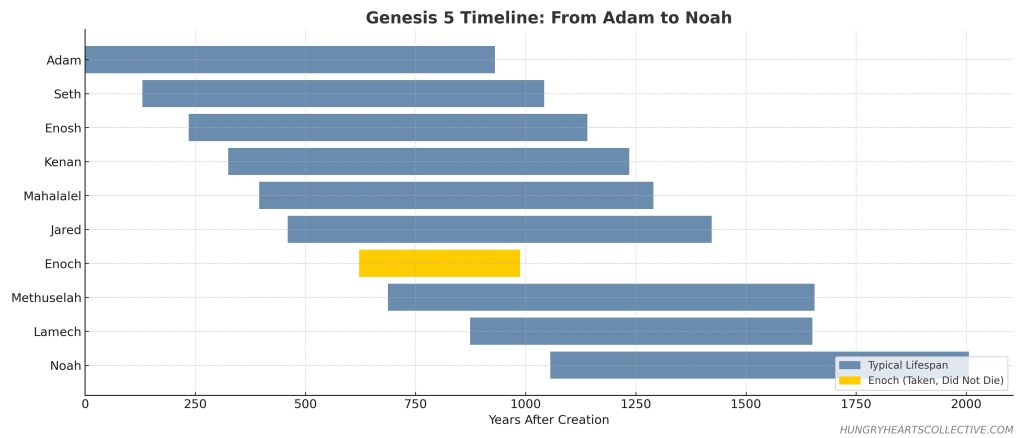
HIGHLIGHT: THEIR NAME WAS ADAM (EARTHLING)
Genesis 5:2 (KJV):
“Male and female created he them; and blessed them, and called their name Adam, in the day when they were created.”
ORIGINAL HEBREW (TRANSLITERATED):
זָכָר וּנְקֵבָה בְּרָאָם, וַיְבָרֶךְ אֹתָם; וַיִּקְרָא אֶת-שְׁמָם אָדָם, בְּיוֹם הִבָּרְאָם
| Hebrew | Transliteration | Meaning |
|---|---|---|
| זָכָר | zakar | male |
| וּנְקֵבָה | u’neqevah | and female |
| בְּרָאָם | bera’am | He created them |
| וַיְבָרֶךְ אֹתָם | vayevarekh otam | and He blessed them |
| וַיִּקְרָא אֶת-שְׁמָם אָדָם | vayikra et-shemam Adam | and He called their name Adam |
| בְּיוֹם הִבָּרְאָם | beyom hibbare’am | in the day they were created |
WHAT IF IT SAID “HIS NAME WAS ADAM”?
If it referred only to the male, the Hebrew would change to:
וַיִּקְרָא אֶת־שְׁמוֹ אָדָם
Vayikra et-shemo Adam
“And He called his name Adam.”
| Hebrew | Transliteration | Meaning |
|---|---|---|
| אֶת־שְׁמוֹ | et-shemo | his name |
This version uses the masculine singular possessive suffix ־וֹ (-o) meaning “his.”
KEY DIFFERENCE:
- שְׁמָם (shemam) = their name
- שְׁמוֹ (shemo) = his name
So Genesis 5:2 is not talking about Adam alone. It’s saying both the man and the woman were called Adam.
WHY THIS MATTERS
This subtle grammatical choice means:
- Humanity was originally named as one.
- Male and female shared the same identity before God.
- The verse supports a unified anthropology, not a hierarchy.
“ADAM” MEANS EARTHLING
The word Adam (אָדָם) is from the root:
- אדם (’a-d-m) – to be red, earthy
- Related to אֲדָמָה (adamah) – ground, soil
This reveals:
Humanity is called Adam because we are earthlings—formed from the dust, yet bearing the breath of God.
THEOLOGICAL AND PHILOSOPHICAL DEPTH
- If the verse had said “his name”, it would suggest that the identity of humanity is male-centred.
- But the actual text intentionally includes both male and female in the name Adam—emphasising oneness, mutual dignity, and collective purpose.
- In a following in-depth post we will look at how this impacts our understanding of “relationship”.
HIGHLIGHT: ENOCH – WALKED WITH GOD
“Enoch walked with God; then he was no more, because God took him.” (Genesis 5:24)
- Hebrew: וַיִּתְהַלֵּךְ חֲנוֹךְ אֶת־הָאֱלֹהִים – suggests continual, intimate fellowship.
- Enoch did not die — one of only two in Scripture (the other being Elijah).
- Jude 1:14–15 calls him a prophet who warned of judgment.
- A glimpse of resurrection hope and divine favour amidst death.
HIGHLIGHT: PROPHETIC TIMESCAPE:
Genesis 2:17 reads:
“But of the tree of the knowledge of good and evil, you shall not eat, for in the day that you eat of it you shall surely die.” (Genesis 2:17, ESV)
This solemn warning from God to Adam has perplexed many readers. Adam does not physically die on the calendar day he eats the fruit, yet God’s pronouncement is not metaphorical nor mistaken. Rather, it unfolds within a prophetic timescale—a heavenly clock not bound to 24-hour cycles.
1 Peter 3:8 echoes a key principle drawn from Psalm 90:4:
“But do not overlook this one fact, beloved, that with the Lord one day is as a thousand years, and a thousand years as one day.” (1 Peter 3:8, ESV)
“For a thousand years in Your sight are but as yesterday when it is past…” (Psalm 90:4)
If one divine “day” equals a thousand human years, then the phrase “in the day you eat of it…” can be understood through God’s eternal perspective. Adam died within that “day”—the first millennium of human history—physically dying at 930 years old (Genesis 5:5), not reaching the full span of a divine day.
This interpretation reveals at least three layers of prophetic significance:
1. THE LITERAL PROPHETIC DAY: A THOUSAND-YEAR LIMIT
Adam’s lifespan is curtailed before he reaches the thousand-year mark—fulfilling the warning. No human in Scripture lives past 1,000, underlining the curse of death on all Adamic descendants. This cements the millennial limit as a prophetic symbol of mortality:
“For dust you are, and to dust you shall return.” (Genesis 3:19)
Every human since Adam dies on the same “day” they were born—none survives the full divine millennium. Thus, the curse is precise, and the mercy is profound: Adam lives nearly a full prophetic day, but not beyond it.
2. THE SPIRITUAL DEATH IMMEDIATELY
While Adam’s body did not collapse instantly, he experienced spiritual death immediately. Separation from God, shame, fear, and exile all manifest that very day (Genesis 3:7–24). In this sense, Adam truly did die the moment he ate—cut off from communion, intimacy, and divine covering.
The Hebrew phrase used—moth tamuth (מוֹת תָּמוּת)—is an infinitive absolute, literally: “dying you shall die.” This denotes both immediacy and process: death begins spiritually and culminates physically, echoing Paul’s teaching:
“You were dead in your trespasses and sins…” (Ephesians 2:1)
3. THE MESSIANIC CLOCK BEGINS
Genesis 2:17 also begins the countdown to a redemptive intervention. The day man eats, death enters—but so does the need for a Saviour, setting in motion the promise of Genesis 3:15: the Seed of the woman who will crush the serpent’s head.
Jesus, the Last Adam (1 Corinthians 15:45), reverses the curse within another kind of “day”. He dies within a literal 24-hour day—but inaugurates the eternal Sabbath, the seventh-day resurrection reality.
He is the only one who can cross the divine threshold and usher humanity back into life beyond the thousand-year curse:
“Whoever believes in Me will never die” (John 11:26)
HEBREW HIDDEN MEANINGS: THE GOSPEL IN THE GENEALOGY?
Many have observed a potential Messianic foreshadowing in the meanings of the ten names from Adam to Noah:
| Name | Meaning |
|---|---|
| Adam | Man |
| Seth | Appointed |
| Enosh | Mortal |
| Kenan | Sorrow |
| Mahalalel | The Blessed God |
| Jared | Shall come down |
| Enoch | Teaching |
| Methuselah | His death shall bring |
| Lamech | Despairing |
| Noah | Rest, comfort |
Interpretation:
“Man (is) appointed mortal sorrow; the Blessed God shall come down, teaching that His death shall bring the despairing rest.”
Though debated, it underscores how the lineage points toward a Redeemer.
THEOLOGICAL THEMES
The Reality of Death
The repetition of “and he died” (וַיָּמֹת) hammers home the curse of Genesis 3. Death reigns—except with Enoch.
Divine Order and Legacy
Each generation is tied to the previous, showing that God’s promises pass through family lines. Faithfulness is generational.
Hope Amidst Judgment
Enoch and Noah are both signs of hope—one walked with God, the other will survive the flood.
COMMENTARIES
RASHI (MEDIEVAL JEWISH COMMENTATOR)
Rashi focuses on chronology, genealogical precision, and the significance of Enoch’s “walking with God,” which he interprets as a prematurely righteous man removed lest he become corrupt.
MATTHEW HENRY (REFORMED CHRISTIAN COMMENTATOR)
Henry sees this as a register of the visible Church. He draws moral lessons:
- Walking with God = a life of communion and obedience.
- Methuselah’s long life = God’s patience before judgment (Flood).
- Enoch’s translation = reward of holiness, anticipation of eternal life.
- Porphetic day = 1000 years.
DEVOTIONAL APPLICATION
“Are you walking with God, or merely existing?”
Genesis 5 is not just a list—it’s an invitation to walk as Enoch walked, to remember that our lives are part of a greater tapestry. The world says death wins, but this genealogy dares to hope otherwise.
🙏 PRAYER
Father, let me not just live long, but live right. Let my walk with You be so close, so uninterrupted, that heaven becomes the natural next step. May my life speak of Your promises through generations yet unborn. Amen.
QUESTIONS FOR REFLECTION
- Am I merely surviving or intentionally walking with God like Enoch?
- What legacy of faith am I building for future generations?
- How does the reality of death shape the way I live today?
- Do I recognise God’s mercy in the space between generations?
- What is God calling me to “birth” in my generation?
Like & Subscribe!
 The Hungry Hearts Collective
Leave a comment