
AUDIO PODCAST
WITHOUT SACRIFICE, THERE IS NO VICTORY
You can have anything you want—if you are willing to bring the sacrifice.
Let that settle.
This isn’t some catchy phrase—it’s a truth that’s been woven into human history since the beginning. Every civilisation, every faith, every tribe has known it deep down: if you want something sacred, something powerful, something lasting… something has to be given.
From ancient blood on stone altars to incense rising from mountaintops, people have always understood: no sacrifice, no victory. No offering, no authority. No cost, no breakthrough.
Every kingdom is built with blood. Every crown is shaped in fire.
And yet, somewhere along the way, we were taught to expect power without surrender, glory without the grind, deep transformation without truly offering anything up.
God doesn’t deal in shortcuts. He honours sacrifice.
THE GREAT DECEPTION: “IT IS FINISHED” MEANS YOU’RE FINISHED
We love to quote Jesus’ final words on the cross—“It is finished”—but few understand what was actually finished. Jesus didn’t cancel your role in the war; He cancelled the barrier. He tore the veil. He opened the throne room. He gave access.
But He never gave permission to retreat into passivity.
Do we really understand what was finished?
- Jesus didn’t end the battle.
- He ended the separation.
- He didn’t cancel your role in the war—He cancelled the barrier.
- He tore the veil.
- He opened the throne room.
- He granted access.
The apostle Paul writes:
“Therefore, I urge you, brothers and sisters, in view of God’s mercy, to offer your bodies as a living sacrifice—holy and pleasing to God—this is your true and proper worship.” (Romans 12:1)
Did you hear that? Your worship is not a song. Your worship is not a service. Your worship is your sacrifice.
Without sacrifice, you are not a worshipper—you are an observer. A fan. A consumer.
And spectators don’t shake kingdoms.
Worship that costs nothing changes nothing.
YOU CAN ONLY POSSESS WHAT YOU’RE WILLING TO SACRIFICE FOR
“We will possess only what the LORD our God gives us.” (Judges 11:24)
Here’s something we don’t talk about enough:
God’s already given you the promise. He’s already said yes. The inheritance is real. The door is open.
But just because something is given doesn’t mean it has been enforced or possessed. The written judgement must be enforced to become effective (Psalm 149:6-9).
- You still have to step into it.
- You still have to fight for it.
- And yes—you still have to sacrifice for it.
Because sacrifice activates covenant—and covenant activates God.
It’s when we honour our side of the covenant that we create the space for God to move on His.
He’s faithful, yes—but covenant isn’t one-sided. It’s a partnership. A sacred exchange.
God responds to what we bring.
And when we bring sacrifice, heaven brings power.
That’s how the Kingdom works.
That’s the part we often skip.
We talk a lot about God’s promises,we want the power, we want transformation, but we rarely ask what these require from us. We quote Scripture like it’s a guarantee… but we don’t always live like we believe it costs something.
Let’s be honest:
- We’ve learned to sound like royalty while living like prisoners.
- We declare breakthroughs we’ve never pursued.
- We speak of victories we’ve never trained for.
And then we wonder why we feel stuck. Why things don’t change. Why the Kingdom feels distant.
The truth?
You will only ever truly possess what you’re willing to sacrifice for.
God gives the promise—but you have to move. You have to let go of something. You have to step out, show up, give up comfort, and sometimes, risk looking foolish.
- No sacrifice? No possession.
- No cost? No crown.
So maybe the question isn’t, “God, when will You do it?”
Maybe the real question is, “What am I still holding onto that’s keeping me from stepping into what God already said is mine?”
His part is done. Now it’s your move.
IF IT DOESN’T COST YOU, IT’S NOT A SACRIFICE
Let’s be honest—we want God to move in our lives, but we don’t want to be uncomfortable.
And that’s exactly why so many of us stay stuck. Real sacrifice is uncomfortable. It stretches you. It costs you.
It requires something that actually hurts to give. If it doesn’t cost you anything, it isn’t a sacrifice—it’s a tip.
King David understood this. When someone offered him a free gift to sacrifice to God, he refused and said:
“I will not offer to the LORD my God that which costs me nothing.” (2 Samuel 24:24)
He knew what we often forget: you don’t honour God by taking the easy way out. You honour Him when you bring Him something that matters to you—something that costs.
And here’s the hard truth most people don’t want to face:
When you avoid the discomfort of sacrifice, you don’t avoid pain—you just trade it for another kind.
A longer, slower, more drawn-out suffering. The pain of delay. The ache of wasted years. The frustration of seeing no breakthrough because you keep choosing what’s easy over what’s right.
- Sacrifice hurts—but it heals.
- It cuts—but it also frees.
- It costs—but it moves heaven.
So maybe the thing that feels too hard to give up…
is the very thing standing between you and the life God already said is yours.
And the longer you avoid it, the longer you stay outside the promise.
AVOIDING SACRIFICE KEEPS YOU IN THE DESERT
The story of the Israelites wandering forty years in the desert isn’t just history—it’s a living picture of what happens when we refuse to pay the price for what God has promised. God set before them a Promised Land—rich, flowing with milk and honey. But they stayed stuck, wandering, lost, and tired. Why? Because they were unwilling to trust, to fight, to sacrifice what it took to enter in.
And the same is true for us today.
When you avoid sacrifice, you stay in the desert—wandering in frustration, delay, and disappointment. You know there’s a promise waiting, but it never seems to arrive. You hear the call, but you hesitate to step forward.
Sacrifice is the doorway into that new life. Without it, you’re stuck in the wilderness of what-ifs and almosts.
Yes, sacrifice demands discomfort and cost. But it’s the path that leads from wandering to resting—from longing to possessing—from desert to Promised Land.
If you keep holding back, you’ll keep circling the same old wilderness.
The Promised Land is waiting—but you have to cross the desert to get there.
THE PROTESTANT PENDULUM: SWUNG TOO FAR
In fleeing the legalism of Catholicism, Protestant theology swung the pendulum too far the other way. What began as a rightful restoration of grace—correcting the “pay-for-play” distortion—ended up becoming a doctrine of disengagement.
- Faith without works.
- Victory without warfare.
- Grace misunderstood as a licence to opt out of sacrifice, rather than the power to embrace it.
But the truth is this: Jesus didn’t die so you could avoid sacrifice. He died so your sacrifice would finally count—to restore the altar within you, the place where heaven and earth meet. Grace isn’t a get-out-of-jail-free card.
It’s the fire that ignites your willingness to give, to suffer, to surrender. It empowers your offering so it becomes a living, breathing act of worship and warfare.
When we forget this, we lose the power and purpose of the Cross. We reduce it to a ticket to ease, not a call to courageous devotion.
GOD IS STILL A GOD OF SACRIFICE
“Not by might, nor by power, but by My Spirit, says the LORD of Hosts.”
— Zechariah 4:6
The victory still comes from God. But that victory is invoked by sacrifice. Not because God is egotistical. Not because He’s like the gods of Olympus, petty and hungry for homage.
No.
Because He gave you dominion.
“Let Us make man in Our image… and let them have dominion…” (Genesis 1:26)
This world is a lease. A vineyard given to tenants. (Matt. 21:33) God owns it—but He entrusted it to us. He does not enter where He is not invited. He does not override where you have already made agreements. And that, dear reader, is the crux of the matter. Don’t believe me? Then listen to Jesus:
“Behold, I stand at the door and knock. If anyone hears my voice and opens the door, I will come in and eat with that person, and they with me.” (Revelation 3:20)
Jesus stands ready to enter—into your heart, your life, your altar. But the invitation requires a response. It demands that you open the door, that you make space through sacrifice and surrender.
WHAT WILL YOU GIVE JESUS TO EAT?
In the verse we just looked at, Jesus says:
“I will come in…and eat…with that person, and they with me.”
At first glance, this sounds like a warm invitation to fellowship—a shared meal between friends. But the biblical symbolism runs much deeper. In the ancient Near Eastern world, eating together was a profound sign of covenant fellowship and mutual commitment. It wasn’t just a casual meal; it was a sacred act sealing relationship and loyalty.
But what exactly will Jesus eat?
The answer lies in the heart of sacrificial worship. In the Old Testament, the sacrifice itself was called the food of God. Exodus 29:33 (and similarly in Leviticus 1:9) says,
“And anyone who comes near shall be holy. And the altar shall be most holy, for the food of your God is on it.“
The “food” God desires is not mere ritual, but the heartfelt offering—the sacrifice of praise, thanksgiving, obedience, and surrender. This is what Paul is referring to in Romans 12:1.
Jesus further explains this process in Luke 17:7-10:
“Suppose one of you has a servant plowing or looking after the sheep. Will he say to the servant when he comes in from the field, ‘Come along now and sit down to eat’?
No, he will say, ‘Prepare my supper, get yourself ready and wait on me while I eat and drink [communion],
You may eat and drink after I have finished.’
Will he thank the servant because he did what he was told to do?
So you also, when you have done everything you were told to do, should say, ‘We are unworthy servants; we have only done our duty.’”
In biblical hospitality, the servant would first gird himself, attend to the needs of the master, and only then partake in the meal. This sacred sequence—sacrifice, service, and communion—reveals a divine order that we too often overlook.
We forget our place before God and crave to sit down and be fed the bread of healing, deliverance, and divine presence without first offering ourselves (Romans 12:1, Psalm 40:6-8) in humble service. Yet this desire echoes the ancient temptation in Eden: “Eat, and ye shall be as gods” (Genesis 3:5).
As Rashi insightfully comments, it is precisely this reversal—seeking to receive before surrendering—that perpetuates chaos, dysfunction, and suffering in our lives. True restoration and peace come only when we embrace the discipline of sacrifice—feeding God—and serve with a willing heart before claiming the promises God has prepared.
The simple truth is this: we don’t get to eat because He doesn’t get to eat. When the servant refuses to serve the master, the table remains empty for both. But this is something we can easily fix—if only we choose to.
When Jesus says He will eat with us, it is as if He is saying,
“I will partake of your sacrifice, your surrender—the offering you bring as your side of the covenant.”
He will enter into intimate fellowship with the one who opens the door through sacrifice and obedience.
Your sacrifice is the food of your God. It feeds Him, satisfies Him, and creates the space for His presence to dwell within you. When He is satisfied, you will also be satisfied—receiving not only what you desire but far more beyond.
This is why sacrifice is never just about giving something up; it’s about opening a table for communion, where heaven and earth meet, and where transformation begins.
YOUR LIFE IS POWERLESS BECAUSE YOUR ALTAR IS EMPTY
Look around. At your life. At the church. What do you see?
If your spiritual life feels dry, weak, stagnant—it’s not because God failed. It’s because your altar is cold.
Your spirit may be saved, but your soul is rented out—piece by piece—to lesser gods i.e. careers, relationships, pensions, governments, experiences, consumerism etc.
Some of you made secret agreements.
- You agreed to trade your peace for popularity.
- You agreed to trade your calling for limited comfort.
- You allowed areas of your life to become neutral zones.
- And the devil took them. And now he has a foothold.
But mark this: he is never satisfied. If you do not evict him through spiritual warfare, he will expand his claim.
“But if you do not drive out the inhabitants of the land… those you allow to remain will become barbs in your eyes and thorns in your sides.” (Numbers 33:55)
This is not a metaphor. It is an ancient law. You either drive out or get driven out.
WARS FOUGHT BETWEEN GODS, NOT NATIONS: THE STRUGGLE FOR DIVINE DOMINION
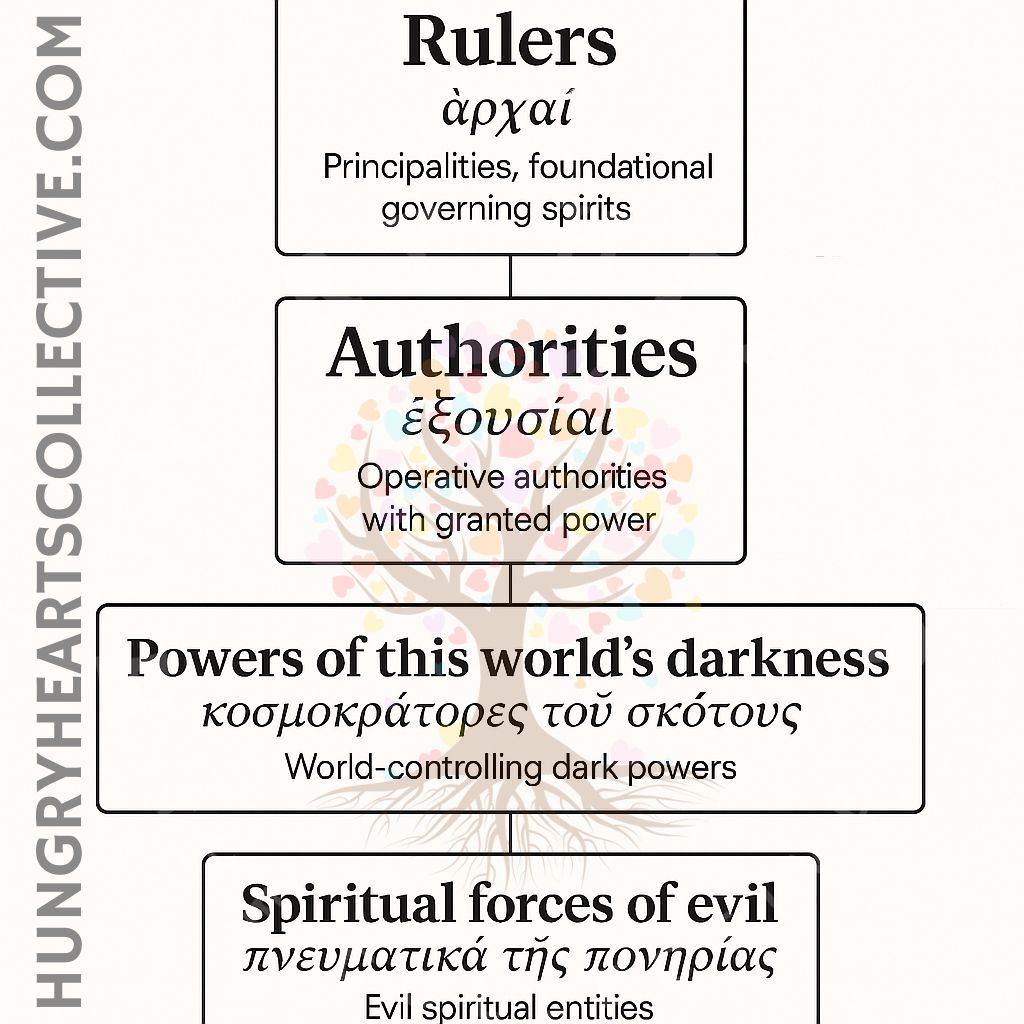
EPHESIANS 6:12 IN CONTEXT
“For our struggle is not against flesh and blood, but against the rulers [archas], against the authorities [exousias], against the powers of this world’s darkness [kosmokratoras tou skotous], and against the spiritual forces of evil [pneumatika tēs ponērias] in the heavenly realms [en tois epouraniois].”
— Ephesians 6:12 (Greek transliterated)In the ancient worldview—whether Israelite, Babylonian, Assyrian, or Chinese—wars were understood fundamentally as cosmic battles between gods, waged through human armies. Nations sought not only to conquer land but to possess the very divine power embodied in their gods’ sacred symbols and idols.
The outcome of war reflected which deity held supreme authority—and the woshippers, enjoyed the lands these gods controlled.
GREEK TERM DEFINITIONS TABLE
| English Phrase | Greek Term | Transliteration | Meaning / Definition |
|---|---|---|---|
| Rulers | ἀρχάς | archas | Principalities, chief rulers, origin or beginning powers; foundational spiritual powers. |
| Authorities | ἐξουσίας | exousias | Authorities or delegated powers; those who exercise jurisdiction or dominion. |
| Powers of this world’s darkness | κοσμοκράτορας τοῦ σκότους | kosmokratoras tou skotous | World-rulers of darkness; cosmic powers governing this present age of moral darkness. |
| Spiritual forces of evil | πνευματικὰ τῆς πονηρίας | pneumatika tēs ponērias | Wicked spiritual beings; malevolent non-physical entities with evil intent. |
| In the heavenly realms | ἐν τοῖς ἐπουρανίοις | en tois epouraniois | In the heavenly spheres; the spiritual dimension or realm above the physical. |
Paul is not simply listing generic evil—he’s describing a spiritual hierarchy, almost like a satanic bureaucracy operating behind world systems, controlling countries, regions, cities, families, people etc. Each term reflects a different tier or function:
- Archas (ἀρχάς) = Foundational governing spirits (e.g., regional strongholds).
- Exousias (ἐξουσίας ) = Operative authorities with granted permission.
- Kosmokratoras (κοσμοκράτορας ) = World-controlling dark powers (e.g., demonic empires or ideologies).
- Pheumatika tēs ponērias (πνευματικὰ τῆς πονηρίας) = Evil spiritual entities—deceitful, manipulative spirits.
This passage underscores that spiritual warfare isn’t chaotic—it’s organised.
THE ANCIENTS WERE SPIRITUALLY SAVVY
The repeated biblical theme of conquering peoples desiring to capture or possess the idols of their enemies as trophies or symbols of divine authority, demonstrates the anscient understood the hierarchy of power and authority. The Israelites themselves were warned not to covet or adopt the false gods of defeated nations (Deuteronomy 7:25-26), and yet the enemy’s gods were seen as tangible sources of power that could be won or lost.
One of the most profound examples is the story of the Philistines capturing the Ark of the Covenant (1 Samuel 4), the sacred chest representing (“containing”) the presence of Yahweh. The Philistines hoped that seizing the Ark would bring them victory and divine favour; yet, it turned out disastrous for them.
The story of the Philistines capturing the Ark of the Covenant (1 Samuel 4) powerfully illustrates the ancient belief that possession of a god’s sacred symbol could tip the balance of power. The Ark represented Yahweh’s presence and power in battle, and thus, the potential power to control territory. The Philistines coveted it, hoping to claim divine favour.
Similar motifs appear in ancient Near Eastern texts:
- Babylonian: In the Enuma Elish, the god Marduk defeats the chaos goddess Tiamat and establishes order, becoming the king of gods and granting kingship to humans as his representatives. Marduk’s victory over Tiamat symbolizes divine supremacy essential for cosmic and earthly order:
“Marduk split her like a shellfish into two halves; with one he made the sky, with the other the earth.” (Enuma Elish, Tablet IV) - Assyrian: Assyrian kings often invoked Ashur, their war god, as the divine force behind their conquests. Royal inscriptions boast:
“Ashur, the great lord, who goes before me in battle, has given me victory over my enemies.” (Tiglath-Pileser III) - Chinese: Ancient Chinese texts such as the Classic of Poetry and Shujing reflect belief in the Mandate of Heaven, where divine approval determines the right to rule and the outcome of conflicts:
“Heaven grants the throne to those who govern with virtue and withdraws it from those who fail.” (Shujing, Book of Documents)
Moreover, battles were often seen as struggles between cosmic forces or deities whose favour was won by ritual and moral conduct.
The Bible vividly portrays this spiritual reality. Jephthah’s firm declaration to the Ammonite king captures it succinctly:
“Will you not possess what Chemosh your god gives you? So whatever the LORD [Eternal One] our God has dispossessed before us, we will possess it.” (Judges 11:24)
Here, territorial conquest is inseparable from divine sovereignty—the land and its fortunes belong to whichever god triumphs, who gives it to those who serve (sacrificial worship) appropriately.
Ancient Near Eastern texts, such as the Ugaritic Baal Cycle, portray similar cosmic struggles. Baal’s defeat of Yam, the sea god, symbolizes the establishment of order over chaos — a divine victory that earthly kings and armies mirrored by conquering their enemies and seizing their sacred idols:
“Baal stood on the mountaintop and smote the sea; he scattered the chaos with his thunderbolt.” (Ugaritic text, c. 14th century BCE)
Thus, in the ancient mind, warfare was the theatre where gods wrestled for dominion, and nations sought to capture the very essence of their enemy’s god through idols and sacred objects. The possession of these divine symbols signified not only political control but spiritual supremacy—a truth still echoed in the Scriptures and ancient writings alike.
THE DEEPER REALITY: SACRIFICE AS COSMIC PARTNERSHIP
Let’s be clear. Sacrifice is not manipulation. It’s not superstition. It is alignment.
- It is you saying, “God, I surrender control of this area back to You,” beginning with my corner of creation— My body.
- It is you reasserting your allegiance and alignment with God—you become the the sacred portal for God to enter through.
- It is you withdrawing legal rights from hell and reinstating Heaven’s claim.
- Sacrifice is scratching an itch that only humans can scratch, so that God can scratch an itch only He can scratch.
Through sacrifice, you become an open gate, a Jacob’s ladder, a mobile Eden, an altar-walking priesthood of power. Your divine calling is priestly at its core—to stand in the sacred space between heaven and earth, offering the sacrifices that align earth with the will of God. This is your spiritual service: to mediate, to intercede, and to bring offerings—of praise, of obedience, of your very life—that draw down heaven’s reality into earthly manifestation.
“You also, like living stones, are being built into a spiritual house to be a holy priesthood, offering spiritual sacrifices…” (1 Peter 2:5)
You become what Jesus paid for. You become what the world needs.
THE ALTAR IS WAITING
This is not the hour for half-hearted offerings.
The world is groaning for deliverance, nations are trembling on the edge, and heaven is still searching for living sacrifices—those who will say, “Here I am. Send me. Spend me.” Not because they are qualified, but because they are willing. God qualifies the willing, those who serve sacrificially.
The truth is simple: if your altar is empty, your authority is too. If your fire has gone out, it’s not because God moved—it’s because the offering stopped.
You were never meant to live a powerless, passionless, fruitless life. But you cannot walk in resurrection power if you refuse the grave of self. You cannot claim covenant promises while avoiding covenant cost.
You cannot sit with Him at the feast if you never fed Him from your fire.
There is only one way forward. Build the altar. Lay it down. Light the fire.
The God who answers by fire is still watching. And when He sees sacrifice—He comes. So let the smoke rise again. Let your life become the food of your God. And let the earth shake as heaven responds.
Because without sacrifice, there is no victory. But with it…The Kingdom advances. And hell cannot stop you.
DEVOTIONAL PRAYER
Father,
I come to You today with trembling but with boldness. I lay down my life afresh upon the altar. Not my will, but Yours. Burn away what must die. Raise up what must live. Let my life be a living, breathing offering. Possess me fully, that I may possess all You’ve given. I declare: I am not my own.
I belong to You. Amen.
MEMORY VERSE
“Present your bodies a living sacrifice… this is your spiritual act of worship.”
— Romans 12:1
REFLECTION QUESTIONS
- What is one thing I’m currently holding onto that I need to let go of in order to step into God’s promise?
- In what area of my life am I avoiding sacrifice because of fear or discomfort?
- How can I intentionally offer my life as a living sacrificial prayer today?
- What would it look like to move from being a consumer of faith to an active worshipper through sacrifice?
- Am I ready to trust God enough to walk through the desert, knowing the Promised Land is on the other side?
Like & Subscribe!
 The Hungry Hearts Collective
Leave a comment