
AUDIO PODCAST
PRAYERLESSNESS: THE SILENT KILLER OF SOULS AND SOCIETIES
Have you noticed how exhausted and distracted our world has become? Prayerlessness is no longer a private issue—it’s a collective crisis. We settle for a defeated, sick, and dysfunctional ‘normal’, while the spiritual air we breathe grows thinner every day. Without prayer, nations decay. Without prayer, families disintegrate. Without prayer, the Church becomes a wilted plant, too fragile to stand upright.
Why? Because prayer is not an accessory. It is a root system. Prayer connects us to the Source of life and strength. As Jesus said, “Without me, you can do nothing” (John 15:5).
Imagine if the promises of God were true. What if every ‘all things are possible’ (Matthew 19:26) became your daily experience? What if ‘ask, and it will be given’ (Matthew 7:7) shaped your reality? What if ‘you will seek me and find me when you seek me with all your heart’ (Jeremiah 29:13) became the lens for every crisis?
If this was true (and it is), how can we justify prayerlessness?
KNOW WHAT YOU ARE FIGHTING FOR
A compelling prayer life rests upon a compelling vision.
What is worth fighting for? What is worth aligning your heart, time, and thoughts with? What victories must be won? What chains must be broken? What breakthroughs must be claimed?
As Tony Robbins puts it:
– Freedom: breaking free from fear and bondage and gaining your autonomy.
– Mastery: becoming proficient at gaining dominion over the forces that seek to dominate you.
– Purpose: aligning with a higher calling and living for something greater in service to others.
There is no higher cause for which we can live than to give ourselves wholly to prayer — in service to God and in service to others. The freedom we claim is not won by our own strength, but granted by the sovereign hand of God (Zechariah 4:6). When we seek first His dominion — His Kingdom — we align ourselves with His purpose for both mankind and ourselves, and He, in turn, adds to our lives what we could never obtain by our own striving (Matthew 6:33).
To master the art of prayer is one of life’s greatest accomplishments. As the saying goes, “It is better to learn how to pray than to obtain a college education.” Unless we govern ourselves and discipline ourselves to seek the secret place of prayer, we risk being governed by tyrants. True autonomy, genuine service, and profound purpose are birthed and sustained in the mastery of prayer.
Design your prayer life around this holy ‘Why’.
PRAYER MECHANICS: MOTIVATION & ABILITY
Authority comes from submission. Submission comes from alignment. Alignment comes from abiding prayer.
“Submit yourselves, then, to God. Resist the devil, and he will flee from you” (James 4:7)
“If you abide in me and my words abide in you, ask whatever you wish, and it will be done for you” (John 15:7)
👉 If we do not abide, we do not align.
👉 If we do not align, we do not have the authority to resist the enemy.
👉 A prayerless life is a powerless one.
THE PRAYER FORMULA
Have you ever wondered why some people pray more easily and others struggle? The mechanics of prayer can be understood through a simple formula:
Bm = M × A
B (Behaviour modification) = Motivation × Ability
If your motivation is low, your ability must be higher for prayer to occur — for example, having built strong habits. Conversely, when motivation is high, you can pray deeply even if your ability (skill or routine) is low.
The graph below illustrates this interplay:
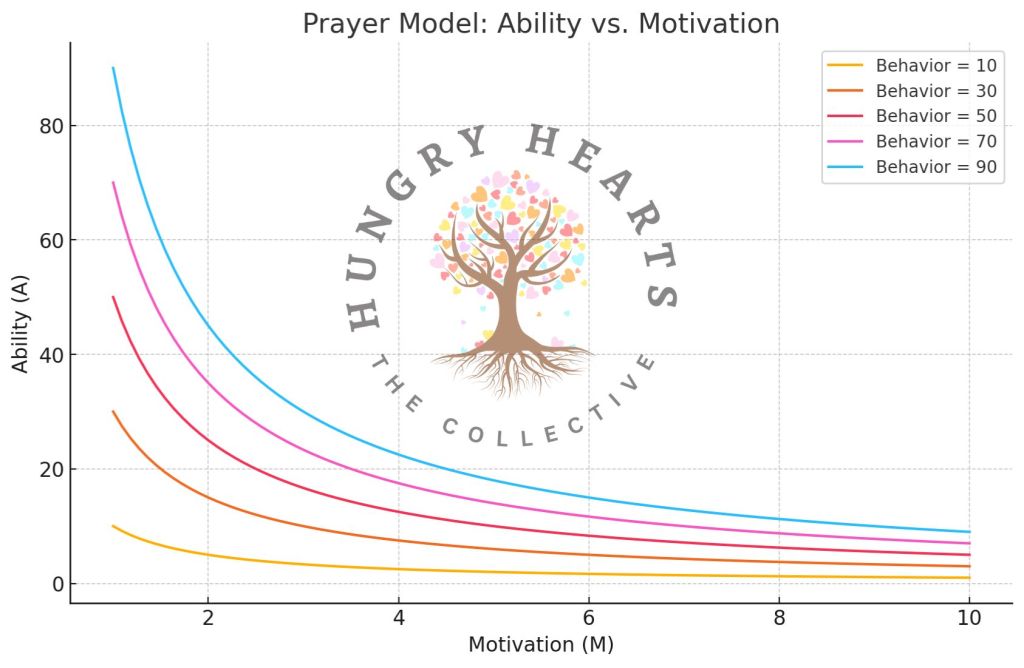
Motivation on the X‑axis and Ability on the Y‑axis.
Each line represents a target “Behaviour” level. You can clearly see:
✅ At low Motivation, you must have very high Ability to achieve a desired result.
✅ As Motivation increases, required ability decreases—making prayer more attainable.
Lesson: Either deepen your ‘why’ (motivation) or build stronger prayer habits (ability). Ideally, cultivate both for a robust and fruitful prayer life.
THREE EXAMPLES
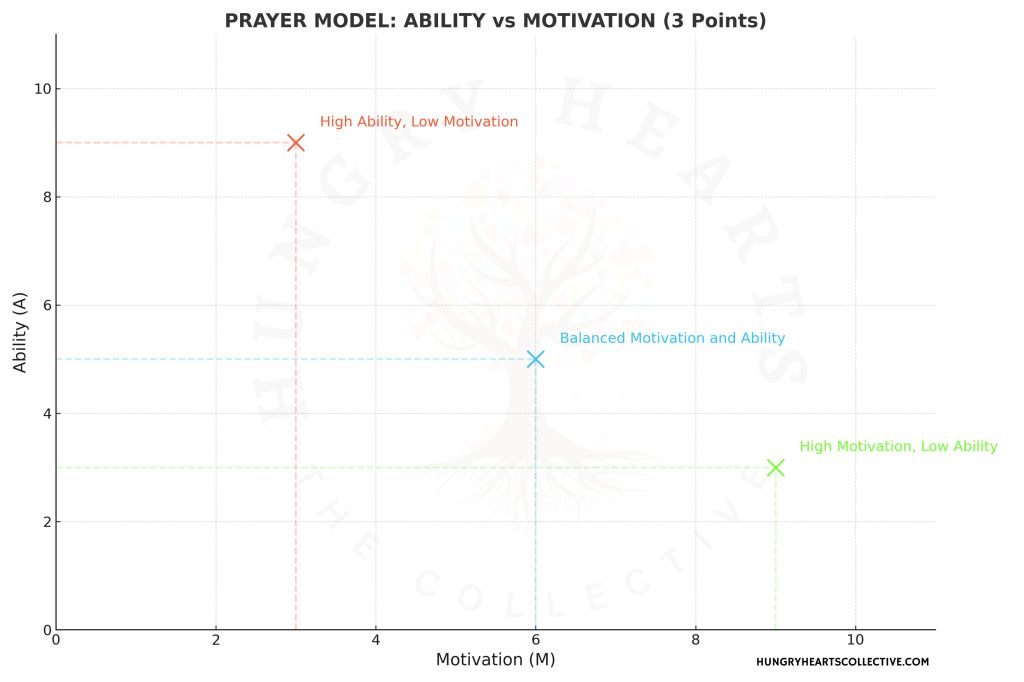
EXPLANATION:
- Point 1 (High Ability, Low Motivation)
(Orange Point: M = 3, A = 9)
Represents those with strong prayer habits, structure, or discipline (high ability), but low emotional drive (motivation). They can pray even when their feelings lag. - Point 2 (Balanced Motivation and Ability)
(Blue Point: M = 6, A = 5)
Represents a balanced prayer life—enough motivation to pray, combined with enough structure or routine (ability). This point captures the ideal rhythm for many. - Point 3 (High Motivation, Low Ability)
(Green Point: M = 9, A = 3)
Represents moments when deep spiritual hunger and emotional drive (personal challenges) compensate for a lack of routine or developed discipline. Motivation can carry prayer even when structure is minimal.
Each point illustrates a different approach to prayer. The goal is to gradually move towards balance—nurturing both motivation and ability—so that prayer becomes a deeply rooted, sustainable practice.
YOU NEED A TRIGGER
All that becomes pointless unless information translates into action, and that is why we psychologically need a trigger. All the goodwill in the world is useless unless you have a way to anchor it into reality.
Spirituality is anchored in practicality—in practices that can be repeated and embodied every day. The “trigger” is the bridge between intention and action, between desire and discipline. It is the cue—a moment already embedded in your routine—that reminds you to pray. This could be as simple as the moment your feet hit the floor in the morning, the making of your first cup of coffee, or the quiet space after putting the children to bed. By attaching prayer to an existing habit, you reduce the mental friction required to pray and make it as natural as breathing. The trigger becomes the faithful alarm clock of your spiritual life, reminding you that prayer is not an interruption of your routine, but its very heartbeat.
This leaves us with a formula that is more than a good idea — it becomes a real, tangible tool for spiritual transformation. Here is the modified formula:
(Bm = M × A) t
Bm = Behaviour (a prayer life that actually happens)
M = Motivation (your compelling ‘why’)
A = Ability (your skill, routine, and environment)
t = Trigger (the cue that anchors intention to action)
TRIGGER: Link prayer to an existing routine:
– Upon rising
– Making your morning coffee
– Before scrolling social media
– At a designated alarm
This formula reminds us that prayer is not just about feelings or abstract ideals. It’s about creating a concrete pathway from intention to practice. The ‘t’ is the pivotal piece—the link between the unseen desire and the actual act. Motivation can carry you for a moment. Ability can build long-term strength. But it’s the Trigger that connects these elements to reality, making prayer a daily rhythm rather than a rare event. Together, this formula transforms prayer from a hopeful thought into a habitual force, aligning your heart, hands, and habits with the life-changing presence of God.
AND WHILE WE’RE ON THE TOPIC, FORGET ABOUT FEELINGS
Feelings don’t take you where you want to be—they only tell you where you already are. They’re indicators, not guides. Too many people wait until they ‘feel like praying’ before committing to prayer, and this is a trap that guarantees inconsistency and spiritual stagnation. If you want to feel love for God, don’t wait for an emotion to arise spontaneously — begin by loving. Spend time with Him intentionally. Sacrifice moments from your day as an investment in your relationship with Him. Show up when it’s convenient and when it’s costly. Then, and only then, will the feelings follow. Prayer is an act of obedience first, a declaration of trust second, and only after that does it become a flood of intimacy that transforms both heart and life. Remember Jesus’ words:
“The spirit is willing, but the flesh is weak” (Matthew 26:41).
This is why, even when your body resists, you must intentionally bring it to prayer and present your flesh to God as an act of faith and surrender (Romans 12:1).
THE PLANT ILLUSTRATION
A wilted plant doesn’t stand tall by sheer willpower. It needs water, sun, and nutrients. Its environment isn’t the problem—it’s how it absorbs what is available. The same applies to prayer. Jesus said,
“I am the vine; you are the branches. Whoever abides in me and I in him, he it is that bears much fruit” (John 15:5).
Abiding isn’t about striving harder or forcing growth; it’s about positioning ourselves to drink deeply of His presence, daily and faithfully i.e abiding.
In the same way you can’t expect a plant to spring up the moment you water it, you can’t expect your life to transform instantly because you spent five minutes in prayer. The seed needs time to germinate, the roots must sink deep, and the sap must rise until the whole plant is strengthened from within. Prayer is an investment—a slow, quiet, and consistent work that forms a strong trunk and deep roots. Stay faithful. Keep showing up. The fruit will come, in its season, as you continue to abide.
Having said that, you will begin to notice a subtle but undeniable difference as the “internal spiritual pressure” starts to build within you, similar to hydrological pressure in a plant increases as it absorbes the water it needs. This effect can be felt sometimes within mere hours, often growing steadily over the course of several days. This pressure is not a burden but rather a sacred internal fortitude, a rising momentum deep within your spirit that signals transformation underway. It is the stirring of something greater—an awakening—as your spirit aligns more closely with divine purpose and truth.
As you remain consistent in your spiritual practices—whether through prayer, meditation, worship, or simply abiding in God’s presence—this pressure intensifies, becoming a powerful force that fuels your growth. It stretches and strengthens your inner being, gradually expanding your capacity to endure, to discern, and to manifest the fruit of the Spirit in your daily life. The more faithful and persistent you are, the more this internal strength multiplies, equipping you to overcome challenges with greater resilience and peace.
In time, this growing spiritual pressure will transform from a quiet stirring into a sustained, empowering energy that carries you forward. It will become the foundation upon which your character, faith, and purpose stand firm—unshakable amidst the storms of life. So, take heart and be encouraged: consistency is the key. Just as pressure in the natural world can forge diamonds, so too does this internal spiritual pressure refine and perfect the precious vessel of your soul.
BUILDING YOUR PRAYER STACK
Think of a prayer routine like a supplement stack. Each element works in synergy:
| Element | Purpose |
|---|---|
| Praise | Entering the gates (Psalm 100:4), focusing on God. |
| Forgive | Forgive and be forgiven (Matthew 6:14). |
| Petition | Making requests based on His promises. |
| Intercession | Praying for others, aligning your heart with God’s heart. |
| Listening | Quiet moments that enable the Holy Spirit to speak. |
| Thanksgiving | Sealing prayers in advance (Philippians 4:6). |
Why pray the promises? We pray the solution, NOT the problem. We pray as those aligning ourselves with the heart and word of God.
To pray the solution instead of the problem is to shift the focus of our heart and words from the weight of the circumstance to the weight of God’s promises. It is choosing to stand upon His truth and to claim His victory, rather than allowing ourselves to be drowned by a constant rehearsal of the crisis we face. In doing so, we align ourselves with the reality of His kingdom—declaring life, peace, and breakthrough where fear, doubt, and defeat would otherwise have a voice. True prayer is not an echo of the problem, but a declaration of the answer found in Him.
God doesn’t need a history lesson — He already knows every detail of the situation we face. What He delights in, however, is when we come to Him not to rehearse the problem, but to ‘remind’ Him of His promises (Isaiah 43:26). This is not for His benefit, but for ours. As we pray His words back to Him, we align ourselves with His will and reaffirm our trust in His character and covenant.
Through the Prophet Isaiah, the Lord Himself invites us, ‘Put me in remembrance; let us argue together; set forth your case, that you may be proved right’ (Isaiah 43:26). In doing so, we fix our hearts upon His faithful nature and fix our prayers upon His eternal word. The psalmist reminds us, ‘Forever, O Lord, your word is firmly fixed in the heavens’ (Psalm 119:89), and “He is ever mindful of His covenant, the promise He made, for a thousand generations.” (Psalm 105:8). And it is upon that unfailing word that our prayers find their foundation.
So when we pray, we are not educating God about the situation—we are anchoring ourselves to His promise, reminding ourselves and declaring before Him that He is faithful to complete what He has spoken. This is how prayer transforms from a desperate recounting of problems into a confident declaration of God’s sovereign solution.
PRAYER STACKS FOR DIFFERENT STAGES
If you are going to pray, then pray. Do not linger in the realm of thought or intention, for prayer is not mastered by mere contemplation but by faithful practice. The ancient Greeks had a word for this—melete—which means ‘practice, exercise, repeated effort.’ True prayer, like any holy discipline, is strengthened and deepened by doing. Just as one must step upon the first rung of Jacob’s ladder to reach the next, so too must we pray in order to grow in prayer.
Build a solid foundation—a baseline of stable, consistent moments with God. Let this become your daily rhythm, a holy habit upon which you can stand. From this faithful platform, launch a larger offensive in prayer once a week or as the Spirit leads. Do not remain a beginner, repeating the same shallow motions indefinitely. Push deeper. Invest more of yourself—more focus, more heart, more expectancy—for the measure you sow will be the measure you reap.
Double Dip: Once you establish a steady practice—perhaps 30 minutes in the morning—consider adding a second, shorter session in the evening. Even 15 minutes more creates extra “air time” with God. It’s a simple, effective way to deepen your rhythm without overwhelming yourself.
Break it up: If an hour of prayer feels overwhelming at first, break it into smaller segments. Try four 15‑minute slots, three 20‑minute blocks, or two 30‑minute sessions. The goal is consistency, not perfection. Short, focused times of prayer build strength and make longer, deeper moments with God a natural part of your daily rhythm.
But remember, this is not a race nor an exercise of brute force. Consistency is worth far more than the one‑off burst of fervour. Prayer is the long obedience, the quiet, daily planting of seed that will, in due time, bear a rich and abundant harvest. Let the habit of prayer become the bedrock of your spiritual life, and from that sacred place, grow strong and bold until prayer is as natural as breathing—a ladder upon which your soul finds its way to God.
If you’re faithful to show up, God will call you into the game—He always chooses the vessels closest to Him, because they’re the ones He can reach and use.
| Level | Focus Areas | Suggested Practices |
|---|---|---|
| Beginner | Build a habit, learn consistency | 15–30 mins/day (Praise & Thanksgiving), Bible Verse Meditation |
| Intermediate | Develop depth and intimacy | 1–2 hours/day (Praise, Petition, Intercession, Listening) |
| Advanced | Pursue mastery and service | 2+ hours/day, fasting, spiritual warfare, deep listening and obedience |
MEASURING PRAYER: BUILDING MOMENTUM
“What gets measured, gets managed.” (Peter Drucker)
The flip side is equally true: what doesn’t get measured, doesn’t get managed. When it comes to spiritual disciplines like prayer, this is especially critical. We often overestimate the time and quality of our positive spiritual habits while underestimating distractions and wasted moments. Without a clear way to track, it’s easy to fall into complacency or lose sight of growth i.e we deceive ourselves.
“Let the one who is taught the word share all good things with the one who teaches. Do not be deceived: God is not mocked, for whatever one sows, that will he also reap. For the one who sows to his own flesh will from the flesh reap corruption, but the one who sows to the Spirit will from the Spirit reap eternal life. And let us not grow weary of doing good, for in due season we will reap, if we do not give up.” (Galatians 6:6-9)
Here are practical steps to intentionally measure and build momentum in your prayer life:
✅ Use a Stopwatch to Track Time:
Instead of setting a fixed goal like “pray for 60 minutes” and watching the time count down, try letting your prayer time count up. This approach makes every minute prayed feel like an achievement—something growing and building rather than a looming deadline.
✅ Keep a Notepad Close By:
Have a notepad beside you as you pray, ready to capture any thoughts, to‑dos, or distractions that arise. Instead of trying to remember them—or letting them pull you out of prayer—write them down. This approach allows your mind to release them and stay fully present with God.
✅ Have a Drink with You:
Keep a drink nearby, like a cup of tea or a bottle of water, as you pray. This simple ritual creates a space of comfort and ease, signalling to your body and mind that this is sacred time worth slowing down for and enjoying. Stay hydrated.
✅ Maintain a Prayer Log:
Keep a simple journal or digital log recording how long you pray each session alongside moments of distraction or time wasted. Comparing your ‘Time Prayed vs. Time Wasted’ provides valuable insight into where you need to recalibrate your focus and priorities.
✅ Maintain a Victory Log:
Few things strengthen your faith in times of discouragement more than reflecting on how faithfully God has come through for you before—and the ways He has done so. Even David faced deep discouragement, yet he chose to encourage himself in the Lord. Don’t wait for someone else to lift you up; follow his example and find your courage in God’s unfailing presence.
“But David encouraged himself in the Lord his God.” (1 Samuel 30:6)
✅ Build Streaks for Consistency:
Aim to create a streak—a consecutive run of days or sessions where you engage in prayer consistently. This builds spiritual discipline until prayer becomes second nature, a natural part of your rhythm and daily life rather than an occasional effort.
By measuring your prayer habits thoughtfully, you transform prayer from a vague intention into a managed practice—one where growth, focus, and spiritual depth increase steadily over time.
TRAPS TO AVOID
When building a consistent prayer life, it’s crucial to recognise common pitfalls that can derail your progress. Being aware of these traps helps you stay on course and persevere even when the journey feels challenging.
→ Coasting When You Feel Better:
It’s tempting to ease off when things seem easier or when you’re spiritually uplifted. But true growth happens in the steady, disciplined commitment—not just in moments of fervour. Don’t let good feelings become an excuse to coast.
→ Hitting the Wall of ‘Dryness’ and Quitting:
Spiritual dryness or a lack of emotional ‘spark’ is normal, but it’s also one of the greatest tests of faithfulness. Quitting at this point interrupts the process of deepening intimacy with God. Press through the dryness—fruit often follows the drought.
→ Saying, “I Don’t Feel Like It.”
Feelings fluctuate, but obedience is not dependent on mood. Ask yourself: What does ‘I’ have to do with obedience? True spiritual discipline isn’t about waiting for motivation; it’s about choosing faithfulness regardless of feelings.
→ “I’ll Do It Later” — The Seed of a Prayerless Life:
Procrastination is deceptively dangerous. Saying “later” often leads to “never.” Guard against delaying your prayer time—it’s the doorway to a consistent, vibrant spiritual life.
→ Impatience: Plants Don’t Respond Immediately to Water. Stay Faithful:
Growth takes time. Just as a plant won’t spring to life the moment it’s watered, spiritual growth requires patience and endurance. Don’t expect immediate results; remain faithful in your daily commitment, trusting the process
→ “I’m only a novice“: Practice makes perfect:
In the Discourses and the Enchiridion, Epictetus taught:
“For it is not things themselves that trouble people, but their judgments about those things. … And every habit and faculty is confirmed and strengthened by the corresponding acts:
If you want to be a good reader, read.
If you want to be a good writer, write.
If you want to overcome anger, practice forbearance.
…For as one that has been accustomed to dissimulation finds it easy to be a deceiver, so one that has practiced resistance to appearances finds it easy to remain serene.”
In the same way, “if you want to be a good prayer, then pray.” Plato adds in The Republic (Book 2, 377a),
“The beginning is the most important part of the work.”
So just begin. As you begin to “walk” with God, the path will aappear. It’s learning by doing, not learning by knowing.
→ “I’m not right with God”: You don’t have to be.
The whole purpose of coming to God is because we need Him. You don’t have to be right with God first; rather, God is the one who makes us right, that is why we go to Him. He is the Saviour—not us.
GUARD YOUR ENERGY
“Without me, you can do nothing.” (John 15:5)
In both prayer and everyday life, your energy is a sacred resource. It is the fuel that powers your focus, your faith, and your fruitfulness. Yet, far too often, we expend this precious energy on distractions, worries, or lesser things that drain us without nourishing our spirit. The question is: Are you aligning your energy with God’s grace, or burning it up on temporary, hollow pursuits?
Prayer is the ultimate act of submitting your energy to a higher purpose. When you enter into prayer, you’re not just speaking words — you’re intentionally connecting your heart, mind, and will to God’s infinite power. This is why Jesus said, “Without me, you can do nothing.” Apart from Him, all your efforts lack true strength and lasting impact.
Guarding your energy means choosing daily to surrender your will and desires to God’s guidance, trusting His timing and provision. It means resisting the urges and temptations that seek to pull you away into frustration, fear, or fruitless activity. As James exhorts us, “Submit yourselves to God. Resist the devil, and he will flee from you” (James 4:7). Submission here isn’t passive resignation; it’s active obedience. It is the posture of the heart that says, “Lord, I will align my thoughts, my time, and my strength with You first.”
In life beyond prayer, this principle holds true as well. Your energy is constantly sought after—by your work, your relationships, your ambitions, and the noise of the world. If you do not consciously guard it, you risk burnout, distraction, and loss of purpose. But when you cultivate a habit of guarding your energy through prayer and spiritual submission, you create a wellspring of peace and clarity that sustains you through every challenge.
Emotion is energy-in-motion. Through prayer, we store up energy for life itself—this is where positive momentum forward comes from. It is this energy that enables us to break through blockages, overcome obstacles, and press on with strength. Therefore, guarding your prayer life is not a mere suggestion—it is a vital priority if you truly care about your life and the quality of the path you walk. Without protecting this flow of spiritual energy, you risk stagnation and defeat. But when you protect and nurture your prayer life, you are investing in the unstoppable force that propels you forward in every area of your life.
THE CURE FOR DOUBT? GIVE THANKS
Doubt often creeps into our hearts like a shadow, whispering fears and uncertainties that threaten to shake our faith and steal our peace. While unbelief is lack of faith, doubt is intellectual reasoning that questions (doubts) the process. And, while unbelief (lack of faith) is cured by internalising more of God’s word—His promises—(Romans 10:17), there is a powerful, God-ordained cure that transforms doubt into unshakable trust—and that cure is thanksgiving.
Thanksgiving is more than polite gratitude; it is a spiritual posture that reshapes the entire landscape of our prayer life. When we give thanks, we actively declare God’s goodness and faithfulness, regardless of our current circumstances. This shifts our focus from what we lack or fear to what God has already done and continues to do. Thanksgiving turns worry into worship, fear into faith, and anxiety into awe.
This is why the Apostle Paul instructs believers in Philippians 4:6 to,
“not be anxious about anything, but in everything by prayer and supplication with thanksgiving let your requests be made known to God.”
Notice the vital role thanksgiving plays—it caps our prayers, anchoring them in grace and confidence. Thanksgiving is the spiritual seal that secures our prayers before God’s throne. Without it, prayers risk becoming mere wish lists or expressions of fear.
When thanksgiving saturates your prayer life, it becomes impossible to sustain worry. Gratitude floods the heart and mind, displacing the dark clouds of doubt with the radiant light of trust. Giving thanks is a form of spiritual warfare—it is a declaration that God’s goodness is bigger than any problem, and His faithfulness greater than any fear.
Moreover, thanksgiving is a practice of remembrance. It recalls past victories, blessings, and answered prayers, reminding us that the God who provided before is still present and able. This remembrance builds our faith muscle and fortifies our soul against future storms.
In practical terms, cultivating a habit of consistent thanksgiving—even in the smallest things—reorients your spirit to dwell in peace and joy. It opens the door for God’s peace to guard your heart and mind, as Paul continues in Philippians 4:7.
So, the next time doubt threatens to overwhelm you, respond by giving thanks. Let thanksgiving be your default response, your spiritual anchor, and your path back to trust. Because truly, you can’t worry when you are giving thanks.
THE CONTAINER PRIORITY SYSTEM
Imagine your life as a clear jar—a “Jar of Life”—ready to be filled. Every activity, responsibility, and priority you have can be thought of as items you place inside this jar. But here’s the secret: how you fill the jar determines the order, quality, and balance of your entire life.
Prayer is the biggest rock—the foundational stone in this jar. It’s the largest and heaviest piece that must go in first, setting the shape and space for everything else. Without placing this biggest rock first, all the smaller priorities can crowd and clutter your jar in chaotic ways, leaving no room for what truly matters.
Why is prayer the biggest rock? Because it is your direct connection to God—the source of wisdom, strength, peace, and guidance. It is the root—the rock upon which you build—and from which all other priorities grow and find their proper place. When prayer is first, everything else naturally falls into order: your relationships, work, rest, service, and even your leisure.
✅ Prayer First:
Begin your day and centre your life around this priority. Just as a builder lays the foundation before constructing walls, your spiritual foundation must be laid first for your life to stand strong.
✅ Everything Else Finds Its Place:
Once the biggest rock is in, you can fill the jar with the smaller stones—family, work, hobbies, responsibilities—knowing they will fit because the foundation has created structure. When prayer anchors your schedule and decisions, the smaller parts of your life will not overwhelm or displace what is most essential.
This system isn’t just about scheduling; it’s about prioritising what sustains you at the deepest level. It reminds you that no matter how busy or overwhelming life becomes, you must protect space for prayer. If you let the little things fill the jar first, your life will feel chaotic, anxious, and out of balance.
So, visualise your Jar of Life today: Place that biggest rock—prayer—firmly at the bottom. Let everything else settle around it. When you do, your life will flow with greater peace, clarity, and purpose.
If you wait until the end of the day, there will be no more space for the rock of prayer to build your life on.
“I have so much to do that I shall spend the first three hours in prayer.”
(Martin Luther)
“Do not work so hard for Christ that you have no strength to pray, for prayer requires strength.”
(Hudson Taylor)
CALL TO ACTION
“And I looked and arose and said to the nobles and to the officials and to the rest of the people, “Do not be afraid of them. Remember the Lord, who is great and awesome, and fight for your brothers, your sons, your daughters, your wives, and your homes.” (Nehemiah 4:14)
Today, design your Prayer Stack:
Break it down into manageable steps. Build momentum. Stay faithful when you feel like quitting. Remember: This world’s system is designed to keep you from prayer, from God, from life itself. Will you succumb, or will you rise? Will you pray like one who knows that every promise of God is true?
What will you fight for? What will you pray for? What will you live for?
👉 Begin now. Set your trigger. Press the stopwatch.
👉 Join our mailing list and be part of a growing community committed to restoring the priority of prayer.
“The prayer of a righteous person is powerful and effective” (James 5:16).
HAS THIS POST HELPED YOU?

SUPPORT THIS COMMUNITY
If you have been helped by the posts on this blog, consider donating to keep the ball rolling.Your gift makes a difference and helps improve this community!
£10.00
 The Hungry Hearts Collective
Leave a comment