
AUDIO PODCAST
NB! IF YOU ARE ONLY GOING TO READ AND STUDY ONE POST—LET IT BE THIS ONE.
This is not just another post. This is a foundation. This is a seed. If you “get” what is written here, if you internalise it, it will revolutionise your life—reshaping your heart, your habits, and your walk with God. This is the soil where faith takes root, the well from which obedience flows, and the blueprint for a life that truly glorifies Him. Don’t just skim these words—linger, pray, ponder, and apply. Let them sink deep until the seed becomes fruit. Let this be the moment everything changes.
The “Rule of Seven” in marketing suggests that people need to encounter a message or idea at least seven times before they truly absorb it and feel compelled to take action.
‘SPIRITUAL’ AND ‘SECULAR’ WORK
THERE IS NO TRUE SEPARATION BETWEEN ‘SPIRITUAL’ WORK AND ‘SECULAR’ WORK
The idea that some work is holy and other work is not, is a false divide, rooted more in Hellenistic, Platonic thought than in biblical reality. All honest labour offered to God is holy. As Mother Teresa once said to a reporter when asked about what it meant to be holy,
“I must be holy in the work I must do, and you must be holy in the work you must do.”
In the kingdom of God, it is not the nature of the work that makes it sacred, but the heart that offers it, and to whom it is being offered.
Only work done for God can be holy, regardless of its form. Let every task, every role, every moment be an altar upon which you offer your obedience, knowing that in His hands, it becomes holy ground.
WE ARE ALL CALLED TO MINISTRY
We are all called to ministry. It is worth pausing to remember that the word ministry itself simply means servant‑hood—a sacred call to be the hands and feet of Jesus in a world that so desperately needs His touch. True ministry is not a title or a platform; it is an obedience to a higher call, an outpouring of the grace and gift God has placed within us.
Ultimately, all work, is a co-labour with the Lord, and so we read in John 15:4-5,
“Remain in Me [through spiritual practice], and I will remain in you. Just as no branch can bear fruit by itself unless it remains in the vine [through spiritual practice], neither can you bear fruit unless you remain in Me. I am the vine and you are the branches. The one who remains in Me, and I in him [through spiritual practice], will bear much fruit. For apart from Me you can do nothing.”
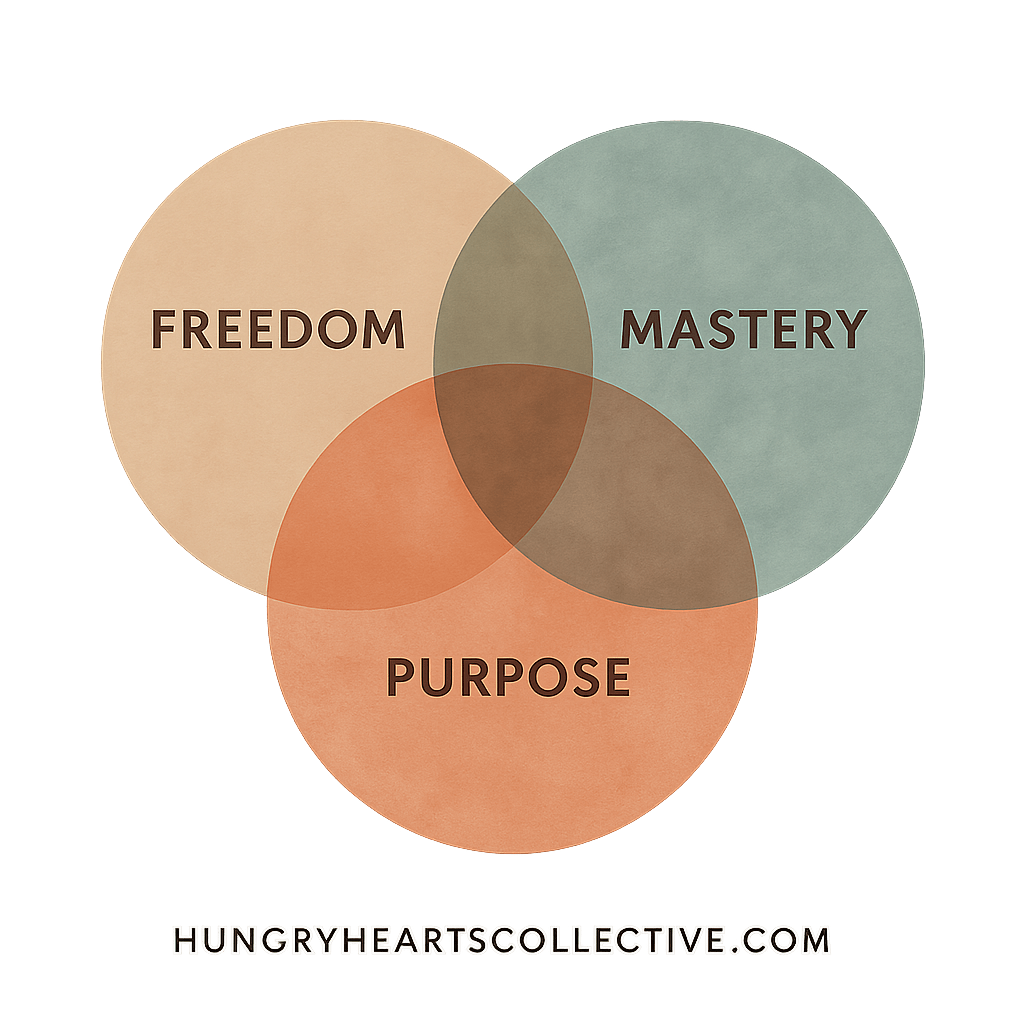
PILLARS OF MEANING
Modern thinkers often speak of three pillars that make life deeply meaningful: autonomy (the freedom to govern ourselves and walk consciously), mastery (the discipline and joy of becoming excellent at something), and purpose (the reason we were created). The world is searching for these things “out there,” in the nebulous confusion of the world, chasing external markers and applause, but for the believer, the order is different—and the source is closer than we might imagine.
For the child of God, purpose is not found by looking outward at the shifting sands of culture or circumstance. It is discovered by looking inward, deep within the heart where the Holy Spirit has deposited His gifts. As Paul reminds us,
“Each has received a gift” (1 Peter 4:10).
This gift is the seed of ministry—a holy, unique, God‑given design meant to bear fruit in the world. Our job is to cultivate this seed.
We don’t have to invent a calling. We have to recognise it. We have to water it, nurture it, and walk it out. The greatest purpose we can fulfil is to become the person God shaped us to be—a living expression of His grace, a conduit of His glory, a vessel of His kindness. In doing so, we step into the holy paradox of servanthood: as we give ourselves away, we find ourselves; as we kneel to wash the feet of others, we rise in strength and dignity. However, we cannot “wash the feet of others,” if we do not first go to Christ so that He can “wash our feet” first (John 13:8, Ezekiel 20:12). This is the heart of ministry. This is the reason we were made.
We are the recreated image of God the world will see.
In Christ, we are called to be His hands and feet, making the world a better place—one prayer, one act of obedience, one seed of grace at a time. Let us look inward, find that holy seed, and carry it outward in words and in acts, that God might be glorified and His kingdom (control, influence) established on earth as it is in heaven (Matthew 6:10).
INTRODUCTION: THE SEED THAT TRANSFORMS
Every believer knows that the spiritual life doesn’t grow from grit or sheer willpower, but from a seed—a seed of truth planted deep within the heart. As the Psalmist declares,
“I have hidden Your word in my heart that I might not sin [miss the make, purpose, goal] against You” (Psalm 119:11).

The Word hidden within becomes the very engine of obedience, grace, and holy service. In a world that encourages us to try harder and strain longer, God reminds us to first receive, internalise, believe, and rest in private before we venture out to serve in public. The seed of the Word gives birth to faith, and it is this faith that transforms service from a duty into a delight and a holy calling.
ROMANS 12:6–8: THE CALLING TO SERVICE
“Having gifts that differ according to the grace given to us, let us use them: if prophecy, in proportion to our faith; if service, in our serving; the one who teaches, in his teaching; the one who exhorts, in his exhortation; the one who contributes, in generosity; the one who leads, with zeal; the one who does acts of mercy, with cheerfulness” (Romans 12:6–8, ESV)
Each gift is a sacred trust, and every role—teaching, serving, leading, giving, encouraging, or extending mercy—operates by one vital force: faith.
WHAT POWERS OUR SERVICE?
But here’s the deeper question: what truly powers this service? Not grit. Not sheer motivation. Not striving harder. The Bible reminds us that it is faith. Faith is the engine that transforms obedience from mere activity into holy, effective service.
“The ones along the path are those who have heard; then the devil comes and takes away the word from their hearts, so that they may not believe and be saved” (Luke 8:12).
Or as James 1:21 puts it,
“Receive with meekness the engrafted word, which is able to save your soul.”
Here, we find the recipe for faith:
- The Word in your heart ➔ Belief ➔ Salvation.
One of the opening declarations in Romans sets the tone for the rest of the message of salvation:
“The power of God saves all who believe” (Romans 1:16–17).
This is not a new sentiment, but a reminder of an eternal truth—that faith is the channel through which God works. We see this theme throughout Scripture:
- “According to your faith it will be done to you” (Matthew 9:29)
- “The just shall live by his faith” (Habakkuk 2:4, Romans 1:17)
- “Your faith has saved you” (Luke 7:50)
If you can believe, then the power of God can save, rescue, preserve, heal, deliver, and provide. Yet belief is not something we manufacture out of thin air; it is a byproduct of internalising God’s Word and spending time in His presence. You can’t trust someone you don’t know, and you can’t truly know Him without abiding with Him, listening to Him, and allowing His promises to sink deep into your heart.
The deeper you internalise His Word, the stronger your belief becomes—and the more fully you walk in the reality of His saving, sustaining, and transforming power.
Salvation (Greek soteria, σωτηρία) is far more than an afterlife guarantee. Its root conveys:
- Deliverance
- Healing
- Preservation
- Wholeness
- Peace and prosperity
- And much more besides
The internalised Word doesn’t just save a soul; it transforms a life, making every area fruitful and aligned with God’s heart.
THE FOUR VARNAS: A GLIMPSE OF CALLING
In ancient times, the four callings or duties shaped the understanding of certain societies. Applying it to our lives can provide us with a lens to recognise what the ancients knew. In Christ, we can understand these as four callings within the Church:
| Ancient Sanskrit Word | Vocation/Duty/Service | Role in the Church Today | Examples from Scripture | Cashflow Quadrant | Gospel | Symbol / Colour |
|---|---|---|---|---|---|---|
| Brahmins | Priest, Teachers, Poets, Prophets | Those called to teach, pray, and lead people deeper into God’s truth. | Jesus, Moses, Ezra, Paul | Investor | John | Eagle / Blue |
| Kshatriyas | Protectors, Leaders, Administrators | Leaders, defenders, and warriors for righteousness and justice. | Jesus, Joshua, David, Nehemiah | Self-Employed / Business Owner | Matthew | Lion / Purple |
| Vaishyas | Stewards, Specialists, Entrepreneurs | Givers, builders, and entrepreneurs supporting the Church’s work. | Jesus, Lydia, Boaz, Barnabas | Business Owner / Self-Employed | Luke | Man / Red |
| Shudras | Servants, Helpers | Helpers and workers dedicated to serving the Church and its people. | Jesus, Phoebe, Stephen, Dorcas | Employee | Mark | Ox / White |
Each role is sacred, no matter how insignificant it may appear in the eyes of the world. In the eyes of God, if He has entrusted you with a task, it is precious and set apart. Every role carries eternal significance. All gifts flow from the one Spirit, and every calling is sustained by the same divine fuel—faith firmly anchored in the Word. It is not what we do that truly matters, but for whom we do it.
While there may be overlaps between various roles, each of us has a distinct primary role and a specific gift uniquely designed to fulfill that purpose. This main calling is the focal point through which your God-given abilities are most effectively expressed to accomplish the goal set before you.
And never forget: While Kiyosaki’s Cashflow Quadrant gives an indication of the usual income stream that may accompany a role, we must never limit God. The psalmist warns, “They limited the Holy One of Israel” (Psalm 78:41), and the gospels tell us that Jesus “could do no mighty work there… because of their unbelief” (Mark 6:5–6). Our true remuneration does not come from the role itself, but from faithful obedience to the Lord who has commissioned us, and who, “supplies every need of yours according to His riches in glory in Christ Jesus” (Philippians 4:19).
HEARTS, FAMILIES & TRIBES
Romans 12:6–8 tells us, and as 1 Corinthians 12 affirms, each of us is gifted by the grace of God—called to teach, to serve, to lead, to give, to encourage, or to show mercy. To discover these callings, we can certainly look inward at the stirrings of our own heart, the things that deeply resonate within us. Yet often, we can also look outward—to our families and heritage—because calling frequently weaves itself across generations. The Scriptures are filled with examples: Moses, Aaron, and Miriam were siblings, each called to a distinct role in God’s great story of deliverance and worship. In the same way, the Levites passed priestly duties from father to son, David came from a line destined for kingship, and Asaph’s descendants became carriers of music and praise. These holy threads remind us that God often plants gifts like seeds within families and nations, allowing a legacy of grace to flourish across generations. What one generation embraces by faith can become the seed that another generation cultivates—a holy inheritance shaping the Church for the glory of God.
Your gift is a supernatural “power tool” that must be “plugged in” to unleash its full potential and accomplish the task at hand. Without this connection, it can become a burden, making your work more difficult rather than easier.
God has placed His divine tool within you for the blessing and service of others. This sacred gift, when embraced and activated, becomes a channel of God’s grace, flowing outward to meet the needs of those you are called to serve.
THREE LEVELS OF WORK: BODY, SOUL, SPIRIT
There are three distinct levels of engagement—poor, intermediate, and exceptional—that correspond intimately to the body, mind, and spirit. In a deeper sense, these levels also mirror our degree of commitment: uncommitted, half-hearted, and fully devoted. This progression is akin to the difference between navigating life in two-wheel drive and shifting into four-wheel drive. While two-wheel drive may keep you moving forward, it restricts your traction and limits your power. But when you engage four-wheel drive—aligning body, mind, and spirit in full harmony—you unlock your fullest potential, empowering you to traverse even the most rugged and challenging terrain with unwavering strength and grace.
INPUT VS OUTPUT
All work is an output based on an input. What we put in determines what we draw out—and how we operate determines the quality, efficiency, and nature of that result.
1. BODY (PHYSICAL WORK):
Input = Action. Output = Result.
Here, work is driven by sheer effort—massive input = massive output. The harder you work, the more you get, but it depends entirely on strength, time, and grit.
2. SOUL (INTELLECTUAL WORK):
Input = Thought. Output = Leverage.
Here, we work smarter, not harder. We gain an improved input‑to‑output ratio—achieving more with less wasted effort, relying on knowledge, understanding, and wisdom.
3. SPIRIT (SPIRITUAL WORK):
Input = Faith. Output = Miracles.
Here, work operates beyond the ordinary and the natural. By applying spiritual laws, we transcend natural constraints and access God’s supernatural grace. The result? Output that is disproportionate, unexplainable, and unreasonable by purely intellectual measure and methods, because it flows from grace powered obedience, alignment, and intimacy with the Spirit of God.
REMEMBER: Whatever you expand will grow. Invest deeply in body, in soul, and especially in the Spirit—and watch as the seed of obedience becomes a harvest of grace that goes far beyond what you could ever ask, think, or imagine. In God’s economy, the greatest fruit always springs from the unseen.
GOD’S JOB, GOD’S WAY, GOD’S POWER
We walk this life by God’s design, for His glory, and by His strength. As Paul reminds us:
“For by grace you have been saved through faith. And this is not your own doing; it is the gift of God, not a result of works, so that no one may boast. For we are His workmanship, created in Christ Jesus for good works, which God prepared beforehand, that we should walk in them” (Ephesians 2:8–10, ESV)
Once again we see the work is linked to grace that comes through faith.
It is God’s job to save, God’s way to call and shape us, and God’s power that accomplishes it. Grace is accessed by faith—a humble trust that rests completely in Him. Our works do not save us, but they flow naturally as evidence of a heart changed by grace, as obedience to the calling He has set before us. We are His workmanship—His handiwork, His living poem—created for a purpose. And that purpose is fulfilled when we walk in the path He has laid out, relying upon the strength of the One who called us.
Trust that as you abide in Him, He will enable you to do God’s work, in God’s way, by God’s power—every step of the way.
SAVED BY FAITH — NOT BY EFFORT, GRIT, OR WILLPOWER
The Apostle Paul reminds us sharply in Galatians 3 that our life with God is birthed and sustained by faith, not by human effort:
“O foolish Galatians! Who has bewitched you? It was before your eyes that Jesus Christ was publicly portrayed as crucified. Let me ask you only this: Did you receive the Spirit by works of the law [by human effort] or by hearing with faith [time in Scripture]? Are you so foolish? Having begun by the Spirit, are you now being perfected by the flesh? Did you suffer so many things in vain—if indeed it was in vain? Does he who supplies the Spirit to you and works miracles among you do so by works of the law, or by hearing with faith—just as Abraham ‘believed God, and it was counted to him as righteousness’” (Galatians 3:1–6, ESV)
As Paul exhorts us in Colossians 2:6-7,
“Therefore, as you received Christ Jesus the Lord, so walk in him, rooted and built up in him and established in the faith, just as you were taught, abounding in thanksgiving.”
This passage calls us to an active perseverance in faith—not a mere one-time acceptance, but a continuous, deepening walk in Christ by accessing this grace that is available through faith. Just as a tree firmly planted draws life and strength from its roots, so must we remain deeply rooted in Him through study and prayer, allowing our faith to grow and mature daily. It is through this steadfast connection to Christ that our body, mind, and spirit align and activate, enabling us to live not in mere survival but in abundant, empowered life i.e. thrival.
These words cut to the heart of a common error—trying to finish by grit and willpower what God began by grace. Salvation is not about how hard you can try, how well you can perform, or how long you can strain in your own strength. It is about faith—an open heart that hears, believes, and rests in the finished work of Jesus. As it is written,
“There remains, then, a Sabbath rest for the people of God. For whoever enters God’s rest also rests from his own work, just as God did from His. Let us, therefore, make every effort to enter that rest [by faith]” (Hebrews 4:9-11)
If you started this race by relying on the Spirit, you must finish it the same way. The God who saved you by grace, through faith, is the same God who now works miracles in and through you. Trust Him. Abide in Him and let His word dwell richly in you. Let His grace carry you every step of the way.
BRINGING IT TOGETHER
The seed of the Word, lodged deep in the heart, is what Psalm 119 reminds us to treasure—so that we might walk holy and aligned with God. As the Apostle Peter encourages,
“As each has received a gift, use it to serve one another, as good stewards of God’s varied grace” (1 Peter 4:10).
This grace is accessed by faith, and faith is born from the Word we consume and internalise. Remember: you are what you eat. Feast lavishly on His words since,
“man [physical] does not live by bread [physical food] alone, but man [spiritual] lives by every word []spiritual food] from the mouth of the Eternal one” (Deuteronomy 8:3)
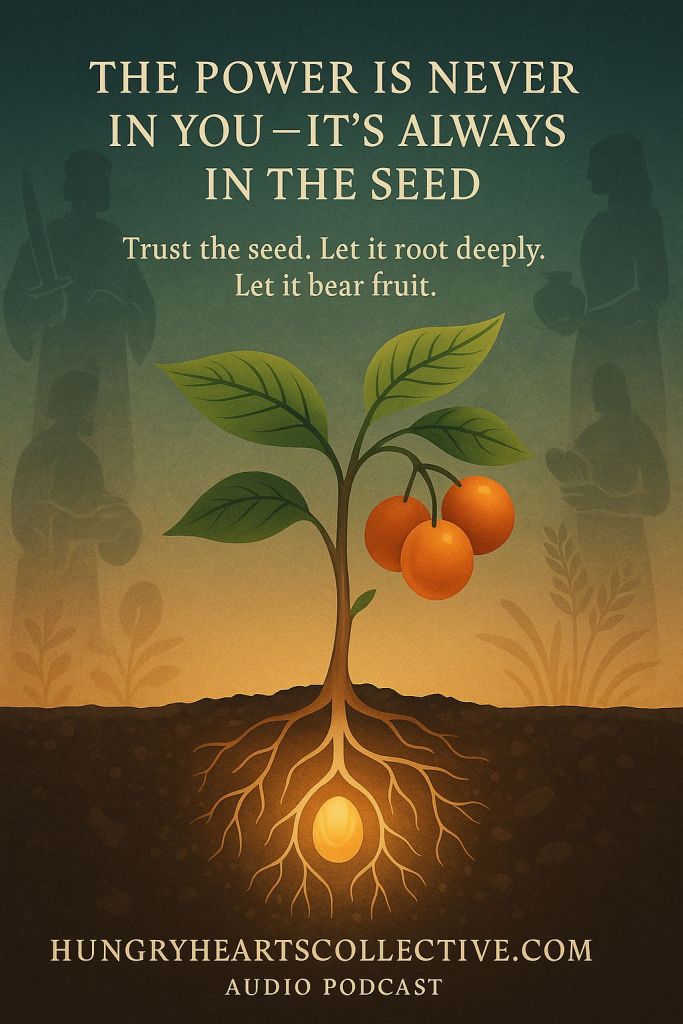
So trust the seed. Let it root deeply. Let it bear fruit. Let it produce a faith that taps into the grace that drives obedience and holy service. Let it transform you—making every role you carry an expression of the richness of soteria, and every moment of your life an offering of grace for His glory.
Remember this: The beanstalk didn’t grow tall enough to touch the heavens because of Jack’s effort—he was an ‘idiot’ who traded a cow for some apparently ‘worthless’ beans. It grew because the seed was planted. The power was never in Jack—the power was always in the seed. God’s word is the seed that connects heaven and earth.
Don’t make the same mistakes as the characters in the
myth and despise it before you can see what it can do in and for you!
A SERIOUS WARNING: DESPISING THE BREAD FROM HEAVEN
The story of the manna is more than an ancient miracle; it is a timeless lesson about obedience, trust, and the posture of our hearts towards God’s provision. In the wilderness, when God rained down manna from heaven, the Israelites asked in puzzlement, “What is it?” (Exodus 16:15). The Hebrew name for this bread is “man. ” Their question captures both the wonder and skepticism of that moment. Yet as the days passed, this miraculous provision became an object of contempt. The people grew tired of it, declaring,
“We loathe this worthless food” (Numbers 21:5).
What began as a symbol of grace, became, in their eyes, a symbol of drudgery and deprivation.
But the manna was never merely about the physical. It was a symbol—a seed planted in history—pointing forward to a deeper truth. Jesus Himself identified this bread from heaven as a shadow of Himself, the True Bread. He proclaimed:
“I am the bread of life. Whoever comes to me [*] shall not hunger, and whoever believes in me shall never thirst” (John 6:35)
*ἐρχόμενος – “coming” (present middle/passive participle) i.e. keeps coming
Yet many refused to understand, grumbling as their ancestors had done:
“The Jews grumbled about him because he said, ‘I am the bread that came down from heaven’” (John 6:41)
Jesus pressed the point further:
“Your fathers ate the manna in the wilderness, and they died. This is the bread that comes down from heaven, so that one may eat of it and not die” (John 6:49–50)
The manna was more than a miracle—it was a symbol, a prelude, a lesson. The physical bread sustained Israel for a time, but it was always meant to point to the eternal sustenance found in Christ, the Living Word. To despise the manna was to reject the hand of God Himself. To reject the True Bread—Jesus—is to reject life itself.
Today, we stand in the same danger of repeating this ancient error. By neglecting the Word of God—the Bible—or treating it as common, routine, or irrelevant, we despise the very bread that gives life to our souls. Likewise, when we fail to seek the presence of Jesus through prayer, we reject the spiritual manna that He so lovingly offers each day.
The lesson of Israel’s wilderness still echoes in our own lives.
The writer of Hebrews warns us of this very thing:
“Anyone who has set aside the law of Moses dies without mercy on the evidence of two or three witnesses. How much worse punishment do you think will be deserved by the one who has trampled underfoot the Son of God, and has profaned the blood of the covenant…?” (Hebrews 10:28–29)
If those who rejected Moses suffered judgment, how much more serious is it when we reject Christ—not by our words, but by our actions (choices), our apathy, and our indifference? Let us, then, come to the table humbly and gratefully. Let us feed upon His Word, abide in His presence, and embrace the True Bread that came down from heaven. In doing so, we walk in obedience and reverence, finding life that is rich, deep, and eternal.
PRAYER
Heavenly Father,
thank You for providing us with the seeds of salvation we can plant deep within our hearts. Stir our faith so that it may grow strong, producing obedience, service, and mercy. Let every gift You’ve given us be used to glorify You and build up Your Church. May Your Holy Spirit empower us to walk faithfully in our calling, remembering that every role is holy when rooted in You.
In Jesus’ Name, Amen.
REFLECTION QUESTIONS
- What gifts has God entrusted to me, and how can you use them to serve others?
- In what ways can I deepen your internalisation of God’s Word daily?
- Where do I rely too much on grit and too little on faith?
- In what ways am I treating certain tasks or roles as “less holy” or insignificant? How can I shift my heart to see every calling as sacred when offered to God?
- Am I relying more on my own effort, grit, or willpower than on God’s grace and the obedience of faith? What would it look like to rest more fully in Him?
- In what areas am I in danger of repeating Israel’s error—treating God’s provision (Word, prayer, obedience) as common or worthless?
MEMORY VERSE
“I can do all things through him who strengthens me” (Philippians 4:13)
DESIGN YOUR LIFE
Today, you have a choice. Will you try to drive obedience by your own strength—or will you slow down long enough to internalise the Word, deepen your faith, and walk in the abundance of grace? Remember, the seed you plant in the soil of your heart will bear fruit far beyond your understanding. Let the Word abide, let the Spirit guide, and watch as every gift becomes a holy offering, every role a sacred trust, every step a walk closer to the heart of the Father.
MAIN THOUGHT
If you what can’t do for you, plant the word, he will do for you what you could never do on your own
LIKE & SUBSCRIBE!
HAS THIS POST HELPED YOU?

SUPPORT THIS COMMUNITY
If you have been helped by the posts on this blog, consider donating to keep the ball rolling.Your gift makes a difference and helps improve this community!
£10.00

 The Hungry Hearts Collective
Leave a reply to THE AGE OF AI AND DISRUPTION: GO WHERE YOU ARE TREATED BEST – The Hungry Hearts Collective Cancel reply