
When the sensation of relief becomes a substitute for the reality of healing
INFOGRAPHIC
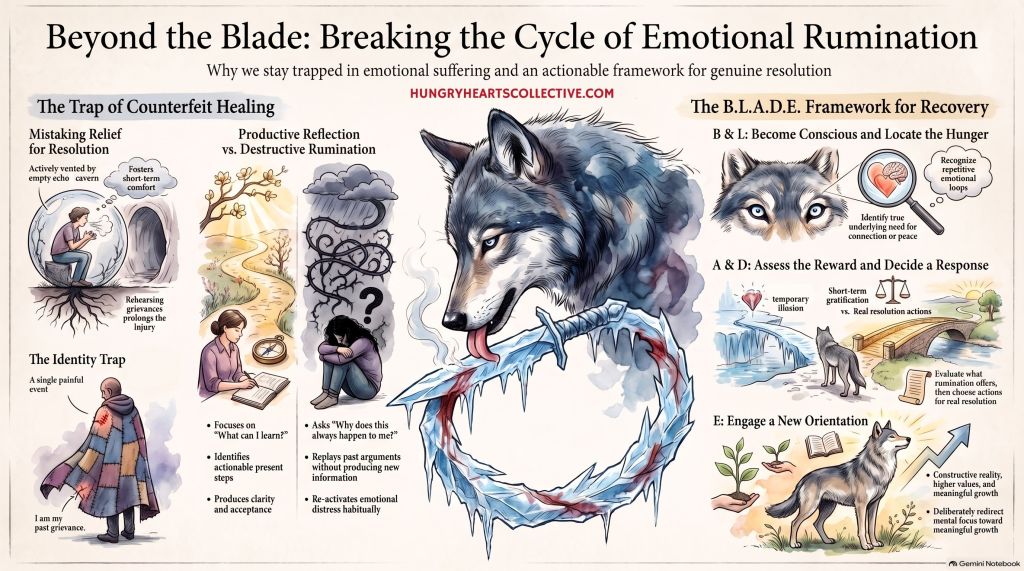
VIDEO 1
VIDEO 2
AUDIO
ABSTRACT
People frequently trap themselves in repetitive emotional loops, constantly revisiting grievances, disappointments, and injustices because these actions trigger a temporary feeling of relief or validation. Rather than actually resolving the underlying issues or promoting true healing, this constant rumination serves as a counterfeit satisfaction that tricks the brain into mistaking mental activity for actual progress. Over time, individuals often mistakenly allow these painful experiences to define their personal identity, weaving historical wounds into their overarching internal narrative and self-concept. We explain that this destructive cycle can be interrupted through conscious awareness and spiritual reorientation, urging people to shift their attention away from past hurts and toward constructive growth and divine connection. Ultimately, breaking free requires recognizing that a past wound is not an identity, allowing individuals to finally stop self-inflicting emotional harm and instead cultivate a life rooted in genuine transformation. We offer a simple 5-step process (B.L.A.D.E.) to exit the emotional doom spiral.
INTRODUCTION
There is something profoundly disturbing about our tendency to keep returning to the things that hurt us.
We revisit disappointments, rehearse grievances, replay conversations, recount injustices, examine our inadequacies, and repeatedly draw attention to everything that is wrong with our lives.
We pick at emotional wounds that are trying to heal.
And strangely enough, we get something out of it.
We experience a momentary change in our emotional state. Perhaps relief, validation, indignation, solidarity, vindication, sympathy, or even a fleeting sense of control.
For a moment, we feel better.
But nothing has actually changed.
The relationship remains broken. The financial problem remains unresolved. The injustice has not been addressed. The disappointment is still there. The loneliness has not disappeared.
And before long, we are back at it again.
I want to explore a psychological mechanism that I believe is responsible for keeping many of us trapped in repetitive cycles of emotional suffering.
When we cannot solve a problem, we frequently settle for the emotional feedback we can obtain by thinking, talking, and feeling about it.
We ruminate, we cogitate, and we emote.
And because these activities produce an emotional response, we mistake them for progress.
We confuse the sensation of psychological activity with the accomplishment of psychological resolution.
The tragedy is that we can become attached not merely to our wounds but to the emotional experience of attending to them.
We are not necessarily addicted to suffering itself. We may have become dependent on the temporary relief we obtain from repeatedly engaging with it.
And that distinction changes everything.
THE PARABLE: HOW TO KILL A WOLF IN ALASKA
I am reminded of an old parable sometimes called How to Kill a Wolf in Alaska.
According to the story, hunters discovered an ingenious but gruesome way to exploit a wolf’s attraction to blood.
They would take a sharpened knife, dip its blade into fresh blood and leave it outside to freeze. Once frozen, they would repeat the process, adding layer upon layer until the sharpened blade was completely concealed inside what we might describe as a frozen blood popsicle.
The knife would then be secured firmly in the ground, with the blood-covered blade exposed.
Attracted by the scent, a hungry wolf would eventually discover it.
Initially, the experience would be delightful. The wolf would lick the frozen blood, increasingly absorbed in what appeared to be an extraordinary meal.
As it continued, its tongue would become numb from the cold. Eventually, the frozen layers would wear away, exposing the sharpened blade beneath.
The wolf would begin cutting its own tongue.
But here is the terrible irony.
Unable to distinguish between the blood originally frozen around the blade and the blood now coming from its own wounds, the animal would continue licking.
The more it injured itself, the more blood it tasted.
And the more blood it tasted, the more it continued.
According to the legend, the wolf would eventually bleed to death, consumed by an appetite it could no longer distinguish from its own destruction.
The wolf believes it is consuming something that satisfies its hunger, when in fact it is consuming itself.
A BRIEF NOTE ON THE ORIGIN OF THE STORY
The account is widely circulated as an Alaskan or Inuit hunting legend. It is also associated in popular retellings with American radio broadcaster Paul Harvey and the tradition of his famous program, The Rest of the Story.
Harvey’s reputation for presenting obscure historical anecdotes helped give stories of this kind an air of factual authority. However, the precise origin of this particular account, including its attribution to Harvey, is difficult to establish conclusively.
There is insufficient reliable ethnographic evidence to present the method as a documented traditional Inuit hunting practice.
I therefore use it here as a parable rather than a historical assertion.
And as a parable of human psychology, it is extraordinarily powerful.
Because I suspect that many of us are licking our own blades.
1. THE PSYCHOLOGY OF FALSE NOURISHMENT
What interests me most about this story is not the wolf’s appetite but its inability to distinguish between nourishment and injury.
The very activity that appears to satisfy its hunger is perpetuating its destruction.
I believe we frequently do something remarkably similar with our emotional wounds.
Consider someone who has been mistreated by a colleague. They recount the incident to a friend. The friend agrees that the colleague behaved appallingly. They experience validation and relief. They repeat the story to another friend. Another moment of validation follows.
Then they mentally rehearse the argument they wish they had made. They imagine confronting the colleague, delivering the perfect response and finally receiving the acknowledgement they deserve.
Each episode produces a small emotional reward.
But nothing has changed in the actual relationship.
No boundary has been established.
No conversation has occurred.
No decision has been made.
And, no action has been taken.
In fact, the person may now be more emotionally invested in the injustice than before they began talking about it.
This is what I call counterfeit consummation.
“Consummation” refers to completion or fulfillment. In this context, I am describing an experience that resembles the emotional consequence of resolution without actually producing resolution.
We obtain the feeling associated with an outcome without achieving the outcome itself.
We experience vindication without justice.
We experience sympathy without reconciliation.
We experience imagined victory without confronting the problem.
We experience emotional relief without genuine release.
There is an enormous difference between feeling better about something, even temporarily, and something actually becoming better.
Neither emotional relief nor emotional expression is inherently wrong. Both are necessary aspects of healthy psychological functioning.
The problem begins when we repeatedly mistake the first for the second.
The sensation of relief is not evidence of the presence of healing.
2. EMOTIONAL MASTURBATION: WHEN FEEDBACK BECOMES THE OBJECTIVE
I want to introduce a deliberately provocative expression here: emotional masturbation.
By this, I mean the repetitive stimulation of our own emotional states for the sake of obtaining temporary gratification, without necessarily producing meaningful resolution, growth, or change.
We keep returning to the same emotional material because it gives us something.
We ruminate.
We cogitate.
We emote.
We rehearse imaginary confrontations. We repeat the same stories. We revisit the same disappointments. We seek another sympathetic listener. We replay the same conversations, hoping to extract another moment of vindication.
And sometimes we are not even seeking an answer anymore.
We are seeking the emotional experience that engaging with the problem provides.
When we cannot solve a problem, we settle for feedback.
That feedback may come in the form of indignation, sympathy, righteous anger, reassurance, self-pity, imagined revenge, or the comforting agreement of another person.
The experience is temporarily satisfying, but it is not necessarily nourishing.
Like the wolf, we return for another taste.
I use the term “emotional masturbation” to describe a particular destructive pattern, not to dismiss legitimate grief, emotional disclosure, or the importance of talking through painful experiences.
But, there is an enormous difference between processing an emotion and repeatedly stimulating it.
One facilitates movement.
The other can become an end in itself.
The question I want us to ask is this:
Am I engaging with this problem because I am moving towards resolution, or because I have become attached to the emotional experience of engaging with it?
3. WHY THE BRAIN KEEPS RETURNING TO THE BLADE
Behavioural psychology offers a useful explanation for this phenomenon through a process known as negative reinforcement.
Negative reinforcement does not mean punishment. It describes a process in which a behaviour becomes more likely because it reduces or removes an unpleasant experience.
Imagine the following sequence:
- Something activates an emotional wound.
- We experience distress, anxiety, anger, rejection, or disappointment.
- We respond by repeatedly thinking or talking about it.
- We obtain temporary emotional relief, validation, or reassurance.
- The underlying problem remains unresolved.
- The emotional discomfort returns, and we repeat the behaviour.
The brain learns that a particular activity provides short-term relief.
It does not necessarily distinguish between the immediate emotional reward and the long-term effectiveness of the behaviour.
This is why destructive psychological patterns can become habitual.
The behaviour does not have to solve the problem to be reinforced. It merely has to change our immediate emotional experience sufficiently for us to repeat it.
We can therefore become increasingly skilled at obtaining emotional relief while becoming progressively less effective at addressing the circumstances generating our distress.
IS IT A DOPAMINE HIT?
Dopamine is frequently described as the brain’s pleasure chemical, but that is an oversimplification.
It is involved in motivation, learning, reward prediction and the processes through which particular experiences become motivationally compelling.
Importantly, wanting something and enjoying something are not identical.
I think this distinction is particularly relevant here.
We can develop an increasingly compelling urge to revisit a painful subject even when we recognise that doing so is unlikely to make us feel better in any lasting sense.
That does not mean every episode of rumination produces a scientifically demonstrated dopamine spike. The mechanism is more complicated than that.
Nevertheless, the broader principle remains:
We can continue wanting an emotional experience long after we have stopped finding it genuinely satisfying.
We say, “I need to talk about this again.”
But perhaps what we actually mean is, “I need to experience the relief that talking about this occasionally gives me.“
Those are not necessarily the same need.
And neither necessarily addresses the original wound.
4. RUMINATION: WHEN THINKING IMPERSONATES PROBLEM-SOLVING
Psychologist Susan Nolen-Hoeksema’s research into rumination provides an important foundation for understanding this behaviour.
Rumination involves repetitive attention to distress, its causes, meanings and consequences, frequently without moving towards constructive action.
What makes rumination particularly deceptive is that it presents itself as an attempt to understand.
We tell ourselves:
- I need to understand why this happened.
- Why did they treat me like that?
- What does this say about me?
- How could I have prevented it?
- What if it happens again?
- Why can’t I stop feeling this way?
These questions are not inherently unhealthy.
But when they become repetitive, abstract and self-referential, they can keep us mentally occupied without producing any new information.
Research by Nolen-Hoeksema and colleagues has associated rumination with prolonged negative mood, impaired problem-solving and the maintenance of depressive symptoms.
This presents us with a disturbing possibility.
The more we engage in certain forms of thinking about a problem, the less capable we may feel of resolving it.
Our thinking is not merely failing to produce a solution. It may be changing our perception of what is possible.
I distinguish between productive reflection and destructive rumination in the following way:
| Productive reflection | Destructive rumination |
|---|---|
| What happened? | Why does this always happen to me? |
| What can I learn? | What is wrong with me? |
| What information am I missing? | How could they possibly do that? |
| What is within my control? | Why can’t I stop feeling this way? |
| What action is available? | What if nothing ever changes? |
| What must I accept? | How can I keep this from ever hurting again? |
The difference is not necessarily how long we spend thinking.
It is whether our thinking produces greater clarity, flexibility, acceptance or effective action.
An hour of serious reflection may transform our lives.
Ten minutes of habitual rumination may simply reactivate yesterday’s distress.
We can become so conscious of what we feel that we become unconscious of what we are doing.
5. VICARIOUS RELIEF: THE ILLUSION OF HAVING ARRIVED
There is another dimension to this behaviour that I find particularly interesting.
We can experience an emotional approximation of an outcome without the outcome actually occurring.
I call this vicarious emotional completion.
Consider someone who repeatedly imagines confronting a person who wronged them.
In the imaginary conversation, they speak perfectly. Their arguments are devastating. The other person finally understands. Justice is restored.
For a moment, they experience something resembling vindication.
But the real relationship remains untouched.
Or consider someone who repeatedly recounts an injustice to sympathetic friends.
Their listeners supply the acknowledgement that the original offender never gave them.
For a moment, the need for recognition is met indirectly.
But the original desire for reconciliation, accountability or closure remains unresolved.
In both cases, we have experienced a fragment of the emotional destination without actually arriving there.
The mind rehearses the feeling of having arrived.
And because that feeling is temporary, it must rehearse it again.
This is why I believe we must learn to distinguish between the emotional reward of a behaviour and its actual contribution to our lives.
We can feel extraordinarily productive while accomplishing remarkably little.
6. THE IDENTITY TRAP: WHEN THE WOUND BECOMES OUR STORY
I want to take this argument considerably deeper.
Sometimes we keep returning to a wound not merely because it provides temporary emotional gratification, but because it has become part of how we understand ourselves.
The wound has become our story.
And our story has become our identity.
Consider someone who has experienced betrayal.
Initially, betrayal is an event within their life.
But through repeated rehearsal, interpretation and identification, the experience may gradually become an organising principle of their personal narrative.
“I experienced rejection” becomes “I am rejected.“
“I experienced failure” becomes “I am a failure.”
“I have suffered lack” becomes “I am someone for whom there is never enough.”
Something that happened becomes something we believe ourselves to be.
The event moves from autobiographical memory into identity definition.
This is an enormously important distinction.
7. ABRAHAM: REFUSING TO LET PRESENT CIRCUMSTANCES DEFINE REALITY
There is a fascinating biblical parallel to the psychology of autobiographical memory in Abraham’s response to God’s promise in Romans 4:19–21.
Romans 4:19–21 (KJV) And being not weak in faith, he considered not his own body now dead, when he was about an hundred years old, neither yet the deadness of Sara’s womb: He staggered not at the promise of God through unbelief; but was strong in faith, giving glory to God; And being fully persuaded that, what he had promised, he was able also to perform.
The Greek verb translated considered in verse 19 is κατανοέω (katanoeō), meaning to observe, perceive, consider or pay attention to something. The verse uses the negative construction ou katanoēsen—he did not consider.
This does not mean Abraham was unaware of his circumstances, denied his age or pretended that Sarah’s barrenness was unreal. Rather, the text presents him as refusing to allow those circumstances to have the final word concerning what God had promised.
This gives us a useful distinction between perceiving reality and allowing a particular aspect of reality to determine our entire interpretation of what is possible.
The connection with autobiographical memory is striking. We can become so preoccupied with the evidence of our past—the rejection, the failure, the betrayal, the disappointment—that we allow our accumulated experiences to become the framework through which we interpret every future possibility.
Eventually, we no longer merely remember what happened. We begin to live as though what happened must determine what will happen.
Abraham’s example challenges this tendency. His circumstances were real, but they were not the only reality relevant to his decision. He interpreted them in the context of a promise he considered trustworthy.
In psychological terms, we might say that Abraham refused to let the available evidence become the exclusive horizon of his expectations. In Paul’s theological argument, faith rests on the trustworthiness and power of the God who made the promise.
The lesson is not to deny the past, but to refuse to grant it unlimited authority over the future. We can acknowledge what happened without allowing it to become an unquestionable verdict on who we are or what remains possible.
8. THE NLP SELF-CONCEPT MODEL
I find the Self-Concept Model developed within Neuro-Linguistic Programming (NLP), particularly the work associated with Steve Andreas, useful as a conceptual framework here.
NLP itself has a mixed and generally weak empirical evidence base, so I am not presenting the model as established neuroscience. I am interested in its practical description of how we organise our subjective experience of identity.
The model proposes that our self-concept is organised through collections of remembered and imagined examples. These instances are asigned value, positive or negative, that we use to support what we believe about ourselves.
For instance, someone who believes “I am a confident person” may have numerous remembered experiences supporting that conclusion.
Someone who believes “I am always rejected” may similarly organise their memories around examples of rejection.
Now consider what happens when we repeatedly revisit a painful experience.
We retrieve it.
We rehearse it.
We interpret it.
We emotionally reactivate it.
We asign value to it.
We connect it with other similar experiences.
The memory is altered.
The memory is reconstructed.
Gradually, through this process, we may begin assembling an increasingly convincing internal collection of evidence supporting a particular identity. This helps connect particular events with broader beliefs about who you are and how your life has unfolded. Thus, constructing meaning across time about who we are, where we are, how we are, why we are etc, leading to subjective and incomplete assursions which are by definition false.
A delayed reply becomes further evidence that nobody cares.
A cancelled appointment becomes confirmation that people always disappoint us.
A difficult financial month becomes proof that we will never have enough.
The mind begins recruiting the present to reinforce the past.
The issue is no longer simply that we remember a wound.
We begin using the wound as evidence of who we are.
And slowly but surely for form a framework we use to define who we are and thus our personality becomes a plastic generilisation rather than a solid immutable fact.
This is why merely stopping a particular behaviour may not be sufficient.
We must also examine the identity configuration that makes the behaviour appear necessary.
What story am I continually rehearsing about myself?
What evidence am I selectively collecting?
What experiences am I ignoring because they do not support my existing self-concept?
What meaning am I choosing to asign to the data points?
And, why?
And perhaps most importantly, who would I be if I stopped organising my identity around this wound? This emotional blackhole?
YETZER — STORY — IDENTITY — DESTINY
There is a Hebrew concept that I find particularly fascinating in this context.
The word יֵצֶר (yetzer) is commonly associated with inclination, disposition, formation, imagination or the framing of thought.
It is related to the Hebrew root יצר (yatsar), meaning to form or fashion.
We encounter it in Genesis 6:5, where Scripture speaks of the inclination, imagination or formation of the thoughts of the human heart.
We also encounter it in Isaiah 26:3:
“You will keep him in perfect peace, whose mind is stayed on You, because he trusts in You.” — NKJV
The Hebrew expression translated as “mind” includes yetzer.
This interests me enormously.
Although modern linguists would deny that yetzer and the English word story are not historically related, I find their conceptual association particularly useful. In fact, yetser is an anagram for story. While linguists may tisk at the idea, I believe anagrams are textually (the Bible) and theologically(cf. Genesis 11:1-7) supported.
Yetser does not merely describe isolated bad thoughts. It describes an inner orientation, a formative disposition (story) that shapes the person’s thinking through which sensory data is interpreted, reconstructed and then returned as thought/word. (cf. Genesis 6:5, Post to follow with in depth discussion). But long story short:
YETZER = STORY → IDENTITY → DESTINY
Our internal formation becomes our story. Our story becomes our identity. And, our identity becomes our destiny.
And our identity influences the way we perceive, interpret and respond to the world, and so becomes a self-fullfilling prophecy.
In other words, we do not merely have experiences. We form narratives about those experiences, and those narratives participate in shaping our understanding of ourselves.
If my internal story is one of rejection, I may continually interpret life through rejection.
If my internal story is one of perpetual lack, I may continually interpret life through scarcity.
If my internal story is organised around what someone did to me twenty years ago, I may still be allowing that event to determine the direction of my present consciousness.
The tragedy is that we can spend years defending an identity we desperately want to escape.
This is where spiritual transformation becomes more than behaviour modification.
It involves the reconfiguration of the inner narrative through which we understand ourselves i.e. our identity.
The gospel does not merely invite us to behave differently. It introduces us to a new reality concerning who we are in Christ.
7. THE STRANGE SATISFACTION OF SUFFERING
The French psychoanalyst Jacques Lacan introduced a concept that offers a provocative additional perspective: jouissance.
- Beyond the Pleasure Principle: Coined and developed extensively by psychoanalyst Jacques Lacan, jouissance describes a state of intense, overwhelming stimulation that crosses the boundary of normal plaisir (pleasure) and enters the realm of pain, suffering, or tension. In sexual contexts, it can mean orgasm.
- Paradoxical State: It is an experience where pleasure and pain, desire and prohibition, or bliss and the “death drive” intermingle.
- The Law and the Signifier: Because entering language and society places limits on human drives, jouissance represents a forbidden, excessive satisfaction that the psyche constantly tries to reach.
While joissance in everyday French means deep enjoyment, joy, or satisfaction, philisophically it describes a form of excessive enjoyment or satisfaction that can extend beyond ordinary pleasure and become entangled with discomfort or suffering.
Applied interpretatively to our parable, the question becomes:
What happens when the wound itself becomes psychologically useful? I.o.w. what perverse pleasure (satisfaction) am I deriving from my suffering
Consider the possible secondary benefits of repeatedly revisiting an injustice.
It may provide a sense of moral superiority.
It may offer a stable explanation for our present unhappiness.
It may preserve an emotional connection to someone who is otherwise absent.
It may provide an identity organised around having suffered or survived something.
It may even protect us from the uncertainty associated with moving forward.
This does not mean that people consciously enjoy being hurt, nor does it invalidate genuine suffering.
It means that our relationship with suffering can become psychologically complicated.
Healing may require more than the removal of pain.
It may also require relinquishing the secondary benefits associated with remaining wounded.
And that can feel like a loss, even an existential threat, when our idenity has become entwined with our trauma (Lat. “wound”.)
Sometimes we discover that we do not merely have to release a grievance.
We have to relinquish the version of ourselves that the grievance has helped sustain.
8. WHEN TWO PEOPLE LICK THE SAME BLADE
There is an established psychological phenomenon known as co-rumination.
It describes excessive discussion of problems within relationships, particularly repeated speculation about causes and consequences, revisiting details and dwelling on associated negative emotions.
The fascinating paradox is that two people may feel increasingly connected precisely because they are repeatedly engaging with the same distress.
Imagine two friends discussing an unpleasant interaction.
Initially, one provides understanding and perspective. That is healthy social support.
But eventually the conversation changes.
They revisit every sentence, speculate about hidden motives, reconstruct previous incidents and reinforce each other’s interpretations.
They feel heard.
They feel united.
They feel emotionally closer.
Yet their distress may intensify.
The relationship is now rewarding the repetition of the problem.
The closeness is real. The validation is real. The temporary emotional relief may also be real.
But none of these necessarily establishes that the conversation is helping either person move towards resolution.
Sometimes our relationships become organised around the maintenance of a shared wound or traumatica event, rather than the pursuit of shared flourishing.
And when that happens, recovery can even feel threatening.
If one person begins moving beyond the grievance, the other may experience this as abandonment, disloyalty or invalidation.
The shared blade has become a form of communion.
9. YOU CANNOT SOLVE A PROBLEM FROM THE SAME LEVEL OF THINKING THAT CREATED IT
There is a familiar saying, frequently attributed to Albert Einstein, that we cannot solve our problems with the same thinking we used when we created them.
Although the popular wording is not securely established as a verbatim Einstein quotation, the underlying principle is valuable.
I would take it further.
Sometimes the problem is not merely that we are using the wrong solution.
It is that we are attempting to solve the problem from within the very framework of thinking that perpetuates it.
If my identity is organised around rejection, I may approach every relationship from the expectation of rejection.
If my consciousness is dominated by lack, I may approach every opportunity through the assumption that there will never be enough.
If my mind is continually rehearsing an injustice, I may interpret even unrelated experiences through that injustice.
I cannot expect genuine transformation while continually reinforcing the internal configuration that maintains my distress.
At some point, the issue is no longer simply the external problem. It is the framework through which I am engaging with the problem.
This is why I believe that genuine change frequently requires a shift in consciousness rather than merely another attempt to manipulate our circumstances.
And this brings me to a rather beautiful illustration from aviation.
10. AEROPLANES TAKE OFF AGAINST THE WIND
An aeroplane generally takes off into the wind, not with it.
Why?
Because a headwind increases the airflow over the wings relative to the aircraft’s ground speed, helping the aircraft achieve the lift required for take-off with a shorter ground roll.
The wind that appears to oppose the aircraft can actually assist its ascent.
I think there is a profound lesson here.
We frequently interpret contrary conditions as evidence that something is wrong.
Resistance means failure.
Opposition means we are moving in the wrong direction.
Difficulty means we have somehow missed the will of God.
But what if some of the contrary conditions we encounter are not there to destroy us?
What if they provide the very resistance through which we develop the capacity to rise?
I am not suggesting that every painful experience is divinely orchestrated, or that we should passively tolerate destructive circumstances.
I am suggesting that our interpretation of resistance can radically influence our response to it.
The same wind can be experienced as opposition or utilised as an advantage.
The difference lies in our orientation.
Contrary conditions are not necessarily there to make us fail. Sometimes they become the very conditions through which we rise.
The challenge is to stop treating every adverse circumstance as confirmation of our existing story of defeat.
Perhaps the question is not simply, “Why is this happening to me?”
Perhaps a more useful question is, “What becomes possible when I learn to respond to this differently?”
11. NOT BY MIGHT, NOR BY POWER—THE SPIRITUAL DIMENSION
This brings me to what I consider the most important part of the discussion.
I do not believe we can adequately address this problem through psychological techniques alone.
They can be useful, sometimes enormously so. But from my Christian perspective, the deeper question concerns the orientation of our consciousness.
What are we continually feeding?
What occupies our attention?
What are we allowing to shape our inner world?
And from where are we attempting to live?
In Zechariah 4:6, God declares:
“Not by might, nor by power, but by my spirit, saith the LORD of hosts.” —KJV
The original context concerns God’s assurance to Zerubbabel regarding the rebuilding of the temple. It is not a direct teaching about emotional regulation.
Nevertheless, I believe the principle provides a powerful spiritual framework.
We frequently attempt to overcome our inner struggles through greater exertion.
We think harder.
We analyse more.
We talk more.
We struggle more intensely.
We attempt to force ourselves into peace.
But sometimes all this additional effort merely increases our engagement with the very thing from which we are trying to escape.
We are attempting to overcome the problem through the same mode of consciousness that keeps us entangled in it.
We cannot think our way into spiritual rest through an endless multiplication of anxious thoughts.
At some point, we must learn to shift our attention.
Not by might.
Not by power.
But by His Spirit.
12. STOP FEEDING THE “BEAST”—START FEEDING THE HUMAN SPIRIT
I want to introduce a distinction that I believe is essential to spiritual practice.
We spend an extraordinary amount of time feeding the body, its appetites, its fears, its immediate emotional demands and its sensory preoccupations.
For the purposes of this discussion, I will refer to this as feeding the beast, the animilistic side of the human experience.
I am not suggesting that the physical body is evil. Scripture does not teach that. The body is part of God’s creation and is to be honoured.
Rather, I am referring to a life governed primarily by immediate appetites, emotional impulses and sense-based reactions which we can describe as survival based consciousness.
The animal is governed by what it senses, senses that constantly scan the environment for threats.
It feels hunger, so it pursues food.
It perceives danger, so it reacts.
It experiences discomfort, so it seeks immediate relief.
The human being, however, was created as more than biology, and for something greater than mere reaction to sensory stimuli.
We are image-bearers. We are spiritual beings having a human, physical experience.
We possess the capacity to orient our consciousness towards realities beyond our immediate physical and emotional experience. This is what is meant by spiritual “mindedness” or centeredness.
This is particularly important when considering Paul’s statement in Romans 8:6:
“For to be carnally minded [centered] is death; but to be spiritually minded [centered] is life and peace.” —KJV
The Greek word translated as “minded” is associated with phronēma — mindset, disposition or orientation of thought. I.o.w. is our consciousness centered in the survival of our biology (DNA) or in the higher reality of spiritual being?
Paul’s distinction is not simply between thinking nice thoughts and thinking unpleasant ones.
It concerns the fundamental orientation of life towards the flesh or towards the spirit.
And this is where I believe we must begin taking spiritual practice (exercise) seriously.
If I spend three hours rehearsing an injustice, I have spent three hours directing my consciousness towards that injustice. Which is why David states in Psalm 42:11,
“Why are you cast down [direction, physical level], O my soul [consciousness]? And why are you disquieted within me [symptom, consequence]?”
If I continually rehearse lack, I am repeatedly bringing lack into the foreground of my awareness (consciousness).
If I continually revisit rejection, I am allowing rejection to occupy an increasingly prominent position in my internal world, my story.
I am feeding something. And we become what we eat.
The question is whether what I am feeding is producing life.
WHAT DOES IT MEAN TO FEED THE HUMAN SPIRIT?
Spiritual practice is not an attempt to persuade God to do something He has not already accomplished in Christ.
It is the deliberate cultivation of our awareness of, and participation in, the spiritual reality made available to us through Him.
I would suggest several practical disciplines.
1. PRACTICE CONSCIOUS ATTENTION.
Begin noticing where your mind habitually goes when it is left unattended.
What subjects dominate your internal conversations?
What imaginary arguments do you repeatedly conduct?
What disappointments do you revisit?
What story about yourself are you continually reinforcing?
Before attempting to change anything, become conscious of the pattern.
You cannot deliberately redirect attention while remaining unconscious of where it is going.
2. INTERUPT THE EMOTIONAL REWARD CYCLE OF JOUISSANCE.
When you recognise that you are revisiting a familiar wound, ask yourself:
What am I hoping to obtain from this? What satisfaction or pleasure do I derive from it?
Am I seeking understanding, resolution, validation, sympathy or simply another emotional experience?
If the activity is no longer serving a constructive purpose, allow yourself to disengage.
You do not have to finish every imaginary argument.
You do not have to answer every anxious thought.
You do not have to revisit every grievance simply because it presents itself to your consciousness.
3. REORIENT YOURSELF TOWARDS SPIRITUAL REALITY.
This is where prayer, meditation on Scripture and communion with God become essential.
I am not speaking about religious activity undertaken merely to fulfil an obligation.
I am speaking about deliberately turning our attention towards God.
Instead of continually rehearsing what has gone wrong, begin attending to what is true in Christ.
Paul writes in Romans 12:2 that transformation is depenedent on the renewing of the mind (Grk. Nous), which is why salvation begins with repentance which is Metanoia in Greek, and means to change one’s mind or purpose.
-
meta-(μετά): A Greek prefix meaning “change,” “after,” or “beyond” nous/noein(νους / νοεῖν): Derived from noos or nous, meaning “mind,” “thought,” “perception,” or “understanding“.
Instead of constructing your identity from the “interpretation” of the accumulated evidence of your disappointments, begin examining the identity Scripture reveals concerning the new creation.
Instead of allowing immediate emotional experience to become the final authority, learn to distinguish between what you feel and what you believe.
4. PRACTICE BEHOLDING RATHER THAN REHEARSING.
Paul writes in 2 Corinthians 3:18 that as we behold the glory of the Lord, we are transformed into the same image.
I find this extraordinary.
Transformation is presented in relation to beholding. Thus, our attention is not incidental to our becoming.
What we continually attend to participates in shaping the direction of our lives.
This is also why Psalm 17:15 has become so significant to me:
“As for me, I will behold thy face in righteousness: I shall be satisfied, when I awake, with thy likeness.” — KJV
Notice the language of satisfaction.
The psalmist’s satisfaction is not located in the endless rehearsal of his enemies, circumstances or grievances. It is found in beholding God.
This is a fundamentally different kind of nourishment.
5. TRANSLATE SPIRITUAL AWARENESS INTO PRACTICAL ACTION.
Spiritual exercise must not become another form of vicarious relief, but the source of inspired action.
We can use religious language, prayer and even Bible study to avoid difficult decisions just as easily as we can use ordinary rumination.
The objective is not merely to feel spiritually uplifted. It is to become increasingly capable of living from the reality we profess to believe.
Sometimes the next faithful action is to forgive.
Sometimes it is to establish a boundary.
Sometimes it is to have an uncomfortable conversation.
Sometimes it is to make a financial decision, seek professional assistance, change a habit or accept something we cannot control.
Spiritual consciousness should make us more capable of engaging with reality, not less.
13. THE WOUND IS NOT YOUR IDENTITY
There is one final distinction I want to make.
A wound is something we have experienced. It is not necessarily a statement about who we are.
We can suffer rejection without becoming rejection. We can experience failure without becoming failure.
We can endure lack without allowing scarcity to become the defining principle of our consciousness.
We can acknowledge injustice without allowing the injustice to determine the remainder of our lives.
This does not require pretending that painful things did not happen.
Nor does it require denying grief, avoiding difficult emotions or prematurely declaring ourselves healed.
It requires learning to distinguish between an experience and an identity.
I believe one of the great human problems is not merely that we are lost, but that we have forgotten what we were made for.
Communion is the awakening of the image-bearer to the One whose image he bears.
The gospel is not simply an invitation to modify our behaviour.
It is an invitation to awaken to our identity in Christ and begin living from that reality.
The wound may remain part of our history.
But it need not remain the organising principle of our identity.
14. HOW TO STOP LICKING THE BLADE
I want to leave you with a simple framework for recognising and interrupting this destructive pattern.
I call it BLADE.
B — BECOME CONSCIOUS
Recognise when you have entered a repetitive emotional loop.
Ask yourself: Am I discovering something new, or am I simply experiencing the same distress again?
L — LOCATE THE HUNGER
Identify what you actually want.
Is it justice, connection, acknowledgement, security, understanding, forgiveness or peace?
Distinguish the underlying need from the temporary emotional experience.
A — ASSESS THE REWARD
What is the current behaviour giving you?
Does repeatedly telling the story provide validation? Does imagining an argument provide a sense of control?
Recognise that a reward can be genuine without being sufficient.
D — DECIDE ON A DIFFERENT RESPONSE
Choose an action that actually serves the underlying need.
This may involve an honest conversation, establishing a boundary, seeking appropriate support, making a practical decision, grieving or accepting what cannot be changed.
E — ENGAGE A NEW ORIENTATION
Redirect your attention towards what is meaningful, constructive and spiritually nourishing.
Become deliberate about what you allow to occupy your consciousness.
You do not have to eliminate every painful thought.
You do not have to pretend that your problems do not exist.
But you can develop the capacity to experience discomfort without automatically responding through the same destructive pattern.
CONCLUSION: THERE IS A DIFFERENCE BETWEEN TASTING RELIEF AND BEING MADE WHOLE
I would suggest that the wolf does not die because it has an insatiable appetite.
It dies because it cannot distinguish between the blood that promises nourishment and the blood that signals its own destruction.
Perhaps we are not so different.
We revisit our grievances, rehearse our disappointments, recount our injustices and endlessly examine our lack, hoping that one more conversation, one more explanation or one more sympathetic listener will finally satisfy the hunger within us.
And occasionally, something happens.
We feel better.
For a moment, we mistake that feeling for freedom.
But the wound remains, and before long we return for another taste.
The tragedy is not that we are hungry.
The tragedy is that we have mistaken the thing that perpetuates our hunger for the thing that will satisfy it.
We can mistake attention for care.
We can mistake emotional intensity for significance.
We can mistake talking for processing.
We can mistake agreement for truth.
We can mistake validation for healing.
We can mistake rehearsing a confrontation for establishing a boundary.
And we can mistake thinking about change for changing.
Perhaps the most dangerous psychological loops are not those that produce pleasure, but those that repeatedly promise relief without delivering resolution.
I believe we must learn to stop asking our wounds to nourish us.
Stop feeding the beast.
Stop rehearsing the story that keeps you imprisoned in yesterday’s identity.
Stop treating every contrary wind as evidence that you were never meant to fly.
The wind may be precisely what you need to rise.
And begin feeding the spirit.
Return your attention to the One in whose image you were created.
Learn to live from what is true, rather than remaining captive to what you repeatedly feel.
Sometimes the beginning of healing is not finding another answer to the problem.
It is recognising that we have been asking the problem to feed us.
Stop licking the blade.
There is a difference between tasting relief and being made whole.
A PRAYER
Father,
Show me where I have mistaken emotional activity for genuine transformation.
Reveal the wounds I keep revisiting, the grievances I continue rehearsing and the stories I have allowed to define my identity.
Teach me to recognise the difference between temporary relief and true nourishment.
Where I have been feeding my fears, my disappointments and my appetites, help me to redirect my attention towards You, Your love, and Your faithfullness.
Awaken me to the reality of who I am in Christ.
Teach me to live not by might, nor by power, but by Your Spirit.
And where I have mistaken contrary conditions for evidence of defeat, give me the wisdom and courage to recognise the opportunities for growth that may be hidden within them.
Let my life no longer be organised around my wounds, but around the One who makes me whole.
Amen.
FIVE QUESTIONS FOR REFLECTION
- What emotional wound, grievance or unresolved problem do I find myself repeatedly revisiting, and what emotional reward do I receive from doing so?
- Am I genuinely moving towards resolution, or have I become attached to the temporary relief I experience through rumination, reassurance-seeking or repeatedly telling my story?
- Has a painful experience become part of my identity? What story about myself am I continually reinforcing, and how does that story compare with what Scripture reveals about who I am in Christ?
- What would change if I stopped interpreting every contrary circumstance as evidence of failure and began asking how I might respond to it from a different level of consciousness?
- What practical spiritual disciplines can I introduce into my daily life to stop feeding destructive emotional patterns and begin cultivating greater awareness of, and communion with, God?
RESEARCH AND FURTHER READING
These references can be appended directly to the published article. They support the psychological mechanisms discussed, rather than the wolf legend or my proposed interpretative concepts.
1. Nolen-Hoeksema, Wisco & Lyubomirsky (2008). Rethinking Rumination. A comprehensive review of how rumination influences mood, negative thinking, problem-solving and behaviour. Read the study.
2. Lyubomirsky & Nolen-Hoeksema (1995). Effects of Self-Focused Rumination on Negative Thinking and Interpersonal Problem Solving. Particularly relevant to the distinction between thinking about a problem and resolving it. Read the study.
3. Lyubomirsky & Nolen-Hoeksema (1993). Self-Perpetuating Properties of Dysphoric Rumination. Examines how repetitive negative thinking can maintain its own psychological conditions. Read the study.
4. Rose (2002). Co-Rumination in the Friendships of Girls and Boys. Demonstrates the association between excessive shared problem discussion, friendship closeness and emotional difficulties. Read the study.
5. Lieberman et al. (2007). Putting Feelings Into Words: Affect Labeling Disrupts Amygdala Activity in Response to Affective Stimuli. Important counterbalance demonstrating that naming and acknowledging emotions can have genuine regulatory benefits. Read the study.


Leave a Reply