

INFOGRAPHIC
VIDEO
AUDIO
INTRODUCTION: THE LIFE THAT DISAPPEARS ONE INTERRUPTION AT A TIME
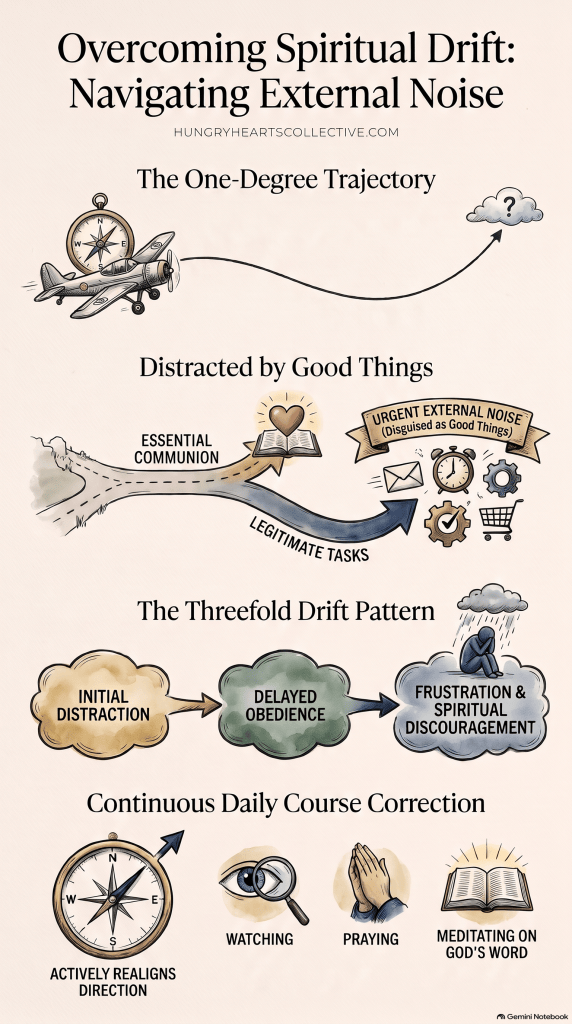
Imagine boarding an aircraft in London. The pilot enters the intended destination, the aircraft takes off, and everything appears perfectly normal. But somewhere along the journey, the aircraft’s heading shifts by just one degree. The passengers notice nothing. The engines continue operating. The aircraft continues making progress. Yet the longer it flies without correcting that heading, the farther it travels from its intended course.
KEY POINT
Small distractions can steadily redirect our attention; returning to prayer, Scripture and deliberate priorities helps us correct our course.
After a thousand miles, a constant one-degree deviation can produce approximately seventeen miles of lateral displacement. The error has not grown exponentially; the accumulated distance has grown with the journey.
We can be moving constantly while moving away from where we intended to go.
I wonder how many Christians experience something similar. We begin with a genuine desire to know God, to pray, to meditate on His Word and to live according to His promises. Then life becomes busy. An appointment interrupts prayer. A notification interrupts meditation. An urgent responsibility displaces an important commitment. A week becomes a month. A month becomes a year. We did not necessarily reject God. We simply stopped correcting our course.
SIGNAL-TO-NOISE RATIO: WHEN EVERYTHING DEMANDS OUR ATTENTION
Modern life presents us with an extraordinary quantity of information. Messages, news, advertising, social media, professional responsibilities, entertainment and the expectations of others compete continuously for our attention. Not all these things are evil. Many are legitimate. But something does not need to be sinful to become spiritually disruptive.
A good responsibility can become a distraction when it repeatedly displaces a greater priority. This is what makes external noise particularly difficult to recognise. It often arrives disguised as something important: a message that must be answered, a problem that must be solved, a conversation that cannot wait. Before we realise it, the time intended for God has disappeared.
MARTHA: DISTRACTED BY GOOD THINGS
Luke 10:38–42 offers a remarkable illustration. Martha welcomed Jesus into her home and became occupied with serving. Mary sat at His feet and listened. Jesus did not condemn Martha for serving. He identified something happening within her:
“Martha, Martha, thou art careful and troubled about many things” (Luke 10:41, KJV).
The Greek verb describing Martha’s distraction is περιεσπᾶτο (periespato), conveying the idea of being drawn away. Martha was doing something good while becoming disconnected from the presence that gave her service its meaning.
We can become so busy doing things for God that we neglect being with God.
The issue is not service versus contemplation. It is whether our activity flows from communion or continually displaces it.
THE TYRANNY OF URGENCY
Urgency is a powerful competitor for attention. Important things often do not shout; urgent things usually do. A ringing telephone demands an immediate response. An incoming message announces its arrival. A deadline creates pressure.
Spiritual formation develops quietly through repeated practices whose benefits are not immediately visible: prayer, meditation, silence, study, obedience, fellowship and rest. These disciplines rarely compete successfully with a constantly ringing telephone unless we deliberately protect them.
Who determines the priorities of my day: my calling or my interruptions? If every external demand has permission to override prayer, then I have effectively surrendered control of my spiritual timetable.
THE TRIFECTA: DISTRACTION, DELAY AND DISCOURAGEMENT
External noise frequently operates through the threefold pattern explored in THE ENEMY’S STRATEGY: RECLAIMING ATTENTION, OBEDIENCE AND HOPE (currently a companion draft).
- Distraction redirects attention away from what matters.
- Delay postpones the obedience that should follow understanding. Discouragement develops when repeated postponement produces frustration and apparent stagnation.
We become distracted, fail to act, experience little progress and then become discouraged. Discouragement makes us increasingly vulnerable to further distraction. The pattern becomes self-reinforcing. Not every interruption is a spiritual attack, and not every delay represents disobedience; nevertheless, these mechanisms can weaken consistency.
THE ONE-DEGREE PROBLEM: SMALL DEVIATIONS, GREAT DISTANCES
The pilot does not wait until the aircraft is hundreds of miles away before adjusting its heading. Navigation requires continuous monitoring and periodic correction. A missed prayer appointment does not mean we have abandoned God. A difficult week does not erase years of faithfulness. But repeated neglect, left unexamined, can establish a new normal. Proverbs 4:26 says,
“Ponder the path of thy feet, and let all thy ways be established” (KJV).
The Hebrew verb פַּלֵּס (pallēs) is associated with weighing or making level a path. We must periodically examine not merely how fast we are moving, but where we are going.
Progress without direction is not necessarily progress.
WATCH AND PRAY: THE DISCIPLINE OF COURSE CORRECTION
Jesus instructed His disciples,
“Watch and pray, that ye enter not into temptation” (Matthew 26:41, KJV).
Watching requires awareness. Prayer cultivates dependence. Obedience gives practical expression to what we have understood. Together, they form a rhythm of spiritual attentiveness.
Watching helps us recognise when priorities have shifted. Prayer brings those priorities before God. Obedience corrects the direction of our lives. This is why I consider a regular appointment with God so important. Our daily prayer time is not simply an opportunity to present requests. It is a time to correct our direction, to realign ourselves with the Lord.
Have I become consumed with matters that are secondary? Am I neglecting something God has made clear? Have I allowed others’ expectations to determine the shape of my spiritual life? The purpose is not condemnation but correction. A pilot does not consider a course adjustment evidence of failure. Correction is part of successful navigation.
HĀGÂ: MEDITATION AS THE RECOVERY OF ATTENTION
Joshua 1:8 instructs Joshua to meditate upon the Book of the Law day and night. The Hebrew verb הָגָה (hāgâ) can describe murmuring, pondering or meditating. Biblical meditation can include speaking, rehearsing, contemplating and applying God’s instruction. The passage explicitly connects meditation with obedience.
Every environment repeatedly presents information that shapes expectations. Advertising tells us what we supposedly lack. Social media tells us what others are doing. News cycles tell us what we should fear. None of these voices is automatically false, but none should possess unquestioned authority over our understanding.
Meditation provides a deliberate alternative.
We choose what will repeatedly occupy our attention, because what occupies our attention gradually influences how we interpret life, and consequently, how we experience life.
THE COST OF A FRAGMENTED LIFE
Attention is finite. Every moment devoted to one activity is a moment unavailable for another. This is not an argument against work, family responsibilities, recreation or technology. It is an argument for intentionality.
External noise can fragment our capacity for sustained attention. We become accustomed to switching tasks before completing them. We struggle to remain with Scripture long enough to understand it. We approach prayer with the hurried expectations we bring to digital communication. Silence begins to feel uncomfortable.
Love requires presence. Wisdom requires stillness. Understanding requires patience. Obedience often requires faithfulness when there is no immediate reward. A fragmented life makes these practices increasingly difficult.
THE SECRET PLACE: RESTORING THE CENTRE
Psalm 91:1 speaks of dwelling in the secret place of the Most High. John 15 speaks of abiding in Christ. The Greek verb μένω (menō) means to remain, stay or abide. These passages are not identical, but together they offer a picture of sustained relationship.
We are not called merely to visit God during emergencies. We are invited into an ongoing life of communion. As Jesus stated,
“The one who remains in Me, and I in him, will bear much fruit. For, apart from Me you can do nothing.” (John 15:5, BSB).
The secret place must become the organising centre of daily life, not because every Christian must follow an identical timetable, but because relationships require attention. And attention must be protected.

A SEVEN-DAY EXTERNAL NOISE AUDIT
Day one: Record unnecessary digital interruptions.
Day two: Protect a fixed appointment with God.
Day three: Spend twenty uninterrupted minutes with one passage of Scripture.
Day four: Complete one neglected responsibility.
Day five: Identify one commitment that can be reduced.
Day six: Create a period without digital stimulation.
Day seven: Review your direction and establish a sustainable rhythm.
The purpose is not to withdraw from ordinary life. It is to recover the ability to live ordinary life from a place of spiritual attentiveness.
REFLECTION QUESTIONS
Which external demands most frequently displace my time with God? Have I confused urgency with importance? What good activities have gradually become substitutes for communion? Where have small interruptions accumulated into significant spiritual drift? What boundaries would help me protect prayer, meditation and obedience?
A PRAYER FOR RECOVERED ATTENTION
Father, forgive me for the times I have allowed the demands of life to determine the direction of my heart. Teach me to recognise the difference between what is urgent and what is eternally important. Restore my delight in Your Word. Give me wisdom to order my responsibilities without neglecting the relationships and duties You have entrusted to me. Help me to watch, pray and obey. When I begin to drift, draw my attention back to Your truth. In Jesus’ name, amen.
CONCLUSION: DO NOT WAIT UNTIL YOU ARE MILES OFF COURSE
Spiritual drift rarely announces itself. It develops through small deviations that become familiar. But the same principle works in reverse. A life can be redirected through small, consistent acts of faithfulness: one protected prayer appointment, one passage carefully meditated upon, one act of obedience, one distraction surrendered, one renewed decision to abide in Christ.
We do not need to wait for a crisis before correcting our course.
The secret of reaching our spiritual destination is not that we never drift. It is that we continually return to the One who gives our lives direction.
Stay abiding.
Leave a Reply