
The Enlarged Heart: Awakening from the Limitations of the Physical Realm to the Unlimited Life We Have in Christ
An exploration of Psalm 119:25–32 through Hebrew linguistics, Jewish mysticism, the New Testament and the spiritual practice of abiding.
HUNGRYHEARTSCOLLECTIVE.COM
INFOGRAPHIC
VIDEO
AUDIO
KEY THOUGHT FROM TODAY’S PASSAGE
Psalm 119:25–32 — DALETH: THE DOOR / ENTRANCE
The greatest limitation in the Christian life may not be what we lack, but what we are conscious of.
The illusion of separation from God, and from His provisions for us in His Son, is an expression of the limitations of the five physical senses.
We can move from clinging to our dusty abilities to having our hearts and spiritual capacity enlarged, so that we move from a narrow bandwidth of consciousness (the physical senses) to an expansive bandwidth of consciousness (seeing with the eyes of our hearts the infinite provision of God).
Dust cannot inherit the kingdom of God, but spiritually we are already heirs to all the promises of God in Christ (2 Corinthians 1:20; compare 1 Corinthians 15:50).
ENTER THE DOOR
Avoid the temptation of being hypnotised by the physical realm into an altered state of consciousness—spiritual amnesia—the underlying cause of the illusion of separation from God.
Rather, become spiritually conscious, allowing your heart and understanding to be enlarged through communion with the Lord and His words.
That is, abiding in Him through prayer and allowing His words to abide richly within us through internalisation (John 15; Psalm 119:11; 3 John 1:2).
The door is not an escape from the physical world but an entrance into a greater consciousness of the spiritual reality already available to us in Christ.
KEY VERSE
“I am the vine and you are the branches. The one who remains in Me, and I in him, will bear much fruit. For apart from Me you can do nothing.”
— John 15:5
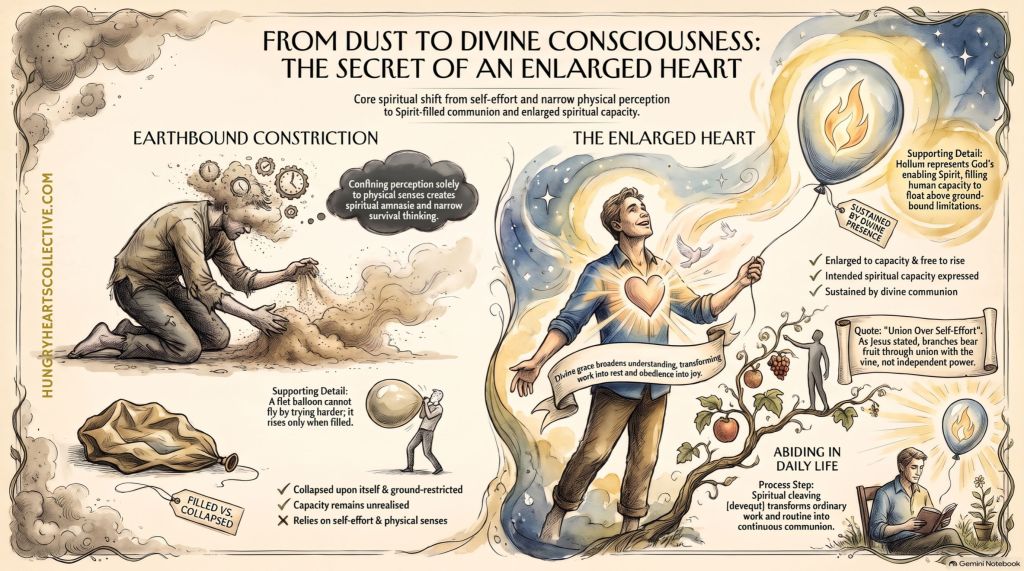
THE HELIUM BALLOON: A PARABLE OF THE ENLARGED HEART
Before we begin our journey through Psalm 119, I want you to imagine two balloons.
They are identical.
They were manufactured from the same material, possess the same potential capacity and were designed to perform precisely the same function.
Yet their present conditions could not be more different.
The first balloon lies flat upon the ground.
It is deflated, collapsed upon itself, unable to rise above the surface upon which it rests.
It has the capacity to expand, but that capacity remains unrealised.
Now consider the second balloon.
It has been filled with helium.
The same balloon that previously lay lifeless upon the ground is now expanded, full and floating freely in the air.
What changed?
Not its fundamental construction.
Not the material from which it was made.
Not its original design.
What changed was what filled it.
And that is the picture I want you to carry with you as we explore the mystical meaning of the enlarged heart.
THE FLAT BALLOON AND THE HELIUM-FILLED BALLOON
| The flat balloon | The helium-filled balloon |
|---|---|
| Collapsed upon itself | Enlarged to its intended capacity |
| Restricted to the ground | Free to rise |
| Its capacity remains unrealised | Its capacity is expressed |
| Represents the dustbound orientation | Represents spiritual enlargement |
| Dependent upon external support to remain elevated | Sustained by what fills it |
Helium is particularly interesting because it belongs to a class of chemical elements known as the noble gases.
It is exceptionally stable and chemically unreactive under ordinary conditions.
Unlike ordinary air, helium is much less dense than the surrounding atmosphere. The buoyant force exerted by the displaced air can therefore cause a sufficiently filled balloon to rise.
The balloon does not need to grow wings.
It does not need to acquire an engine.
Nor does it need to struggle against gravity by generating its own power.
Its ability to rise comes from a fundamental change in what fills it.
In our analogy, helium represents the enabling presence and life of God’s Spirit, while the balloon represents the human being and, more specifically, the capacity of the human spirit to participate in spiritual life.
We should not press the comparison beyond its purpose: God’s Spirit is a living, personal divine presence, not an inert physical substance. The noble gas is simply a memorable illustration of stable, sustaining fullness.
Yet the image communicates something profound.
A balloon may be enlarged merely by filling it with ordinary air, but enlargement alone does not guarantee that it will rise. What fills it matters.
Similarly, the human mind may be filled with knowledge, opinions, intellectual arguments and religious information without necessarily becoming spiritually alive to the realities of communion with God.
We may possess an impressive knowledge of Scripture while remaining largely unconscious of the life to which Scripture directs us.
The question is not simply how much information we have accumulated.
It is what animates our inner life.
SPIRITUALLY GAS-POWERED CHRISTIANITY
I realise that describing the Christian life as “spiritually gas-powered” sounds rather unconventional.
But perhaps that is exactly why the illustration is useful.
A flat balloon cannot make itself float by trying harder.
Similarly, there are Christians who spend their lives attempting to produce through self-effort what can only be sustained through communion with God.
They try to overcome the flesh through greater determination.
They attempt to manufacture love, joy and peace through sheer willpower.
They strive to produce spiritual fruit independently of the very life from which that fruit must grow.
But Jesus says:
“Apart from Me you can do nothing.” — John 15:5
Notice that the branch does not generate the life of the vine.
It receives that life through its union with the vine.
The resulting fruit is produced in the branch, but the branch is not an independent source of life.
This distinction is also fundamental to how I understand Paul’s language of walking according to the spirit rather than the flesh.
In passages such as Romans 8:5–6 and Galatians 5, I understand the contrast, in significant measure, as one between the fleshly orientation of the human being and the orientation of the renewed human spirit.
The original Greek manuscripts did not employ the modern English distinction between capitalised Spirit and lowercase spirit. The interpretation must therefore arise from grammar and context, and the identification of the referent remains debated.
The human spirit is not the Holy Spirit.
But the human spirit is intended to live in communion with God, receiving and responding to His life.
In the analogy, the balloon represents our capacity; the helium represents God’s enabling presence; and the rising represents the freedom of a spiritually responsive life.
The fruit appears in us as we abide in Christ.
This is why an enlarged heart is not simply an intellectually expanded mind.
It is an inner life made increasingly capable of receiving, recognising and responding to God’s life.
WHAT MATTHEW HENRY SAW
Matthew Henry, commenting on Psalm 119:32, associated the enlargement of the heart with divine grace, wisdom, love and joy.
He concluded with a beautiful observation:
“The joy of our Lord should be wheels to our obedience.”
What an extraordinary picture.
Obedience was never intended to be merely the exhausting movement of a soul dragging itself along the ground.
The enlarged heart acquires a freedom, an eagerness and a capacity for movement that it did not previously demonstrate.
And Charles Spurgeon’s Treasury of David preserves an insight attributed to Thomas Manton that is especially relevant here: our narrow expectations can restrict our apprehension of God’s greatness.
The limitation is not necessarily in God.
It may lie in the smallness of our understanding of Him.
Consider that for a moment.
God does not need to become greater. Our hearts need to become more capable of apprehending His greatness.
The helium-filled balloon gives us a simple way of picturing this.
We do not need to persuade God to become greater, more generous or more faithful.
We need our inner lives enlarged so that we become increasingly receptive and responsive to the reality of who He already is.
And here is the most important distinction.
The balloon does not rise because it has mastered the art of flying. It rises because of what fills it.
This is the difference between self-salvation and abiding.
Between striving to manufacture spiritual life and learning to participate in the life that comes from Christ.
The psalmist describes this transformation beautifully:
“I will run in the way of Your commandments, for You will enlarge my heart.” — Psalm 119:32
The flat balloon cannot fly.
The enlarged balloon does not need to try to fly.
And the spiritually enlarged heart need not approach every act of obedience as an exhausting attempt to generate its own life.
The secret is not greater self-generated effort. The secret is an enlarged capacity for communion.
Keep these two balloons in mind as we proceed.
We are about to discover that Psalm 119 begins with the human soul attached to the dust and ends with the human heart enlarged sufficiently to run freely in God’s ways.
INTRODUCTION: WE HAVE BEEN LIVING IN TOO SMALL A WORLD
I want to suggest something rather provocative: the greatest limitation in the Christian life may not be what we lack, but what we are conscious of.
We have become so accustomed to experiencing life through our five physical senses that we frequently mistake what we can perceive for the totality of what exists.
What we see, hear, touch, taste and feel becomes our reality. Our circumstances become the evidence by which we determine what is possible, what is available, and ultimately, who we are.
Yet Christianity introduces us to an extraordinary proposition: there is an entire dimension of reality that cannot be adequately apprehended through the physical senses alone.
Paul writes:
“We look not at the things which are seen, but at the things which are not seen. For the things which are seen are temporary, but the things which are not seen [by sphysical perception] are eternal.” — 2 Corinthians 4:18
And again:
“God has blessed us in Christ with every spiritual blessing in the heavenly places.” — Ephesians 1:3
Notice the tense. God has blessed us.
These blessings are not presented merely as possibilities that might become available at some future date. In Christ, they have already been given.
Paul goes even further in 1 Corinthians 2:12:
“We have received … the Spirit who is from God, that we might understand [by spiritual perception] the things freely given us by God.”
Here is the problem.
We may possess something in Christ without having developed the spiritual understanding necessary to recognise and participate in it.
This is why I have become increasingly interested in the relationship between consciousness, identity, the Word of God and spiritual practice.
Psalm 119:25–32 provides an extraordinary framework for exploring this subject.
It describes a movement from a soul attached to the dust to a heart enlarged by God.
I propose that we can read this movement mystically as a transition from constricted, physically dominated perception to an expanded spiritual consciousness grounded in God’s Word.
This is an interpretative, canonical reading of the psalm. Its immediate historical meaning concerns distress, faithful obedience and God’s sustaining instruction. But when read in conversation with Genesis, the teachings of Jesus, Paul and the Jewish mystical tradition, a remarkable picture emerges.
The psalmist begins trapped in the dust.
He ends running in freedom.
And the difference is what has happened to his heart.
1. THE HUMAN CONSTRUCT: DUST AND THE BREATH OF GOD
To understand Psalm 119, we must first return to the beginning.
Genesis 2:7 describes the creation of humanity:
וַיִּיצֶר יְהוָה אֱלֹהִים אֶת־הָאָדָם עָפָר מִן־הָאֲדָמָה וַיִּפַּח בְּאַפָּיו נִשְׁמַת חַיִּים וַיְהִי הָאָדָם לְנֶפֶשׁ חַיָּה׃
Vayyîtser YHWH ʾĔlōhîm ʾet-hāʾādām ʿāfār min-hāʾădāmāh, vayyippaḥ beʾappāyv nishmat ḥayyîm, vayhî hāʾādām lenefesh ḥayyāh.
“The LORD God formed the man from the dust of the ground, breathed into his nostrils the breath of life, and the man became a living being.“
Notice the elements of this description.
| Hebrew | Transliteration | Meaning |
|---|---|---|
| עָפָר | ʿĀfār | Dust, earth |
| אֲדָמָה | ʾĂdāmāh | Ground, soil |
| נִשְׁמַת חַיִּים | Nishmat ḥayyîm | Breath of life |
| נֶפֶשׁ חַיָּה | Nefesh ḥayyāh | Living being |
The biblical account does not describe humanity as merely a physical object.
Nor does it present the human being simply as a spirit temporarily imprisoned inside a body.
Rather, the human being is a living unity: formed from the ground, animated by divine breath, and brought into relationship with the Creator.
For the purposes of our mystical reading, however, we can distinguish two dimensions of human existence.
Dust represents our material constitution—our bodily existence, biological needs, mortality and sensory engagement with the world.
The breath of life directs our attention towards our God-given existence, which cannot be reduced to the material ingredients from which the body is formed. It is the breath of God fill us with life, not our own clumsy efforts.
This distinction is theological rather than a strict division of human anatomy.
The body is not evil. The physical world is not a mistake. God’s creation is good.
The problem begins when the physical dimension of existence becomes the exclusive reference point by which we interpret life.
Put differently:
Dust is not our enemy. Confining our consciousness to the dust is our limitation.
And this is precisely where Psalm 119 begins.
2. DĀVEQĀH: THE SOUL THAT CLINGS TO THE DUST
Psalm 119:25:
דָּבְקָה לֶעָפָר נַפְשִׁי חַיֵּנִי כִּדְבָרֶךָ׃
Dāveqāh leʿāfār nafshî; ḥayyēnî kidvārekhā.
“My soul clings to the dust; give me life according to Your word.”
The Hebrew word I want us to examine is:
דָּבְקָה — Dāveqāh
It comes from the root דבק (d-b-q), meaning to adhere, cling, cleave, hold fast or become attached.
This is not the language of casual interest.
It is the language of attachment.
The same root appears in Genesis 2:24, describing a husband cleaving to his wife.
It also appears in Deuteronomy, where Israel is commanded to cling to God.
Now consider the implications.
The psalmist declares that his soul is attached to the dust.
In its immediate literary meaning, this describes profound humiliation, distress and proximity to death.
But there is another way of reading this image at the level of spiritual anthropology.
What if the dust represents the restricted horizon of our physical perception?
What if the psalmist is describing the condition of humanity whose attention has become absorbed by the material realm?
We are physically constituted from dust, yet our capacity for consciousness is not intended to be confined to the information provided by the dust.
The physical senses report the circumstances.
They report symptoms, danger, scarcity, opposition and mortality.
These reports may be entirely accurate.
But they are not necessarily a complete account of reality.
The senses can tell us that our circumstances are difficult. They cannot, by themselves, disclose everything God has made available to us in Christ.
This is the distinction I want to establish.
The problem is not that the physical senses are lying to us. The problem is that they possess only a narrow band of information.
They are useful instruments for navigating physical existence. They were never intended to be the final authority concerning spiritual reality.
The soul that clings exclusively to this narrow band of perception becomes restricted to it.
It begins to derive its identity, expectations and understanding of life primarily from what it can physically verify.
This is the human condition I believe Psalm 119 invites us to examine.
We have become attached to the dust.
And so the psalmist cries:
חַיֵּנִי — Ḥayyēnî — Give me life!
But notice where he expects that life to come from.
“According to Your word.”
Not according to his circumstances.
Not according to the limitations of his physical perception.
According to what God has spoken, and words are formed from breath.
This introduces the central mechanism of the entire passage:
The Word of God is the means through which the earthbound soul is reoriented towards life.
3. MAN DOES NOT LIVE BY BREAD ALONE: THE TWO HORIZONS OF HUMAN EXISTENCE
This brings us directly to Deuteronomy 8:3.
כִּי לֹא עַל־הַלֶּחֶם לְבַדּוֹ יִחְיֶה הָאָדָם כִּי עַל־כָּל־מוֹצָא פִי־יְהוָה יִחְיֶה הָאָדָם׃
Kî loʾ ʿal-halleḥem levaddô yiḥyeh hāʾādām; kî ʿal-kol-môtsāʾ pî-YHWH yiḥyeh hāʾādām.
“Man does not live by bread alone, but by everything that proceeds from the mouth [breath] of the LORD.”
Consider the contrast.
Bread is physical.
It sustains the biological organism.
But Moses tells Israel that the human being cannot live by physical nourishment alone.
There is another dependence: the Word that proceeds from the mouth of God.
The manna narrative teaches Israel that even their physical survival ultimately depends upon God’s faithful provision.
But the theological principle is broader.
The human being was not created to exist independently of the Creator.
We were designed for continuous dependence upon God.
Jesus repeats this passage in Matthew 4:4 when tempted to satisfy His physical hunger by turning stones into bread.
He refuses to allow a legitimate physical need to override the authority of His Father’s Word.
Notice that Jesus does not deny His hunger.
He simply refuses to make the demands of His physical condition the supreme authority governing His actions.
Here we see the distinction between two orientations of consciousness.
- The earthbound orientation asks: What do my senses tell me I need to do in order to survive (save myself)?
- The spiritually oriented mind asks: What has my Father said, and how am I to live in agreement (alignment) with Him?
Both acknowledge physical reality.
Only one treats physical reality as the ultimate reference point.
This is why our spiritual diet matters.
We become deeply influenced by the words we repeatedly entertain, believe and act upon.
The issue is not merely the information we consume.
It is the authority we assign to that information.
We were created to live from the Word of God, not merely to survive through our responses to the physical world.
4. TORAH, HORA’AH AND RHEMA: WORDS THAT COMMUNICATE LIFE
There is a fascinating linguistic relationship that helps us appreciate the significance of divine instruction.
The Hebrew word תּוֹרָה (tôrāh) is commonly translated law.
But its more fundamental meaning is teaching, instruction or direction.
It is associated with the Hebrew root ירה (y-r-h), whose range of meanings includes shooting, directing, showing and instructing.
The related Hebrew verb הוֹרָה (hôrāh) means he instructed or directed, while הוֹרָאָה (hôrāʾāh) is a noun meaning instruction or direction.
| Word | Language | Meaning |
|---|---|---|
| תּוֹרָה — Tôrāh | Hebrew | Instruction, teaching, law |
| הוֹרָה — Hôrāh | Hebrew | He instructed or directed |
| הוֹרָאָה — Hôrāʾāh | Hebrew | Instruction, direction |
| λόγος — Logos | Greek | Word, message, discourse, reason |
| ῥῆμα — Rhēma | Greek | Word, saying, utterance |
This is important because we frequently approach Scripture as though it were merely a collection of religious regulations.
But Torah is fundamentally about instruction in the way of life.
It is divine teaching that directs human understanding and conduct.
The Word does not exist merely to provide information about God.
It teaches us how to live in relationship with Him.
HORA’AH: THE EDENIC CONNECTION BETWEEN INSTRUCTION AND HEARING
There is a fascinating linguistic connection I want to explore through the lens of Edenics, the hypothesis that modern languages preserve traces of an original language closely associated with biblical Hebrew.
The Hebrew הוֹרָה (hôrāh), meaning he instructed, directed or taught, belongs to the same linguistic family as תּוֹרָה (Torah), meaning instruction.
Now consider the striking phonetic resemblance to the Germanic words:
- Afrikaans: hoor — to hear.
- Dutch: horen (historically hooren) — to hear.
- German: hören — to hear.
- English: hear — to hear.
Within an Edenic framework, one might propose that these words preserve an ancient relationship between instruction and hearing.
This is a speculative connection, not an established etymology. Historical linguistics traces the Germanic words to Proto-Germanic hauzijaną and ultimately to Indo-European ancestry, rather than deriving them from Hebrew hôrāh.
Nevertheless, the conceptual relationship is fascinating.
Instruction presupposes hearing, but biblical hearing demands more than the reception of sound. It calls for attentive understanding and response.
This brings us to the Hebrew שָׁמַע (shāmaʿ), which can mean to hear, listen or obey.
Perhaps the deepest significance of this proposed Edenic connection is not merely that the words sound alike, but that they point us towards a biblical principle:
God speaks to impart life. We hear to receive His instruction. And through believing and responding to His Word, that instruction becomes formative in our lives.
The Word is not merely something to be studied. It is something to be heard, internalised and lived.
“Man shall not live by bread alone, but by every word that proceeds from the mouth of God.” — Matthew 4:4
THE WRITTEN WORD AND THE SPOKEN WORD
Christians sometimes distinguish between logos as the written Word and rhēma as a personally spoken or presently applied Word.
That distinction can be useful devotionally, but it must not be overstated linguistically.
The Greek terms overlap. Logos is not restricted to written Scripture, and rhēma does not automatically mean a private revelation.
A more reliable theological distinction is between God’s enduring written revelation and the Word as proclaimed, heard, understood and brought to bear upon our lives through the Spirit.
These are not competing sources of truth.
The living activity of God’s Spirit does not make the written Word obsolete. Nor should an alleged personal message from God be permitted to contradict the revelation of Christ.
Consider Matthew 4:4.
Jesus quotes the written Scriptures, saying:
“Man shall not live by bread alone, but by every word that proceeds from the mouth of God.”
The Greek word translated word here is ῥῆμα (rhēma).
Jesus employs the written Word to affirm humanity’s dependence upon God’s utterance.
This destroys any simplistic opposition between the written and spoken Word.
God has spoken. His testimony has been preserved. His message is proclaimed. The Holy Spirit brings understanding and conviction so that what we hear becomes formative in our lives.
And this brings us to one of the most extraordinary statements in the New Testament.
5. WORDS BY WHICH YOU AND YOUR HOUSEHOLD WILL BE SAVED
In Acts 11:14, Peter recounts the angelic instruction given to Cornelius.
The angel had told Cornelius that Peter:
“Will speak words to you by which you will be saved, you and all your household.”
The Greek reads:
ὃς λαλήσει ῥήματα πρὸς σὲ ἐν οἷς σωθήσῃ σὺ καὶ πᾶς ὁ οἶκός σου.
Hos lalēsei rhēmata pros se, en hois sōthēsē sy kai pas ho oikos sou.
He will speak words to you through which you and all your household will be saved.
The crucial expression is:
ῥήματα — Rhēmata — Words, utterances.
Think about what this passage is telling us.
God sends an angel to Cornelius, but the angel does not simply announce that Cornelius has received everything he needs.
Instead, Cornelius is instructed to summon Peter.
Why?
Because Peter will speak words.
And these words will communicate the message through which Cornelius and his household may receive salvation.
The context makes clear that these are the words of the gospel concerning Jesus Christ, not mysterious syllables possessing independent magical power.
Acts 10 records Peter proclaiming Christ’s life, death, resurrection and forgiveness through His name.
While Peter is speaking, the Holy Spirit falls upon those hearing the message.
Here is the relationship:
God’s Word is proclaimed, the message is heard, Christ is revealed, and salvation is received through faith.
Notice the role of hearing.
Romans 10:17 tells us:
“Faith comes from hearing, and hearing through the word [breath] of Christ.”
Again, the Greek employs rhēma.
And Acts 16:31–32 provides a complementary household example: Paul calls the Philippian jailer to believe in the Lord Jesus and then speaks the Word of the Lord to everyone in his house.
The promise is not that our words automatically save unwilling people.
Rather, God’s saving message is made known so that people may hear and respond in faith.
The Spirit–breath of God–follows the word of God.
Yet the principle is astonishing:
Words can communicate the revelation by which an entire household encounters the saving work of Christ.
The same God who created by speaking has chosen to communicate the gospel through words.
This is why I am so concerned about spiritual ignorance.
Many Christians spend years trying to obtain from God what He has already provided in Christ, because they have never understood the testimony of His Word.
The answer is not simply to become more religious.
It is to hear, understand, believe and live in agreement with what God has said.
6. THE RELOCATION OF CONSCIOUSNESS: FROM MY STORY TO GOD’S STORY
Psalm 119:26–27 describes the next movement:
“I recounted my ways, and You answered me; teach me Your statutes. Make me understand the way of Your precepts, and I will meditate on Your wonders.”
The word translated recounted is סִפַּרְתִּי (sippartî).
It comes from the Hebrew root ספר (s-p-r), which includes recounting, narrating and relating.
The psalmist brings his story before God.
But he does not stop there.
He asks God to teach him (God’s story).
This is a profound change in the relationship between experience and interpretation.
Most of us construct an understanding of ourselves and the world from the experiences we accumulate.
Over time, these experiences become our autobiographical narrative.
We explain who we are, what life is like, what people are like, and what we can reasonably expect in the future.
Our experiences may be real, but our interpretation of them is not necessarily complete or correct since they are subjective and filtered through our limited understanding.
This is especially important when our lives have been shaped by disappointment, rejection, fear or repeated failure.
We can become attached to the story of our circumstances.
But the psalmist effectively says:
Here is my story, Lord. Now teach me Yours.
He is moving from self-referential interpretation towards revelation.
He then asks:
הֲבִינֵנִי — Havînēnî — Make me understand.
The root בין (bîn) concerns understanding and discernment.
It is not enough merely to hear the words.
The psalmist wants to understand the way they reveal.
And then:
וְאָשִׂיחָה — Veʾāśîḥāh — I will meditate.
This is where sustained spiritual practice enters.
Meditation is the deliberate occupation of the mind with what God has revealed.
We are all meditating on something.
Some of us spend hours rehearsing conversations, anxieties, disappointments and imagined future catastrophes.
We call this thinking.
But much of it is actually rumination.
The same mind that can repeatedly rehearse a feared outcome can be intentionally occupied with divine truth.
This is why Joshua 1:8 calls for continual meditation upon the Book of the Law.
And why Deuteronomy 6:6–7 places God’s words upon the heart and calls for them to be spoken throughout ordinary daily life.
The Word becomes formative through sustained attention, understanding, remembrance and faithful practice.
The question is not merely whether I have read the Bible today.
The question is whether I am allowing God’s Word to become the governing reference point of my consciousness and my interpretation of reality.
7. THE WAY OF FALSEHOOD AND THE WAY OF FAITHFULNESS
Verses 29–30 introduce another important development.
“Remove the way of falsehood from me, and graciously grant me Your instruction. I have chosen the way of faithfulness; I have set Your judgements before me.”
The Hebrew describes two opposing ways:
דֶּרֶךְ־שֶׁקֶר — Derekh-sheqer
The way of falsehood.
דֶּרֶךְ־אֱמוּנָה — Derekh-ʾemûnāh
The way of faithfulness (agreement with truth).
The word ʾemûnāh belongs to the same Hebrew family as amen, with associations of reliability, firmness, trustworthiness and faithfulness.
This is not merely about adopting more positive thoughts.
It is about choosing what is true and worthy of trust.
The psalmist declares:
בָחָרְתִּי — Bāḥārtî — I have chosen.
He has chosen the faithful way.
This is enormously significant.
We cannot always choose the circumstances in which we find ourselves.
We cannot necessarily control every thought or feeling that enters our awareness.
But we can learn to choose what we give sustained attention to and which testimony will govern our response. As Isaiah 53:1 states,
“Who has believed our message and to whom has the arm of the LORD been revealed?”
Here we encounter a close theological parallel to Romans 8:5–6.
Paul distinguishes between the phronēma of the flesh and the phronēma of the spirit.
The Greek φρόνημα (phronēma) concerns the mindset, disposition or governing orientation of a person.
In my understanding of Paul’s argument, this contrast concerns the orientation of human consciousness: towards the flesh and its limited sensory horizon, or towards the renewed human spirit, through which we become spiritually responsive to God.
Many English translations capitalise Spirit here, identifying the referent with the Holy Spirit. That is an important traditional reading, but the capital letter itself is an editorial decision rather than an independent grammatical proof.
The distinction matters because it restores attention to human participation and responsibility.
God’s Spirit is the divine source of life; the renewed human spirit is the inward dimension of our being called to live consciously in response to Him.
The fleshly orientation is not merely the fact of possessing a physical body.
It is a mode of living governed by fleshly desires and priorities rather than a life directed towards God.
In the theological framework I have been developing from Genesis 3, humanity’s tragedy can be described as a relocation of attention.
The human being, created for communion with God, gives decisive authority to a creaturely voice over the divine Word.
The consequence is not merely a wrong action.
It is a disruption of the human being’s relationship to truth.
The way back therefore involves more than behavioural correction.
It involves the restoration of our spiritual orientation.
The way out of deception is to return our attention to truth.
And this is precisely what the psalmist does.
8. DEVEQUT: THE MYSTICAL ART OF CLEAVING TO GOD
We now arrive at verse 31:
דָּבַקְתִּי בְעֵדְוֹתֶיךָ יְהוָה אַל־תְּבִישֵׁנִי׃
Dāvaqtî beʿēdvotekhā, YHWH; ʾal-tevîshēnî.
“I have clung to Your testimonies, LORD; do not let me be put to shame.”
Something remarkable has happened.
In verse 25, the soul clings to the dust.
In verse 31, the person clings to God’s testimony.
The same Hebrew root appears in both places.
דבק — D-b-q — To cleave.
The soul has not lost its capacity for attachment.
Its attachment has changed.
This is where Jewish mysticism introduces us to the concept of דְּבֵקוּת (devequt).
Devequt refers to cleaving to God, an enduring awareness of His presence, and an intimate orientation of the entire person towards Him.
The idea has biblical roots and became particularly important in Kabbalistic and Hasidic spirituality.
In Hasidic thought, the goal was not simply to experience occasional moments of religious intensity.
It was to cultivate continuous communion with God, even while participating in the ordinary activities of life.
This reminds me of Brother Lawrence (1614–1691), the seventeenth-century French Carmelite lay brother whose spiritual insights were later collected in the remarkable little book The Practice of the Presence of God.
Brother Lawrence discovered that communion with God was not something to be confined to scheduled prayer, religious ceremonies or contemplative solitude. Even while performing the most mundane tasks in the monastery kitchen, he cultivated a continuous inward awareness of God’s presence.
For him, washing dishes and preparing meals could become just as spiritually significant as kneeling in prayer. He famously observed that “The time of business does not with me differ from the time of prayer,” describing a life in which outward activity and inward communion were no longer competing occupations.
What strikes me is that Brother Lawrence was not attempting to escape the physical world but had learned to inhabit it from an entirely different orientation of consciousness. His attention remained attached to God while his hands remained occupied with ordinary work.
This is precisely the principle of devequt and Christian abiding: we do not need to withdraw from life to experience communion with God; we need to learn to live our entire lives consciously in His presence.
Prayer ceases to be merely an activity we perform and becomes the abiding relationship from which all our activities proceed.
This is particularly interesting when compared with the Christian teaching of abiding.
Jesus says in John 15:
“Abide in Me, and I in you.”
The Greek verb μένω (menō) means to remain, stay, continue or abide.
It is not the Greek equivalent of dāvaq, but the two concepts share an important relational dimension: continuity of attachment and communion.
And Paul provides an even closer linguistic connection.
In 1 Corinthians 6:17 he writes:
ὁ δὲ κολλώμενος τῷ κυρίῳ ἓν πνεῦμά ἐστιν.
Ho de kollōmenos tō kyriō hen pneuma estin.
“The one who is joined to the Lord is one spirit with Him.”
The Greek kollaō means to join or cleave, and this is the same word family used to translate dāvaq in the Greek Old Testament.
Now we can begin to appreciate the significance.
The Christian life is not merely an attempt to imitate someone from a distance. It is a life lived in communion with Christ.
We are called to abide in Him.
And this communion is intended to become increasingly conscious and formative.
The problem is not necessarily that Christ is absent.
It may be that our attention has become so consumed with the dust that we are scarcely conscious of the communion into which we have been brought.
This is what I mean by spiritual awakening.
Not inventing something that was never there.
But awakening to what is already true in Christ.
9. THE ENLARGED HEART: FROM NARROW PERCEPTION TO SPIRITUAL SPACIOUSNESS
We have finally reached the climax of the passage.
Psalm 119:32:
דֶּרֶךְ־מִצְוֹתֶיךָ אָרוּץ כִּי תַרְחִיב לִבִּי׃
Derekh-miṣvotekhā ʾārûṣ; kî tarḥîv libbî.
“I will run in the way of Your commandments, for You will enlarge my heart.”
Here the Hebrew becomes extraordinary.
תַרְחִיב לִבִּי — Tarḥîv libbî
You will enlarge my heart.
The root רחב (r-ḥ-b) concerns breadth, spaciousness and expansion.
The verb tarḥîv means you will make wide.
And the object of this expansion is:
לֵב — Lēv — The heart.
In Hebrew anthropology, the heart is much more than the seat of emotions.
It is associated with understanding, thought, intention, desire, judgement and will.
I want to suggest that, within our present spiritual reading, the heart represents the inward, spiritually responsive dimension of the human person.
We must be careful not to impose a rigid physical-versus-spiritual anatomy upon the Hebrew text. The Hebrew lēv describes the integrated inner person, not an immaterial organ separated from the body.
Nevertheless, as a theological metaphor, the contrast is powerful.
At the beginning of the psalm, the soul is attached to dust, representing the restricted horizon of physical existence.
At the conclusion, God enlarges the heart, representing the inward capacity to understand and respond to spiritual reality.
The progression is from the limitations of sense-bound perception towards the spaciousness of an inner life formed by divine revelation.
This is not simply a matter of changing our mood.
It is a change in our capacity to apprehend reality.
The enlarged heart sees the same world, but understands it within a greater horizon.
It recognises that physical circumstances, however compelling, do not exhaust the possibilities of God.
SOLOMON’S BREADTH OF HEART
This has a fascinating parallel in 1 Kings 4:29.
God gives Solomon wisdom, understanding and:
רֹחַב לֵב — Roḥav lēv — Breadth of heart.
The text compares this breadth with the sand on the seashore.
In Solomon’s case, the expression concerns the extraordinary breadth of understanding given to him.
Here we discover something important.
An enlarged heart is not merely a heart capable of feeling more. It is a heart capable of understanding more.
It has greater capacity for discernment.
Greater capacity for wisdom.
Greater capacity for receiving and responding to what God reveals.
And this leads us directly into Jewish mystical theology.
A JEWISH INTERPRETATIVE INSIGHT
Rabbi Abraham ibn Ezra offers an interesting alternative interpretation of Psalm 119:32.
He associates the enlargement of the heart with the way of God’s commandments itself.
In other words, the faithful way is not merely the route along which the psalmist runs. It is also connected with the enlargement of his heart.
This is a fascinating complement to our understanding of spiritual practice.
God’s Word is not simply information we consult before returning to life.
It is breath that fills us as we live in response to it.
The relationship is not simply between knowledge and action.
It is between participation and transformation.
As we abide in Christ and practise His words, our capacity for communion, understanding and faithful action is developed.
The mystical interpretation need not place the enlargement entirely before our participation or entirely after it.
It can recognise a continuing relationship between God’s gracious activity and our conscious, faithful response.
10. MOḤIN DE-GADLUT: THE MYSTICISM OF EXPANDED CONSCIOUSNESS
Jewish Hasidic spirituality makes an intriguing distinction between two states of consciousness.
מוֹחִין דְּקַטְנוּת — Moḥin de-qatnut
A state of constricted, limited or diminished awareness.
מוֹחִין דְּגַדְלוּת — Moḥin de-gadlut
A state of enlarged, expanded or greater awareness.
These concepts emerged from later Kabbalistic thought and were adapted by Hasidic teachers to describe the inner spiritual life.
They are not technical terms found in Psalm 119. But they offer a remarkable conceptual parallel.
In the state of qatnut, the person experiences life within a narrow interpretative horizon.
Ordinary appearances dominate awareness.
The spiritual significance of reality remains obscured.
In gadlut, perception becomes more expansive. The person becomes increasingly aware of divine presence and meaning beyond the immediately apparent.
The Jewish mystical tradition describes this movement as one from constricted perception towards a greater spiritual awareness associated with devequt, or communion with God.
Now consider our Psalm.
The movement from dust to the enlarged heart can be understood as a poetic counterpart to this mystical progression.
Dust-bound consciousness is constricted consciousness.
The enlarged heart is consciousness whose capacity for spiritual understanding has been widened by God.
The Christian theological interpretation must take this further by locating our communion in Christ and the work of the Holy Spirit.
Paul writes in Romans 8:6:
“The mind [attention] set on the spirit is life and peace.”
I read this in terms of the renewed human spirit, conscious of and responsive to God, rather than assuming that every reference to pneuma necessarily identifies the Holy Spirit Himself.
The wider theological relationship remains essential: the human spirit does not create divine life independently. It, not the dusty flesh, participates in the life God gives.
Romans 12:2 describes transformation through the renewal of the mind.
That renewal is not merely the accumulation of religious information.
It concerns the reformation of how we understand, evaluate and respond to reality.
Our perception is gradually brought into agreement with the truth revealed in Christ.
The result is not that we cease to inhabit the physical world.
It is that we cease to understand ourselves solely through its limitations.
11. FROM NARROWNESS TO SPACIOUSNESS: THE MYSTERY OF REST
Psalm 118:5 provides another powerful Hebrew parallel.
מִן־הַמֵּצַר קָרָאתִי יָּהּ עָנָנִי בַמֶּרְחָב יָהּ׃
Min-hammēṣar qārāʾtî Yāh; ʿānānî vamerḥāv Yāh.
“Out of the narrow place I called to the LORD; the LORD answered me in spaciousness.”
Notice the contrast.
מֵצַר — Mēṣar — A narrow place, distress, confinement.
מֶרְחָב — Merḥāv — A wide place, spaciousness, freedom.
The second word belongs to the same Hebrew family as the enlargement of the heart in Psalm 119:32.
Psalm 118 speaks of God bringing a person out of confinement into spaciousness.
Psalm 119 speaks of God enlarging the heart itself.
We might say that one describes a change in the space we occupy, while the other describes a change in the inward spaciousness with which we inhabit life.
Here lies a profound relationship with biblical rest.
We frequently imagine rest as the absence of difficulty, conflict or responsibility.
But what if rest is not primarily the absence of activity?
What if it is freedom from the inward constriction created by fear and the attempt to secure our own existence independently of God?
I have previously described bāṭaḥ, the Hebrew language of trust and security, in terms of ceasing from self-salvation.
That is a theological interpretation of trust, not the literal dictionary definition of the verb.
The enlarged heart brings another dimension to this understanding.
A narrow heart (consciousness) is consumed with its own survival.
An enlarged heart (consciousness) can become increasingly free for love, service and obedience.
And here is the paradox:
The psalmist does not end by sitting still. He ends by running.
He says:
“I will run in the way of Your commandments, for You will enlarge my heart.”
The enlargement of the heart creates a new freedom for action.
This is not the frantic activity of someone trying to make himself acceptable to God.
It is the activity of someone whose inner life is being enlarged by God.
The difference is profound.
One person runs to obtain life. The other runs because life has been imparted.
The second person may be extraordinarily active and yet inwardly at rest.
This is the freedom of abiding.
12. THE ENLARGED HEART BECOMES CAPABLE OF GREATER LOVE
The New Testament provides a beautiful connection in 2 Corinthians 6:11.
Paul tells the Corinthians:
“Our heart has been opened wide to you.”
The Greek reads:
ἡ καρδία ἡμῶν πεπλάτυνται.
Hē kardia hēmōn peplatyntai.
Our heart has been enlarged.
The Greek word peplatyntai belongs to the same verb family used by the Septuagint to translate the enlargement of the heart in Psalm 119:32.
But Paul’s application is especially interesting.
He is speaking about love.
His heart has been enlarged towards other people.
This provides a vital safeguard against making spiritual consciousness merely a private mystical experience.
An enlarged heart becomes capable of greater love.
Greater compassion.
Greater generosity.
Greater freedom from self-preoccupation.
Greater willingness to participate in God’s purposes for others.
The fruit of spiritual consciousness is not simply the ability to perceive invisible things. It is the transformation of how we live.
The movement from the dust to the heart is therefore not an escape from humanity.
It is the restoration of our capacity to live as humanity was intended to live: in and from communion with God and in love towards others.
13. THE GREAT AWAKENING: REALISING WHAT IS ALREADY OURS IN CHRIST
This brings me back to Psalm 17:15:
“As for me, I shall behold Your face in righteousness; when I awake, I shall be satisfied with Your likeness.”
I have become convinced that this verse provides a particularly fruitful theological framework for understanding spiritual awakening.
Awakening is not the creation of something that did not previously exist.
Awakening can describe the transition from not being conscious of a reality to becoming conscious of it.
We see this in ordinary life.
A sleeping person may be physically present in a room without being consciously aware of everything taking place around him.
When he awakens, he does not necessarily enter a new reality.
He becomes aware of the reality in which he was already present.
This is how I want us to think about our participation (communion with and) in Christ.
Paul tells us that we have been blessed with every spiritual blessing in Him.
He tells us that we have received God’s Spirit so that we might know what has been freely given to us.
He tells us of the life and peace associated with the mind oriented towards the spirit.
Yet many Christians continue to live as though the material world provides the final account of their existence.
They are Christians by confession, but their daily expectations remain almost entirely governed by the dust (flesh and its ability to perceive/sense).
Their thinking is dominated by what they can see.
Their prayers are dominated by what they fear.
Their identity is dominated by what has happened to them.
And their sense of possibility rarely extends beyond what their circumstances appear to permit.
This is not a condemnation of those who suffer or struggle with faith.
It is an invitation to discover a larger reality.
What if much of Christian spiritual formation is the recovery of conscious participation in what God has already accomplished for us in Christ?
What if the renewal of the mind involves learning to recognise the implications of a spiritual union that is already ours through grace?
What if the practice of meditation, prayer, worship and abiding is not principally about persuading God to give us something?
What if it is about allowing His Word to enlarge our hearts until our understanding, desires and actions increasingly align with what He has revealed?
This is the distinction between merely possessing a promise and becoming persuaded of its truth.
It is the difference between knowing that Scripture says something and allowing what Scripture says to transform the way we live.
The gospel is not fundamentally a programme of behaviour modification. It is the announcement of what God has accomplished in Christ, through which we receive new life and are transformed in identity, understanding and conduct.
14. THE PRACTICE: HOW DO WE MOVE FROM DUST TO THE ENLARGED HEART?
The Daleth (doorway to life) stanza itself gives us a practical framework.
| Verse | Movement | Spiritual practice |
|---|---|---|
| 25 | Clinging to dust | Recognise the limitations of sense-bound perception |
| 26 | Recounting my ways | Bring my story and assumptions before God |
| 27 | Understanding His ways | Study, discern and meditate upon His Word |
| 28 | The soul exhausted by grief | Seek God’s sustaining strength rather than relying exclusively upon personal resources |
| 29 | Rejecting falsehood | Identify and renounce beliefs contrary to God’s revelation |
| 30 | Choosing faithfulness | Deliberately set God’s truth before the mind |
| 31 | Cleaving to testimony | Practise sustained attachment to God’s Word and presence |
| 32 | The enlarged heart | Respond freely and actively as God develops spiritual understanding |
This is not an eight-step technique for manufacturing supernatural experiences.
It is a pattern of relationship.
God reveals.
We hear.
We meditate.
We believe.
We respond.
And by His grace, our capacity to participate in His life is enlarged.
I want to highlight three practices in particular.
FIRST: CHOOSE YOUR WORDS CAREFULLY
Deuteronomy 8:3 reminds us that we cannot live by physical bread alone.
Our lives are profoundly influenced by the words we continually receive.
We cannot spend every waking hour feeding upon fear, hostility, discouragement and worldly anxieties while expecting our minds to remain effortlessly oriented towards divine truth.
We must become intentional about our spiritual diet.
What we continually listen to helps shape what we become persuaded of.
SECOND: PRACTICE THE PRESENCE OF GOD
The mystical concept of devequt provides a useful reminder that communion is not restricted to religious meetings.
The Christian is called to abide in Christ.
This means cultivating an awareness of His presence and an attentiveness to His Word throughout ordinary life.
Work, conversation, meals, relationships and responsibilities become opportunities to remain consciously oriented towards God.
We need not withdraw from the world to become spiritually attentive.
We need to learn to live in the world without allowing it to monopolise our attention.
THIRD: LET THE WORD BECOME THE GOVERNING AUTHROITY
The psalmist says:
“I have clung to Your testimonies.”
This is the decisive reattachment.
A circumstance may tell me that I am defeated.
God’s Word may call me to hope, faithfulness and perseverance.
A feeling may tell me that I have been abandoned.
God’s Word directs me to His enduring faithfulness.
An accusation may tell me that my past defines my identity.
The gospel declares the significance of what Christ has accomplished.
This does not mean suppressing evidence, denying pain or refusing practical help.
It means that no circumstance should be permitted to become a higher authority than the truth God has revealed.
The written Word establishes the testimony. God’s Spirit brings understanding, while our renewed human spirit is called to receive and respond to that testimony in living faith.
And the result is the transformation of our inner orientation.
CONCLUSION: WE WERE NOT CREATED TO LIVE ATTACHED TO THE DUST
We began with Psalm 119:25:
“My soul clings to the dust.”
And we end with Psalm 119:32:
“I will run in the way of Your commandments, for You will enlarge my heart.”
Between these two statements lies an extraordinary portrait of spiritual transformation.
The soul begins attached to the narrow horizon of earthly existence.
It brings its story before God.
It receives instruction.
It meditates upon divine truth.
It rejects falsehood.
It chooses faithfulness.
It cleaves to God’s testimony.
And finally, the heart is enlarged.
The transformation is not simply from sadness to happiness.
Nor is it merely from disobedience to obedience.
In the mystical reading I have proposed, it is the movement from a consciousness dominated by the dust towards a heart increasingly capable of apprehending and participating in spiritual reality.
This does not mean we cease to be physical beings.
It means we no longer derive our complete understanding of ourselves from the physical dimension alone.
We are embodied human beings called into communion with the living God.
We have been given His Word.
We have received His Spirit.
And in Christ, we have been blessed with spiritual riches that far exceed what the physical senses can measure.
The tragedy is not merely that we have forgotten what God has promised. It is that we have become so attached (conscious of) to the dust that we have forgotten how to live from His Word (breath).
The solution is not to despise the physical world.
It is to recover our spiritual orientation.
To cease treating the visible as the whole of reality.
To give the Word of God its rightful place in our thinking.
To cultivate the practice of abiding.
And to allow God to enlarge our hearts.
Remember the two balloons.
One lies collapsed upon the dust.
The other is enlarged and floats freely because of what fills it.
The Christian life is not about persuading the flat balloon to try harder.
It is about understanding the source of spiritual life, abiding in Christ and allowing that communion to transform our capacity to live.
The psalmist does not say that he will crawl.
He does not say that he will struggle merely to survive.
He says:
“I WILL RUN.”
And why?
“FOR YOU WILL (HAVE) ENLARGED MY HEART.”
Perhaps the great problem of the Christian life is not simply that we are trying too little.
Perhaps it is that we are attempting to live the Christian life with an understanding of reality far smaller than the life God has given us in Christ.
The answer is not necessarily to try harder.
It is to awaken, to cleave to His Word, and to allow our hearts to be enlarged.
We were formed from the dust.
But we were never intended to live as though the dust were all that existed.
REFLECTION QUESTIONS
- What am I clinging to? When I examine my daily thoughts and concerns, am I more conscious of my limitations and circumstances than of God’s presence and promises?
- What is filling my balloon? Am I attempting to sustain my spiritual life through self-generated effort, religious information and willpower, or am I learning to abide in Christ and receive the life that comes from Him?
- What is shaping my reality? Am I allowing the evidence of my five physical senses to become the final authority over what I believe, or am I learning to see through the eyes of faith and the revelation of God’s Word?
- What words am I living by? What is my daily spiritual diet? Am I internalising God’s written Word and making room to hear and respond to His direction through the Holy Spirit?
- Am I practising abiding or merely practising religion? Do I approach prayer primarily as a means of asking God to do something, or as a continual practice of communion with the One in whom I already live and have my spiritual inheritance?
- Is my heart being enlarged? Am I becoming more conscious of what is mine in Christ, more confident in His faithfulness, more capable of loving others and more free to participate in His purposes?
DEVOTIONAL PRAYER — LORD, ENLARGE MY HEART
Heavenly Father,
I come before You recognising how easily my soul becomes attached to the dust.
So much of my attention is consumed by what I see, hear, feel and experience through my physical senses. I have often allowed my circumstances to define the boundaries of my understanding, forgetting that Your reality is infinitely greater than what my senses can perceive.
Forgive me for living as though I were separated from You, when through Christ You have called me into communion with Yourself.
Forgive me for striving in my own strength to obtain what You have already freely given me in Your Son.
Lord, enlarge my heart.
Expand my understanding beyond the narrow horizon of my physical circumstances.
Open the eyes of my heart so that I may know the hope of Your calling, the riches of my inheritance in Christ and the immeasurable greatness of Your power towards those who believe.
Just as the empty balloon cannot lift itself from the ground, remind me that spiritual life cannot be manufactured through self-effort.
Fill me with the life and understanding that come from communion with You.
Teach my spirit to become increasingly responsive to Your Spirit, and let my mind be renewed through Your Word.
Teach me to live by every word that proceeds from Your mouth.
Let Your written Word become deeply rooted within me, and let Your Holy Spirit illuminate that Word so that I may recognise Your truth, hear Your direction and respond in faith.
Remove the way of falsehood from me.
Expose every belief, assumption and expectation that has been shaped more by fear, experience or worldly thinking than by Your testimony.
I choose the way of faithfulness.
Today I deliberately turn my attention away from the dust as the final measure of my existence and towards the life that is mine in Christ.
Teach me the mystery of devequt—to cleave to You, to remain conscious of Your presence and to abide in You throughout every part of my life.
May I no longer be hypnotised by the physical realm into spiritual forgetfulness.
Awaken me to what is already true in Christ.
Let my thoughts, desires, imagination and understanding be transformed through communion with You.
And as You enlarge my heart, may I discover the freedom to run in Your ways—not striving to save myself, but living from the abundance of Your grace.
May the fruit of this communion become evident in greater love, greater wisdom, greater peace and greater faithfulness towards others.
For apart from You, I can do nothing.
But abiding in You, I can bear the fruit for which You created me.
Enlarge my heart, Lord, until my understanding of life is no longer confined to the dust but continually illuminated by Your Word and Spirit.
In Jesus’ name,
Amen.
SCRIPTURES FOR FURTHER MEDITATION
- Psalm 119:25–32 — The movement from clinging to dust to an enlarged heart.
- Genesis 2:7 — Humanity formed from dust and animated by the breath of life.
- Deuteronomy 8:3 — Humanity lives by every word from the mouth of God.
- Psalm 17:15 — Awakening and satisfaction in God’s likeness.
- Psalm 118:5 — From narrowness into spaciousness.
- Psalm 119:11 — Treasuring God’s Word within the heart.
- John 15:4–7 — Abiding in Christ and allowing His words to abide in us.
- Acts 11:14 — Words through which Cornelius and his household would hear the gospel of salvation.
- Romans 8:5–6 — The flesh/spirit contrast and the question of spiritual orientation.
- Romans 12:2 — Transformation through the renewal of the mind.
- 1 Corinthians 2:12 — Understanding the things freely given to us by God.
- 2 Corinthians 1:20 — God’s promises finding their Yes in Christ.
- Ephesians 1:3, 17–19 — Spiritual blessings and the enlightened eyes of the heart.
- 3 John 1:2 — The prayer for well-being in relation to the soul’s prosperity.
COMMENTATORS AND FURTHER READING
- Matthew Henry, Commentary on the Whole Bible, Psalm 119:32 — Spiritual enlargement, wisdom and joyful obedience.
- Abraham ibn Ezra, Commentary on Psalms, Psalm 119:32 — The relationship between the way of God’s commandments and the enlargement of the heart.
- Charles Spurgeon, The Treasury of David, Psalm 119:32 — The movement from constraint to spiritual freedom, including observations from Thomas Manton and other historical commentators.
- Jewish Hasidic thought — Devequt, moḥin de-qatnut and moḥin de-gadlut as models of spiritual attachment and expanded awareness.
MEMORY VERSE — PSALM 119:32
דֶּרֶךְ־מִצְוֹתֶיךָ אָרוּץ כִּי תַרְחִיב לִבִּי׃
Derekh-miṣvotekhā ʾārûṣ; kî tarḥîv libbî.
“I will run in the way of Your commandments, for You [not I] will enlarge my heart.”
SUBSCRIBE & LIKE
HUNGRYHEARTSCOLLECTIVE.COM


Leave a Reply