
© HUNGRYHEARTSCOLLECTIVE.COM
VIDEO
PODCAST
INTRODUCTION
Lately, I’ve often been speaking about biblical psychology—not as an abstract theory, but as the missing key to the kind of transformation believers long for most deeply. Every Christian I’ve ever spoken with shares the same cry beneath their prayers: “I want my life to change.”
We long for the promised renewal—mentally, physically, spiritually, relationally, financially, emotionally, and circumstantially. We want to think differently, feel differently, and live differently. We want the outer world to reflect the promise of redemption. And yet, according to Paul, there is no true transformation without renewal.
“Be transformed by the renewing of your mind.” —Romans 12:2
This single verse is both diagnosis and cure. Paul doesn’t say be transformed by trying harder, or by praying louder, or by reading more rules. He identifies one precise point of leverage—the mind—the inner framework through which we interpret reality.
Everything else in life flows downstream from this source. Until the mind is renewed, every effort at change is cosmetic. We’ll continue repainting the walls of Egypt instead of leaving it. But when the mind is renewed—when thought, imagination, and belief align with truth—the whole inner kingdom begins to reform.
That’s why biblical psychology matters. It isn’t a modern invention or a self-help fad; it’s the ancient architecture of transformation itself—the inner Exodus, the crossing from slavery to freedom, from the old nature to the new creation.
This, then, is our starting point: unless we fix the way we think, nothing else we do will matter. But if we get this right—if we learn how to let God renew our phronēma, our disposition, our inner map — then everything else begins to follow: peace replaces anxiety, purpose replaces confusion, love replaces fear, and wholeness and abundance replace brokenness and lack.
TECHNICAL NOTE:
Phrónēma (φρόνημα) derives from the Greek root phrēn (φρήν)—the word from which diaphragm also originates.
In ancient Greek thought, phrēn referred not merely to the physical diaphragm, but to the seat of thought, emotion, and moral perception—the inner faculty where heart and mind converge.Thus, phronēma is the formed state of the phrēn—the settled disposition of one’s inner being. It describes the inner constitution that governs how a person conceives of self, reality, and God — a spiritual map for navigation, the constitution of the inner kingdom, directing both discernment and desire. The mind, renewed by the Spirit, becomes the throne where Christ reigns. And from there, every part of life begins to take shape accordingly.
In this post, you’ll find a biblical psychology, archetypal maps from Maps of Meaning, and a practical framework you can live by. You’ll also find links to deeper explorations on HungryHeartsCollective.com if you want to go further.
True transformation is not habit-hacking or moralism. It is identity reformation, the exodus of consciousness from bondage to freedom.
YOUR IDENTITY IS A STORY, NOT A FACT
This is what Paul means in Romans 12:2: “Be transformed by the renewing of your mind.”
We often imagine identity as an unchangeable fact—a fixed essence carved in stone. But in truth, identity is a story, a generalisation woven from how we selectively attend to memory. And memory itself is nothing more than a constellation of experiences—data gathered through our senses, which are continually scanning the environment for signs of safety or threat.
What we call “self” is largely a narrative constructed from these sensory impressions. Yet our senses are physical, not spiritual; they belong to the realm of the body, which was designed for survival, not transcendence. They tell us about temperature, pressure, light, and sound—but they cannot discern the things of the Spirit.
In the biblical construct of the human being—spirit, soul, and body—each part plays a distinct role. The body is the vessel, tuned to the material world and governed by instinct. The soul (mind, will, and emotions) is the interpreter, translating sensory data into meaning. And the spirit is the innermost sanctuary—the seat of divine awareness, where communion with God occurs.
When identity is built only from the body and soul—from sensations and emotions—it remains trapped in survival mode, bound to the visible and reactive. But when the spirit becomes the governing principle, a new hierarchy emerges: the body no longer dictates, the soul no longer dominates, and the spirit begins to inform the mind with truth from above.
Identity isn’t fixed. It’s a story—a curated fiction we come to believe about ourselves because no one ever taught us how to steward the inner world. The mind too often remains untrained, a wilderness of reaction, when it was meant to be a kingdom of life.
True transformation begins when identity shifts its center of gravity—from the outer to the inner, from the reactive self to the redeemed self—when we no longer live by the data of the senses, but by the revelation of the Spirit.
For example: believing “I am disciplined” means you spotlight every moment you persisted while ignoring the times you quit. Conversely, believing “I’m a failure” means your attention rigidly mines every disappointment.
Your self-concept is a lens, not a law. You are the curator. And because it is a story, it can be edited.
If you’re curious how this plays out in spiritual practice, see our article What Is Identity: Rewriting the Story of Self.
THE THREAD OF CONTINUITY
Your identity doesn’t rest in the present—it runs through your whole life. That psychological thread is your continuity: it allows you to say, “That’s me, ten years ago.”
That is good, but it also entraps you. When you try to change, you resist not only present habits but the entire force of subjectively experience history and arbitrary imagination of what those experiences mean. Identity shifts are so scary because they rearrange not just the now but your past and future.
Additionally, modern neuroscience has revealed that memory is far less reliable than we imagine.
Studies from institutions such as Northwestern University and the University of California have shown that up to 50% of what we remember is not entirely accurate—it is reconstructed rather than replayed. Memory is not a fixed recording stored in the brain like a film reel; it is a living, malleable process. Each time we recall a memory, we do not access the original event itself, but the last version of how we remembered it. In essence, every act of remembering is also an act of rewriting. The brain reactivates the neural network associated with the memory, and when we store it again, it is subtly altered—coloured by our current emotions, beliefs, and context. Over time, these small edits accumulate, and what we hold as “truth” about our past becomes a story continually revised by the present self. This is why Scripture’s call to renewal of the mind is so profound: it invites us to edit the narrative consciously, aligning memory not with trauma or fear, but with divine truth.
When you begin to alter what you believe about yourself now, you begin editing the meaning of every chapter of your life—especially those you’ve long considered immutable.
HERE LIES THE CRUCIBLE
The moment you choose not to act as you did yesterday, you step across the threshold into uncertainty. And when you do, your old self does not go quietly. It resists with every fiber of its being, protesting in neuro-chemical alarm: “This isn’t who we are!” Discomfort, fear, and shame rise to the surface, the body’s chemistry signaling danger as it mistakes transformation for threat. Yet this is the crucible—the holy tension where a new identity is forged. Just as metal cannot be reshaped without heat, the self cannot be renewed without the fire of inner resistance.
Why are our efforts so often cosmetic, not transformative?
The wilderness teaches us this sacred law: resistance is not failure; it is birth. The trembling, the uncertainty, the ache—these are the labour pains of a new self pushing through. The old identity collapses, its scaffolding dismantled, so that something truer, freer, and divinely aligned may take its place. Transformation, then, is not the absence of struggle but the reorientation of it—from fighting what is dying to embracing what is being born.
TRANSFORMATION BEGINS WITH THE INNER SELF-CONCEPT
Every identity generates its own prophecy. What you believe about yourself shapes your attention, your action, and thus your outcomes, which then reinforce your belief.
Positive loop: “I am confident” → you act boldly → small wins strengthen belief → you grow more confident.
Negative loop: “I am a failure” → you notice every misstep → you avoid risk → life shrinks into fear.
Before habits take root and before behaviours transform, identity must first be reshaped. The body, routines, and even external circumstances respond to the inner framework, not the reverse. Yet, so often, we attempt to alter the outward effect, naively hoping it will recalibrate the inner cause—but life, in its true design, does not operate that way; that is what Paul is addressing.
Renewal of the mind is not optional—it is foundational. Without it, change is surface-level and fleeting. With it, your entire life begins to reorient.
Your mind is a kingdom that you have the authority and the response-ability to govern.
As Paul says, “Do not be conformed to this world, but be transformed by the renewing of your mind” (Romans 12:2). That inner renewal is the root, and everything else—the fruit—grows from it.
We may wander through decades in the shadow of survival, even when no lion prowls the horison. Our nervous system, forged to guard against death itself, reads the pangs of stress, the sting of rejection, and the fog of uncertainty as the roar of predators. From this arises a subtle, pervasive vibration—a hum of collective unease—that veils the mind’s higher sight and dims the soul’s awakening.
In this way, our consciousness becomes consumed with guarding against the ever-present shadow of impending doom, blind to the higher reality of God’s truth and the eternal unfolding of His kingdom. We are sleepwalking in tension, forever braced for disaster. That is Egypt’s echo—fear reigning, even in supposed freedom.
This is the root that must be deliberately and courageously addressed if we are to ascend into a consciousness capable of perceiving and partaking in the fullness of the blessings and authority available to us in Christ.
Until we confront the subtle currents of fear and survival-driven thought that tether us to the lower mind, we remain blind to the higher realms of truth, grace, and divine potential. Only by actively recalibrating the inner landscape—by reshaping identity and thought—can we awaken to a consciousness aligned with the life, power, and freedom promised in Him.
THE THREE STAGES OF INNER EXODUS
| Experience | Stage | Map Theme | Psychological Reality | State |
|---|---|---|---|---|
| Body | Egypt | The Known Tyranny | Fear-based order; dependence on external control; slavery disguised as safety | Justification |
| Soul | Wilderness | Chaos of Transition | Collapse of old identity; testing, uncertainty, purification of trust | Sanctification |
| Spirit | Promised Land | Integrated New Map | Internalised divine order; faith-led autonomy; peace as the new baseline | Glorification |
EGYPT: THE MIND ENSLAVED TO FEAR
Egypt symbolises the consciousness ruled by survival instincts. Power is outsourced: Pharaoh decides, systems control, rules dictate. Here the soul seeks certainty, even at the cost of freedom since what is feared internally manifests as the oppressive Pharaoh in some form or fashion.
“We sat by the pots of meat and ate bread to the full…” (Exodus 16:3)
This is nostalgia for captivity—the comfort of predictability. The weak mind clings to control, mistaking familiarity for safety. It cannot yet trust the inner compass of Spirit. It doesn’t want to stray from the comfort of the known even if the known is familiar suffering. Egypt is order without life—a map that forbids exploration.
Egypt is the consciousness bound to fear. Here power is outsourced: systems, authority, tradition, religion. The weak mind says, “I need someone/something else to think me safe.”
The weak mind, is the survival mind of the body that obeys rules, seeks approval, fears uncertainty. It never internalises spiritual sovereignty.
THE WILDERNESS: THE RIVER OF CHANGE
Here lies the crucible—the sacred, fiery threshold where the old map of self crumbles into ash and a new pattern quietly emerges, tested in the heat of transformation. It is here that we realise slavery was never chained to the world outside, but bound deep within the architecture of our own soul. The instant you refuse to identify as a “captive” of some sort, and thus move as you once did, you step into the unknown, into a current that reshapes being itself—a luminous stream in which identity dissolves, burns, and is reborn, carrying the soul toward its higher destiny.
This is where discomfort surges. Doubt whispers. Yet the wilderness is holy. It is the field school of faith, the neurological rewiring of the soul. It is God’s pedagogical landscape.
“The LORD led you in the wilderness to humble you and test you, [for you] to know what was in your heart.” (Deuteronomy 8:2)
Jordan Peterson would call this “the confrontation with chaos.” Joseph Campbell would call it “the road of trials.” Scripture calls it sanctification. When old patterns (slavery) dissolve, the self feels naked. The weak mind panics, but the strong mind perceives: the wilderness is where the old map (identity) dies so the new one can be drawn.
Here, manna takes the place of ordinary bread, and revelation replaces the need for control. You begin to live by the Word, not by the habits and conditioning of the past. Just as physical bread nourishes and sustains the external body, so spiritual bread strengthens and sustains the inner spiritual body, cultivating resilience, clarity, and depth from within. As spiritual consciousness grows and reliance on the purely physical wanes, our identity begins to shift—from a survival-driven awareness to a consciousness rooted in higher dominion. This is the path by which we transcend brokenness, scarcity, and limitation, stepping fully into the abundance and authority inherent in our true nature. This is how we transcend “captivity” and enter into “freedom,” and the place where that transition takes place is the soul.
“Man shall not live by bread alone, but by every word that proceeds from the mouth of God.” (Deuteronomy 8:3; Matthew 4:4)
This Word—living, dynamic, Spirit-breathed—becomes your new internalised map of a new life. Faith becomes perception; obedience becomes orientation on the map of life.
CANAAN: THE MIND GOVERNED BY SPIRIT
The Promised Land is not geography but psychology—the state of consciousness where we reign with Christ from within.
Here, the mind no longer oscillates between doubt and faith. The new map has integrated chaos into order; the heart has learned to rule through love, not fear. We are completely aligned with the kingdom of God in this phase.
“The kingdom of God is righteousness [alignment], peace, and joy in the Holy Spirit.” (Romans 14:17)
This is phronēma tou pneumatos (spiritual consciousness)—the strong, Spirit-governed mind. It sees through illusion, forgives quickly, discerns quietly, and loves abundantly with wisdom.
In Campbell’s terms, this is “the return with the elixir,” or “boon.” The transformed soul brings peace back to its community. Freedom no longer flaunts itself; it serves voluntarily, not by compulsion.
“If your brother is grieved by what you eat, you are no longer walking in love.” (Romans 14:15)
Strength becomes gentleness; sovereignty becomes service.
THE MIND AS KINGDOM
The mind is not merely a battlefield—it is a kingdom—controlled (dominated) either by the flesh, the phronēma tēs sarkos), or the spirit, the phronēma tou pneumatos.
It has citizens (thoughts), laws (beliefs), borders (attention), and a ruler (your dominant consciousness) based on focus.
When we are aligned with Christ, peace reigns. When we are aligned with the world, Egypt reigns. The divided mind is civil war; the integrated mind is the Kingdom come.
Renewal, then, is royal reformation. Every thought surrendered to truth becomes a citizen of light. Every fear dethroned becomes a slave set free.
“Take every thought captive to the obedience of Christ.” (2 Corinthians 10:5)
Here psychology meets theology: your phronēma (mindset) is your internal government, and repentance (metanoia) means literally “to change the mind’s framework.” Transformation begins in sovereignty over thought—choosing which ruler governs the kingdom within.
THE MAP OF THE SELF
Peterson describes the map as the brain’s way of organising experience through narrative. We interpret everything according to our belief about who we are, where we’re going, and what it all means…arbitrarily of course! The self is the hero navigating a moral landscape between chaos and order.
Scripture echoes this. Every believer is both Israel (the wanderer) and Christ (the archetype of divine order). The map is redrawn whenever you obey faith over fear because we have taken or surrendered mental territory.
To rewrite your map—your identity—is to participate consciously in God’s creative work within you.
It’s to recognise that:
You are not the story you inherited; you are the storyteller learning to speak the language of the kingdom of heaven.
PRACTICAL FRAMEWORK FOR TRANSFORMATION
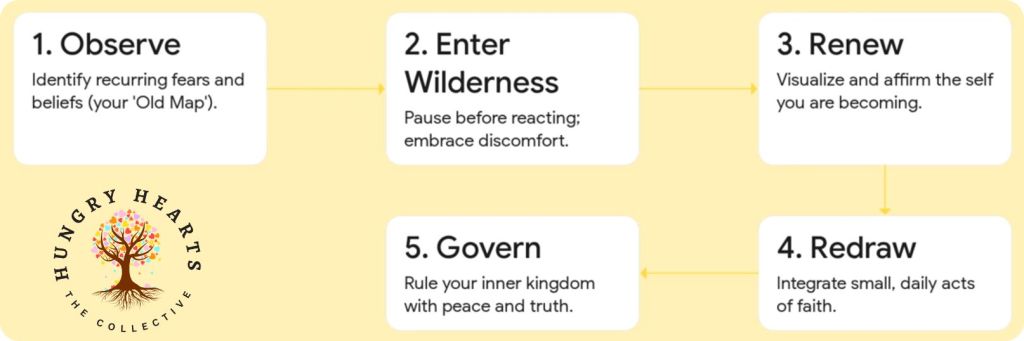
- Observe the Old Map
- Identify recurring fears, beliefs, or reactions. These are Egypt’s hieroglyphs written in your mind.
- Ask: “What am I trying to control?” “Where am I avoiding uncertainty (the unfamiliar)?”
- Enter the Wilderness
- Disrupt habitual responses. Pause before reacting. Let the silence stretch.
- This discomfort is not regression—it’s rewiring.
- Renew the Yetser
- Visualise the self you are becoming. Imagine, in detail, the emotional and spiritual atmosphere of that identity.
- Pray and affirm from this state. The Spirit reshapes your inner formation through attention.
- Redraw Your Map
- Integrate small acts of faith daily. Behaviour follows belief, and belief determines behaviour in a feedback loop.
- Record every evidence of progress—the “manna moments” that prove God’s faithfulness.
- Govern the Kingdom Within
- Rule your mind with peace. Maintain inner order by hitching your thoughts to divine truth.
- When fear arises, remind yourself: “I have left Egypt. I am learning to live free.”
THE THEOLOGY OF CHANGE
Every transformation follows this divine pattern: death, wilderness, resurrection.
Egypt must die within. It is not enough to be delivered from Egypt, we must now evict Egypt out of our minds. The wilderness must be endured. This is where we learn that the kingdom is within, not without in the arbitrary tyranny of rules. Only then does the Promised Land emerge within and spill out like a river into our lives (3 John 1:2, Proverbs 4:23).
This is not punishment but process—the same cycle found in Christ’s life, death, and resurrection.
“For you died, and your life is now hidden with Christ in God.” (Colossians 3:3)
Identity renewal is not self-improvement; it is participation in the divine unfolding of the life within.
In one of our articles, “Carnal vs. Spiritual Mindedness: The Battle for Dominance”, we dive deeper into what it looks like to live from flesh vs. spirit.
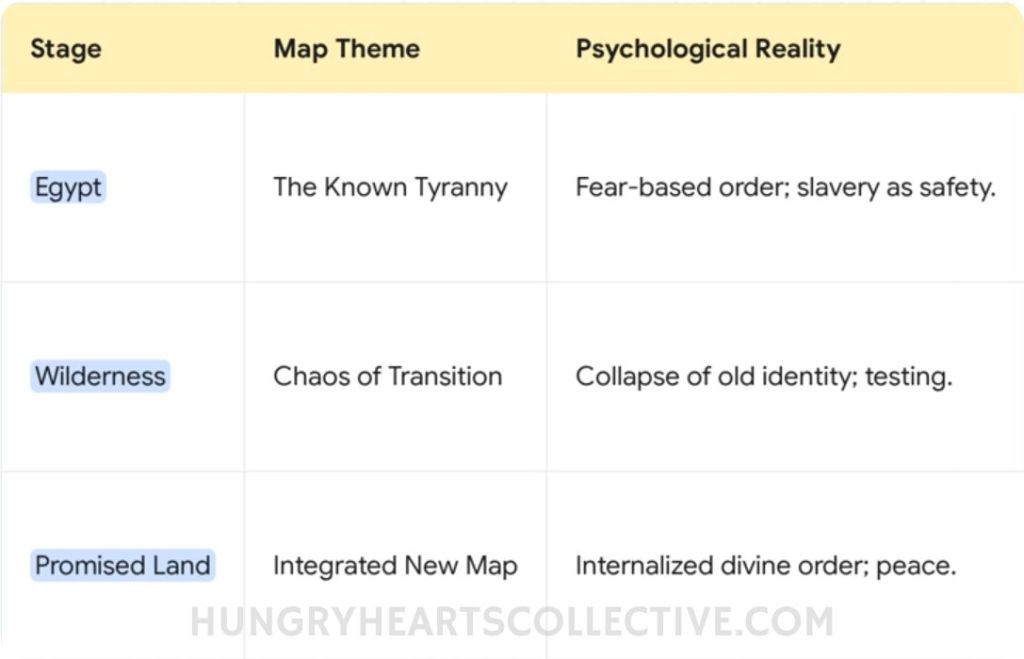
THE WILDERNESS: THE RIVER OF CHANGE
Between Egypt and the Promised Land lies the wilderness—the place of collapse, testing, and remapping.
You cross the river of change, leaving old reactions behind. The old self protests. Fear mounts. Doubt arises. But this is where new neural circuits are formed: old maps are broken so new maps can be drawn.
Jordan Peterson calls this the encounter with chaos. Joseph Campbell calls it the hero’s trials. Scripture calls it sanctification.
In this wilderness, you begin to live by spiritual provision. The manna (Word) becomes your daily bread. The cloud/fire (Spirit) becomes your compass.
Our piece “Meditation as Spiritual Warfare: Internalising God’s Word and Walking in the Promised Land” explores how meditation anchors this wilderness journey.
PROMISED LAND: THE STRONG MIND
The Promised Land is also not geography—it is also a state of consciousness. Here the mind is integrated, governed by the Spirit, no longer fragmented by fear or habit.
This is phronēma tou pneumatos—the mindset of the Spirit. It perceives, discerns, loves, and rules with peace. It sees shadows as shadows, not realities. It also does not need external laws to feel safe.
In the Promised Land, strength is not domination but thoughtful restraint. Freedom is obedience to inner truth. Love becomes the law of the inner kingdom.
THE MAPS OF MEANING & IDENTITY
Jordan Peterson’s Maps of Meaning describes how humans build maps to navigate life, structuring experience into order and meaning. We lean on what we know; we dread what we don’t.
In biblical terms:
- Egypt (enslavement) is oppressive order devoid of life.
- Wilderness (formation) is chaos, the uncharted.
- Promised Land (freedom) is meaning, order born from faith.
Meaning arises when you voluntarily engage chaos—even risk—and reassemble it under new interpretations. That’s exactly what the exodus of consciousness is: choosing to cross the river, trusting that God carries you through the chaos into a new order.
A PRACTICAL FRAMEWORK OF TRANSFORMATION
Below is a step-by-step lens you can apply to your daily life:
- Pause & Observe
When fear, anger, or shame arises, resist reacting instantly. Name it “Egypt speaking.” Witness without approving or resisting. In that pause, your mind begins to govern. - Feed on Manna (Truth)
Daily, saturate your mind with Scripture. Let one verse sink into your thinking. Rehearse it and meditate on it until it becomes internal language. (See “Hearing God: Is the Word of the Lord Scarce?” for deeper insight on hearing and internalising God’s voice.) - Rehearse Your New Identity
Speak it, visualise it, write it. Use homologia—say the same thing God says about you. Claim it until your inner world begins to echo it. - Reframe Your Past
Return to your life story and reinterpret the “Egypt” chapters. Extract wisdom, trace grace, forgive. Write new subplots that validate your new self. - Embrace Wilderness
Intentionally step into places of uncertainty. Don’t avoid discomfort—walk through it. Every wilderness is a school of faith. - Architect Inner Order
Journal, prioritize, establish spiritual practices. Notice which internal “voices” dominate and invite the Spirit to reign over them. - Act from Vision, Not Emotion
When decisions arises, let vision—not emotion—guide. Trust the map God is drawing beneath your feet.
These aren’t abstract steps—they are a biblical psychology you can live day by day.
MORE RESOURCES FOR DEEP DIVE
If you want to go deeper, here are five Hungry Hearts Collective articles worth exploring:
- What Is Identity: Rewriting the Story of Self—on how identity is curated and how to begin rewriting it.
- Carnal vs. Spiritual Mindedness: The Battle for Dominance—exploring the internal struggle between flesh and Spirit.
- Meditation as Spiritual Warfare: Internalising God’s Word and Walking in the Promised Land—a guide to anchoring your mind in spiritual truth.
- Romans 6:5-14 United With Him in Life—on union with Christ, death to the old self, and resurrection living.
- The New Creation: Divine Reset—on accepting and living out your new identity as a new creation in Christ.
DEVOTIONAL PRAYER
Father of Light,
You who lead us across the river of change,
teach us to pause when reaction rages,
to listen when fear shouts,
and to trust when maps collapse.Renew our yetser, reshape our phronēma,
till our inner kingdom reflects Your love and wisdom.
Let our identity be less what we once were
and more who You have made us to be.Lead us from Egypt, through wilderness, into new land.
Let our thoughts be Your throne; our will aligned with Yours;
our hearts at rest in the reign of grace.
Amen.
QUESTIONS FOR REFLECTION
- Which “Egypt” in your life still holds unconscious control over you?
- Where are you resisting the wilderness—the discomfort needed for growth?
- What identity do you want to rehearse? What evidence can you find for it?
- How will you feed daily on “manna” (truth) for the renewal of your mind?
- What does your Promised Land—your integrated, Spirit-led mind—look like in day-to-day life?
May this essay become a road map for your soul. May you cross rivers, embrace wilderness, and inherit your promised identity in Christ.
AMAZON AFFILIATE LINK
© HUNGRYHEARTSCOLLECTIVE.COM


Leave a comment